
The challenge
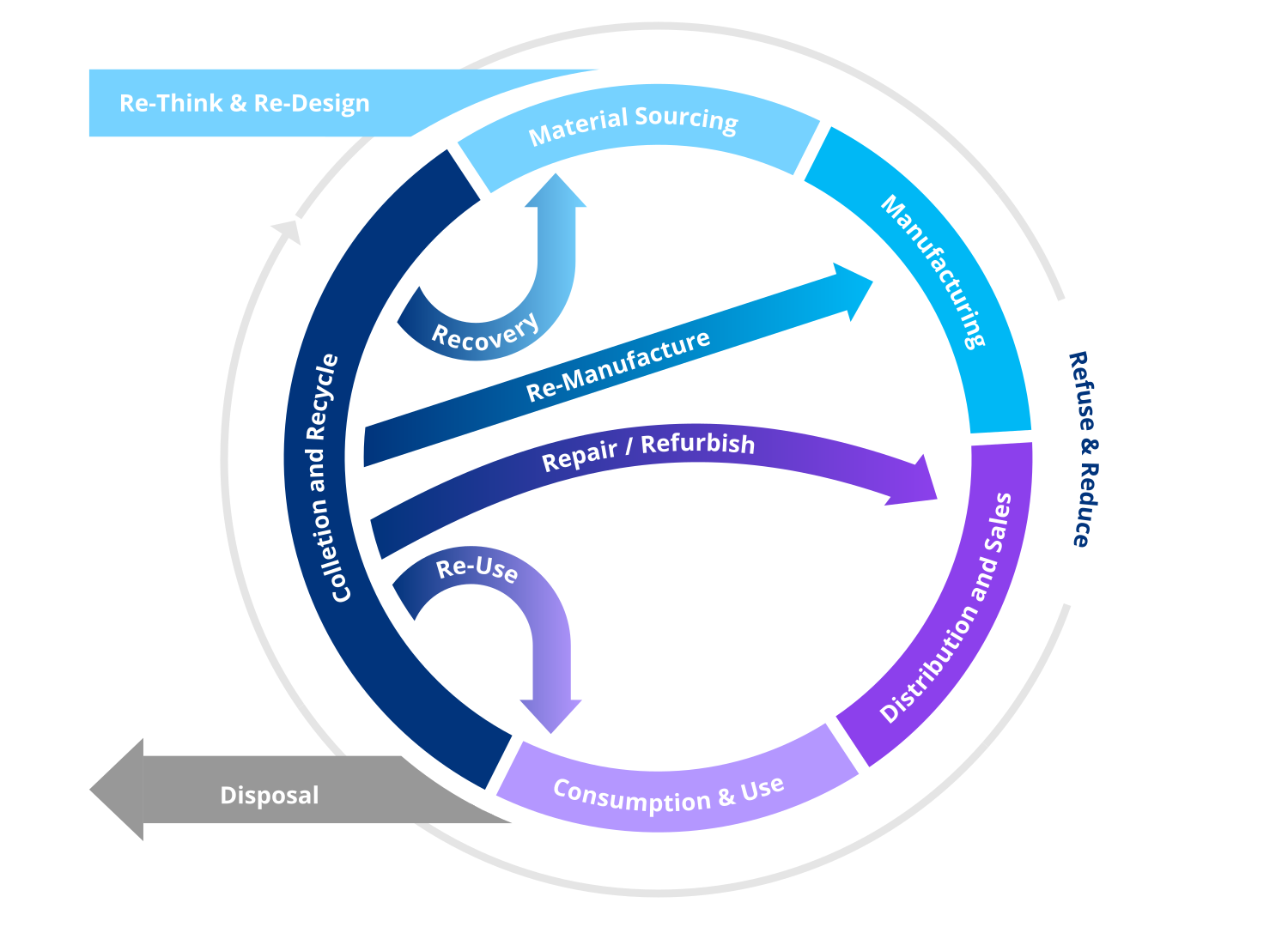
Your company is under increasing business and operational pressure: margins are shrinking, raw material and energy costs are rising, supply chains are volatile and regulatory requirements are constantly changing. The multitude of new market challenges creates a dynamic and sometimes uncertain environment that has a profound impact on product development, supply chains and business models. The result is increasing complexity in strategic and operational decisions. In order to remain competitive in this environment, it is important to utilise resources more efficiently, reduce costs and tap into new sources of revenue. The current "take-make-waste" model - i.e. the linear principle in which raw materials are extracted, products are manufactured and finally disposed of - is neither economically viable nor ecologically responsible in the long term. The circular economy offers a forward-looking alternative here: it enables value retention through the reintegration of products and components into the value creation cycle and at the same time strengthens the resilience of supply chains against geopolitical, climatic and resource-related risks. It is crucial to identify the right form of circular economy for the respective corporate context and specific product portfolio. We are happy to support you in developing customised solutions for circular and economically viable value creation.
Our solution
The circular economy is far more than just a tick on the compliance checklist. If thought through correctly, it becomes a driver for innovation, efficiency – and real added business value.
Where your company benefits from the circular economy
Resilient supply chains
Circular models, such as the return and reuse of own products and materials, make your company less dependent on fragile, linear supply chains and increase security of supply in times of geopolitical uncertainty and scarce resources.
Resource efficiency
More efficient use of materials and longer product life cycles reduce costs and waste volumes. Circular thinking helps to utilise resources longer, more intelligently and more economically.
New sources of revenue
The shift from product to service and platform business is giving rise to new, recurring revenue models, for example through subscription models for products and spare parts, pay-per-use and performance-based offers or second-life and sharing concepts.
Competition and market access
Circularity facilitates access to markets and tenders in which sustainability criteria are decisive. Companies with clear circular economy strategies overcome trade barriers and position themselves as favoured partners.
Our solution
Our solutions to support your company on the path to circular value creation are based on three platforms. They combine strategic alignment, resilient management and impact-orientated implementation – exactly where your company currently stands. Our approach creates the basis for future-orientated business models that integrate ecological, economic and regulatory requirements and generate measurable value.

Strategy and value enhancement
We analyse the circularity of your business model based on recognised frameworks such as the Global Circularity Protocol (GCP), identify strategic levers, derive prioritised fields of action and quantify measurable financial added value as part of our business case analyses. You will gain clarity on where economic value is created through circularity and how regulatory, technological and market-orientated developments can be strategically addressed.
Performance measurement and control
The focus here is on measurability, transparency and a basis for decision-making relevant to management. Quantitative analyses – based on CTI, PCF or LCA, for example – make the ecological and economic effects of circular solutions visible. In addition, KPIs, reporting structures and dashboards are created that systematically record progress, fulfil regulatory requirements and enable fact-based corporate management.
Implementation and continuous improvement
A successful circular economy strategy requires circular principles to be anchored in the organisation, processes and products. We support you in the development of a target operating model with suitable structures, processes and governance mechanisms as well as the integration of circular requirements into product strategy and development. In addition, pilot programmes, scaling approaches, digital solutions and continuous improvement processes are part of the ongoing operational implementation and further development of circular activities.
Would you like to find out more about our solution approach? Register for our free ESG Suite and get exclusive insights into ESG topics.
Publications



Further interesting content

Your contact
Stay up to date with what matters to you
Gain access to personalized content based on your interests by signing up today

Yannik Michels
Partner, Performance & Strategy, Enterprise Performance; ESG & Finance Transformation
KPMG AG Wirtschaftsprüfungsgesellschaft
Connect with us
- Find office locations kpmg.findOfficeLocations
- kpmg.emailUs
- Social media @ KPMG kpmg.socialMedia