

On July 24, 2026, the Ministry of Finance and the State Taxation Administration jointly issued Announcement No. 21 of 2026, and the State Taxation Administration separately issued Announcement No. 15 of 2026. Both took immediate effect upon publication. These announcements clarify tax obligations across the lifecycle of offshore trusts and reinforce the administration of individual income tax (IIT).
Summary
Background
On July 24, 2026, the Ministry of Finance and the State Taxation Administration jointly issued Announcement No. 21, and the State Taxation Administration issued Announcement No. 15, both effective from the date of issuance. The purpose is to clarify tax responsibilities throughout the lifecycle of offshore trusts and enhance the management of IIT.
Scope of Application
The regulations apply to trusts or legal arrangements with trust-like functions established under foreign law. Specifically, they cover the following scenarios:
- Resident individual (including those holding foreign nationality or residency rights but deriving most economic benefits from China) who transfer domestic and/or overseas assets into an offshore trust.
- Non-resident individual who transfers domestic assets into an offshore trust.
- Non-resident individual who transfers assets into an offshore trust that is effectively controlled by a resident individual.
Tax Implications
- Urging taxpayers to file and settle unpaid taxes within 90 days from the implementation of Announcement No. 21, including:
- IIT arising from resident individuals transferring assets into offshore trusts between January 1, 2023 and December 31, 2025, as well as IIT arising during the existence period of offshore trusts established before January 1, 2026.
- IIT arising from non-resident individuals transferring assets into offshore trusts between January 1, 2023, and July 24, 2026.
Taxpayers who comply within this period are exempt from late payment interest.
- Tax treatment concerning offshore trusts under Announcement No. 21 are outlined as follows:
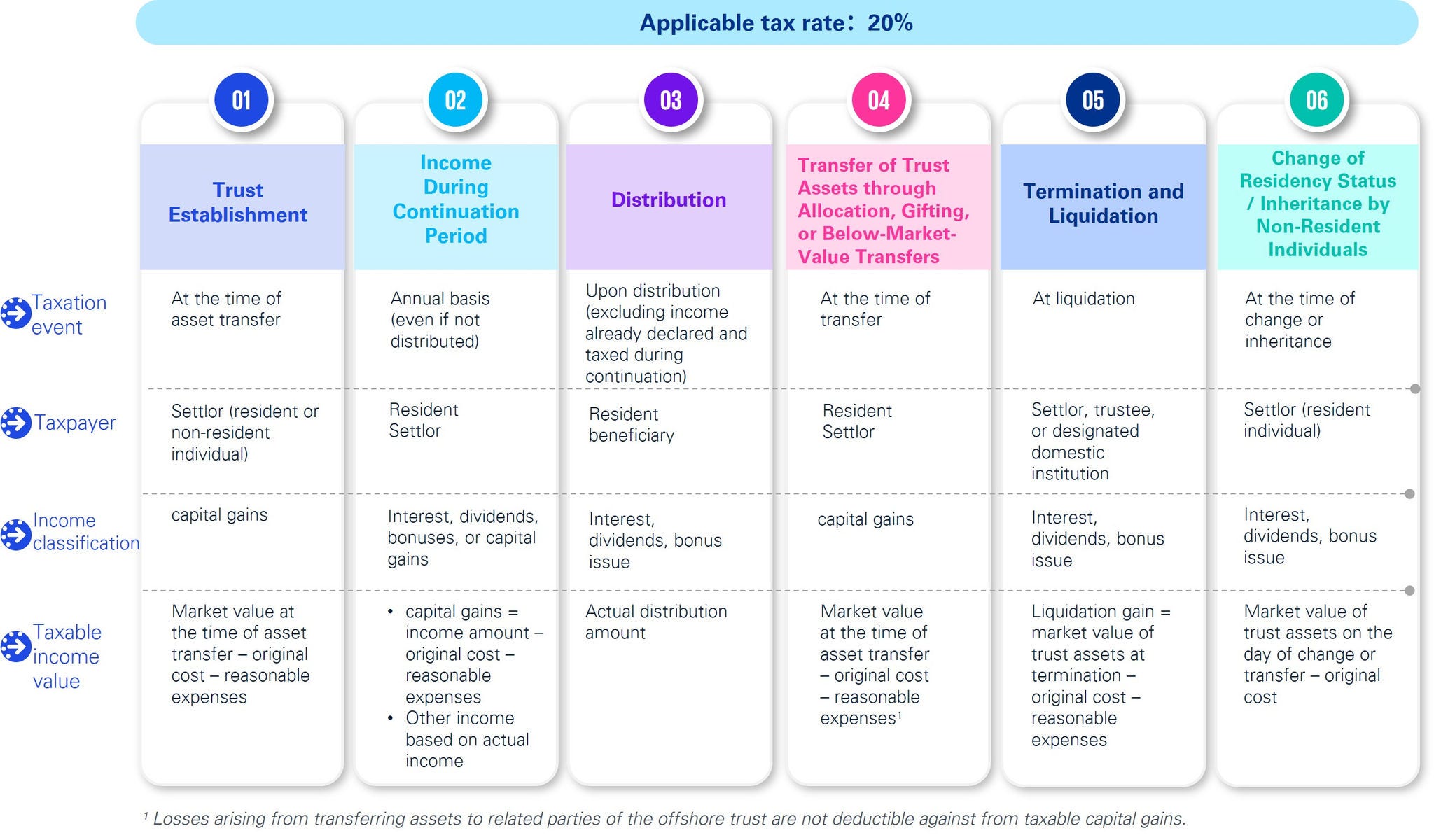
- Tax Credit and Grace Period: Foreign taxes paid on the same income may be credited against the corresponding IIT liability.
Outstanding tax arising from offshore trusts in the years 2023–2025 is subject to a 90-day grace period, beginning on July 24, 2026, during which no late payment interest will be applied.
Where the outstanding tax amount is deemed substantial, the tax authority retains the discretion to extend the look-back period beyond 2023. - Filing Deadlines:
- Resident: March 1 to June 30 of the following year.
- Non-resident: within 15 days of the following month.
- Compliance Consequences: Failure to file or delayed filing may result in late payment interest, tax recovery, and legal liability.
- Anti-Avoidance Provisions: Offshore trusts controlled by resident individuals are attributed to those individuals. Benefits distributed to residents or related parties may be taxed as income. Tax authorities will adjust any arrangements identified as clear cases of tax avoidance.
KPMG Observations
Announcement No. 21 reinforces China’s growing emphasis on taxing the worldwide income of its tax residents. This move aims to improve tax fairness and provide clearer guidance for taxpayers.
Key Observations
- Clarification of Scope: The term “offshore trust” does not include financial products issued by publicly offered, independently operated institutions (such as banks, insurance companies, securities firms, and funds) that are subject to foreign financial regulations.
- Multi-Stage Taxation: Tax liabilities may arise at multiple stages—asset transfer, trust continuation, and income distribution—with overall high tax costs. It is recommended to assess tax implications in advance. Taxes on assets transferred into offshore trusts before January 1, 2023, may not be pursued.
- Responsibility of Overseas Entities: If a resident individual controls an overseas entity through which assets enter an offshore trust, that individual retains tax responsibility. Despite Announcement No. 21 providing exemptions for entities with legitimate business purposes and substantive operations, the standards for these exceptions are not clearly defined.
- Unspecified Filing Location: Practically, the filing location is determined by the registered address of domestic businesses, the location of domestic assets, and the individual’s primary residence in China.
- Trust Distributions: Non-resident individuals who transfer assets into offshore trusts may be considered to have distributed income to associated resident individuals if any of the following occur:
- Debt Support: Using trust assets as collateral or guarantees to support residents’ personal debts that remain outstanding or unpaid by year-end.
- Expenses and Usage: Covering expenses for residents or enabling their free or substantially undervalued access to trust assets.
- Indirect Benefits: Providing economic benefits to tax residents through third parties, such as channelling assets, covering expenses, or offering other forms of financial support.
- Benefit to Related Parties: Extending the aforementioned benefits to related parties or entities controlled or beneficially owned by residents.
- Definition of Reasonable Expenses: The announcement does not provide specific guidance on which expenses qualify as “reasonable expenses” for tax deduction purposes. Taxpayers are advised to consult with local tax authorities in advance to clarify the eligible scope and amounts of deductible expenses, ensuring full compliance with relevant regulations.
- Extended Look-back Period: Taxpayers may declare and pay unpaid taxes without incurring late payment interest within 90 days of July 24, 2026. This applies to liabilities from 2023–2025 for residents and from 2023 through July 24, 2026, for non-residents. For outstanding tax amounts deemed substantial, the tax authority reserves the right to extend the look-back period, potentially covering periods prior to 2023.
- Possibility of Instalment Payments: In cases where the tax liability is substantial, taxpayers may apply for instalment payments, with a maximum repayment period of up to five years.
- Cross-Border Tax Payment: Taxpayers involved in cross-border tax obligations should stay informed about relevant policies through official channels to ensure timely and compliant tax payments.
Recommended Action
For taxpayers engage in cross-border asset portfolios, the following are recommended:
1. Comprehensive Self-Inspection and Assessment
- Determine your tax residency status.
- Review all existing offshore trusts, compile trust agreements, asset lists, and related records.
- Re-examine past tax filings to identify any unreported taxable items.
- Individuals in the following situations complete the declaration and payment of overdue IIT by October 22, 2026, to avoid late payment interest:
Resident Individual
Non-Resident Individual
2. Prudent Planning for Future Arrangements
- Conduct a comprehensive evaluation of tax implications prior to establishing new offshore trusts, ensuring accurate estimation of potential liabilities.
- Mitigate excessive tax liabilities and compliance risks arising from regulation misinterpretation.
3. Engage Professional Expertise
- Engage professional teams to formulate compliance strategies and risk control measures to ensure that cross-border asset allocation is in full conformity with relevant tax regulations.
Announcement No. 21 signifies a paradigm shift in China’s offshore trust regulatory regime. Enhanced transparency, systematic reporting, and rigorous compliance have become operational imperatives. Stakeholders are urged to adopt proactive measures to navigate evolving requirements and minimise exposure to tax-related risks.
KPMG remains committed to monitoring regulatory developments and stands ready to provide tailored guidance to individuals and enterprises navigating this complex landscape.
New Individual Income Tax Rules for Offshore Trusts Implemented: Tax Transparency and Compliance Now the Norm
China Tax Alert - Issue 5, July 2026

