Summary

      The draft legislation to implement (1) the enhanced tax concessions for the maritime service industry and (2) a new half-rate tax concession for physical commodity trading in the Hong Kong SAR (Hong Kong) was published in the Gazette on 12 June 2026.  Subject to the enactment of the draft legislation, these enhanced / new tax concessions will take retrospective effect from the year of assessment (YOA) 2025/26.

      In this tax alert, we discuss the key features of these tax concessions and share our observations.


      As mentioned in the Legislative Council Brief issued on 8 July 20251 , the HKSAR Government will (1) enhance the existing tax concessions for the maritime service industry and (2) introduce a half-rate tax concession regime for physical commodity trading in Hong Kong. On 12 June 2026, the Inland Revenue (Amendment) (Tax Concessions for Shipping-related Activities and Physical Commodity Trading) Bill 20262 (the Bill) was gazetted to set out the detailed legislation for implementing these enhanced / new tax concessions.

      Enhancing the existing tax concessions for the maritime service industry

      The existing tax concessionary regime for the maritime service industry provides (i) a 0% tax rate for qualifying ship lessors, (ii) a 0% or 8.25% tax rate for qualifying ship leasing managers and (iii) a tax exemption or a tax rate of 0% or 8.25% for shipping commercial principals (i.e. ship agents, ship managers and ship brokers). 

      To further strengthen Hong Kong’s position as a leading international maritime centre and in view of the implementation of the global minimum tax (GMT) and Hong Kong minimum top-up tax (HKMTT) under BEPS Pillar 2 in Hong Kong from fiscal years beginning on or after 1 January 2025, the Bill seeks to implement the below refinements to the existing tax concessions. 

      1. Expanding the scope of “lease” and “lessee”

      • The definitions of “funding lease” and “operating lease” will be amended to remove the requirement that the lease term must exceed one year. In addition, “operating lease” will cover a sublease of a ship by a person (other than the lessee of the head lease of the ship) to another person.
      • The scope of “lessee” for ship leasing activity will be expanded to cover “any other persons” rather than limited to ship lessors, ship leasing managers and ship operators.

      2. A 15% concessionary tax rate upon election

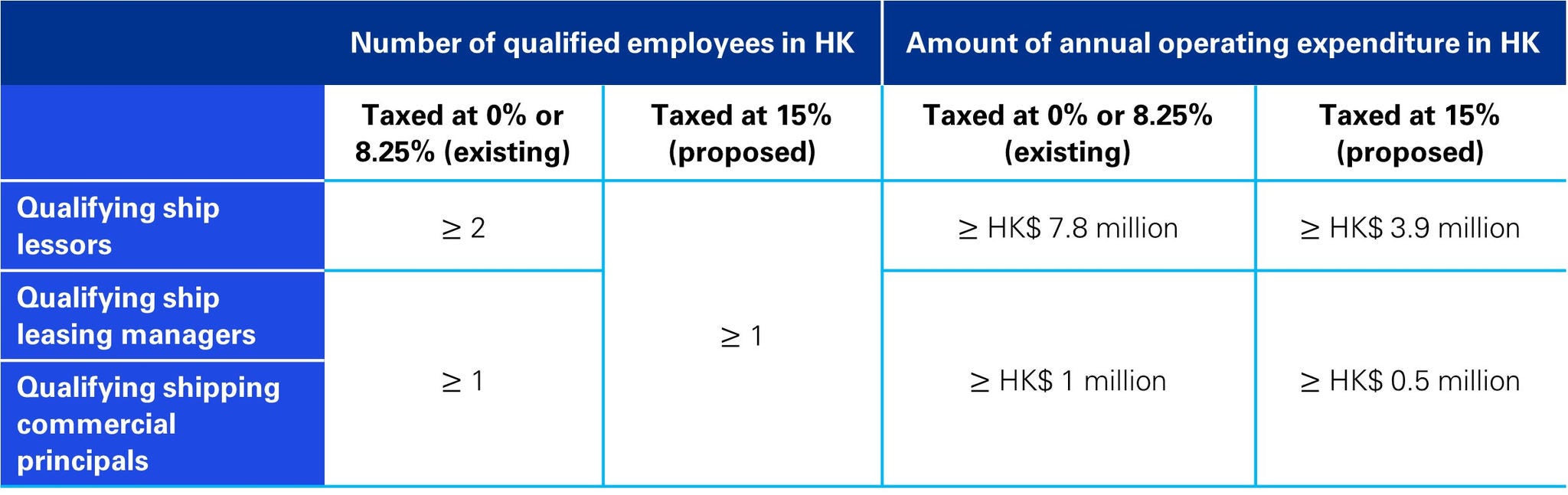
      A 15% concessionary tax rate will be introduced as an additional option for qualifying ship lessors, ship leasing managers and shipping commercial principals. These corporations can elect their preferred concessionary tax rate on an annual basis. Corresponding measures will be introduced to deal with offsetting assessable profits with tax losses carried forward in situation where a taxpayer elects different concessionary tax rates (e.g. 8.25% vs 15%) for its maritime services income across different YOAs. 

      Corporations electing for the 15% rate would be subject to a reduced substantial activity requirement as set out in the table below.

      3. New tax deduction for ship acquisition costs for ship lessors under operating lease

      Under the current regime, qualifying ship lessors under operating lease are not entitled to any tax deduction for the ship acquisition costs. Instead, a “20% tax base concession” applies whereby the assessable profits are calculated based on 20% of the lease income. For Hong Kong profits tax under Part 4 of the Inland Revenue Ordinance (IRO) purposes, this does not have any actual impact given the applicable tax rate is 0%. However, with the implementation of BEPS Pillar 2, such computation basis will drag down the effective date rate for Hong Kong for GMT and HKMTT purposes and may result in top-up tax being imposed for in-scope MNE groups.

      The Bill introduces a 100% immediate tax deduction for the capital expenditure incurred on acquisition of ships used for qualifying ship leasing activity relating to operating lease in lieu of applying the 20% tax base concession. Such capital expenditure would include the consideration for acquiring the ship as well as legal expenses and valuation fees incurred in connection with the acquisition.

      The proposed tax deduction applies to capital expenditure on ship acquisition incurred before or after the YOA 2025/26. For ships which have been acquired and used prior to the YOA 2025/26, the tax deduction amount will be adjusted for any tax depreciation allowances granted in Hong Kong and overseas as well as notional annual allowances in Hong Kong.

      Upon disposal of a ship of which a tax deduction has been granted, the disposal proceeds of the ship (capped at the total amount of deduction allowed and allowances granted) will be deemed as taxable trading receipts for calculating the assessable profits in the disposal year.

      4. New tax deduction for interest expenses incurred on ship acquisition for ship lessors

      Under the existing stringent interest expense deduction rules, interest expenses incurred by qualifying ship lessors for financing ship acquisition may not be deductible at all (e.g. for borrowings from an overseas associated company that is not a financial institution). Under the Bill, subject to certain conditions, tax deduction would be available to a qualifying ship lessor for interest expenses incurred for ship acquisition on borrowings from:

      • a non-associated lender (e.g. an overseas non-financial institution); and
      • an associated lender who has paid or will pay a similar tax (i.e. Part 4 profits tax in Hong Kong) on the interest income in a jurisdiction outside Hong Kong at a rate not less than the tax rate applicable to the Hong Kong ship lessor (i.e. 0% or 15%).

      5. Other provisions

      The Bill also contains revised formulas for calculating: 

      • The assessable profits derived from qualifying ship leasing activity under an operating lease and a funding lease respectively that are eligible for the concessionary tax rates. In particular, other Hong Kong sourced income and trading receipts (in addition to lease income / finance charges) that are attributable to the qualifying ship leasing activity are also eligible for the concessionary tax rates.
      • The net lease payments under operating lease (including subleasing of ship) and the net payments of finance charges or interest under funding lease.

      KPMG observations:

      We welcome the above enhancements proposed by the government, which have addressed most of the key concerns of the industry players. The enhancements would make the maritime service tax regime better serve its policy intent. We set out below our additional observations on the proposed enhanced regime:

      • The new tax deduction for ship acquisition costs would help mitigate the top-up tax impact under BEPS Pillar Two for in-scope MNE groups when the international shipping income exclusion under the GloBE rules is not applicable.
      • One potential benefit for Pillar Two in-scope MNE groups in electing the 15% concessionary tax rate is that they may opt for the Simplified Effective Tax Rate Safe Harbour (SESH) 3. If the effective tax rate for Hong Kong computed under the SESH is not less than 15%, the Pillar 2 top-up tax for Hong Kong will be deemed as zero.
        However, in‑scope MNE groups should conduct a detailed assessment of the pros and cons of electing the SESH and bear in mind that considerable compliance burden remains despite the election. For example, the SESH computation, although less complex than the full GloBE computation, is still substantial. In addition, the filing of the Hong Kong top‑up tax return and the GloBE Information Return will still be required.
      • We recommend that the government relaxes the requirement on “actual corporate income tax payment” by the overseas associated lender on the interest income before the Hong Kong ship lessor can deduct the interest expenses incurred on the borrowings from that overseas associated lender to finance the ship acquisition.
      • As the next step, we recommend that the government considers:
        • (i) expanding the scope of the regime to cover container leasing, freight forwarding and logistics services, and maritime technology services; and
        • (ii) conducting a holistic review of all the existing income-based tax concessions in Hong Kong in view of the Substance-based Tax Incentive Safe Harbour introduced by the OECD in the Side-by-Side Package released in January 20263 and considering possible reform of such tax concessions to make them more attractive to Pillar Two in-scope MNE groups. 

      New tax concession for physical commodity trading

      To attract more physical commodity traders to conduct their businesses in Hong Kong so as to promote the development of maritime service industry in Hong Kong, the Bill proposes to introduce a new tax concession for physical commodity trading activities in Hong Kong. We summarise below the key features of the proposed tax concession.

      1. The tax concession

      Profits derived by a qualifying physical commodity trader (qualifying trader) from qualifying physical commodity trading activity (qualifying trading activity) and income incidental to such profits4 (together referred to as qualifying profits) will be taxed at either 8.25% or 15% if the specified conditions (discussed below) are met. Qualifying traders can elect their preferred concessionary tax rate on an annual basis.

      2. Physical commodity

      Three categories of physical commodities are covered, namely (1) energy or industrial commodities, (2) agricultural commodities and (3) metal mine commodities. The full list of in-scope physical commodities is set out in the new Schedule 17FE to be added to the IRO.

      3. Qualifying trader

      A corporation is a qualifying trader if it fulfils both Condition 1 and Condition 2:

      Condition 1 is fulfilled if one of the following conditions is satisfied:

      • The corporation has carried out one or more qualifying trading activities in Hong Kong and has not carried out any other income generating activities in Hong Kong;
      • The corporation satisfies the safe harbour rule5 (i.e. not less than 75% of the corporation’s total accrued profits during the basis period of a YOA are profits from qualifying trading activities and not less than 75% of the value of all its assets at the end of the basis period for a YOA is derived from assets used for qualifying trading activities); or
      • The corporation has obtained the determination of the Commissioner of Inland Revenue that it is a qualifying trader.

      Condition 2 is fulfilled if the corporation’s total revenue derived from its qualifying trading activities is not less than HK$700 million.

      4. Commodity trading activity

      This refers to an activity of a trader (i) that involves the selling to, and the buying from, the trader of a physical commodity; (ii) that also involves carrying out of any other specified activities6 by the trader; and (iii) that leads to or results in the actual transport and delivery of the commodity to the purchaser. However, a commodity trading activity does not include any activity of wholesaling or retailing.

      5. Qualifying trading activity

      Qualifying trading activity refers to a commodity trading activity that (i) is carried out in the ordinary course of a trader’s business carried on in Hong Kong and (ii) both the contracts of buying and selling of the physical commodity are effected in Hong Kong.

      6. Other requirements

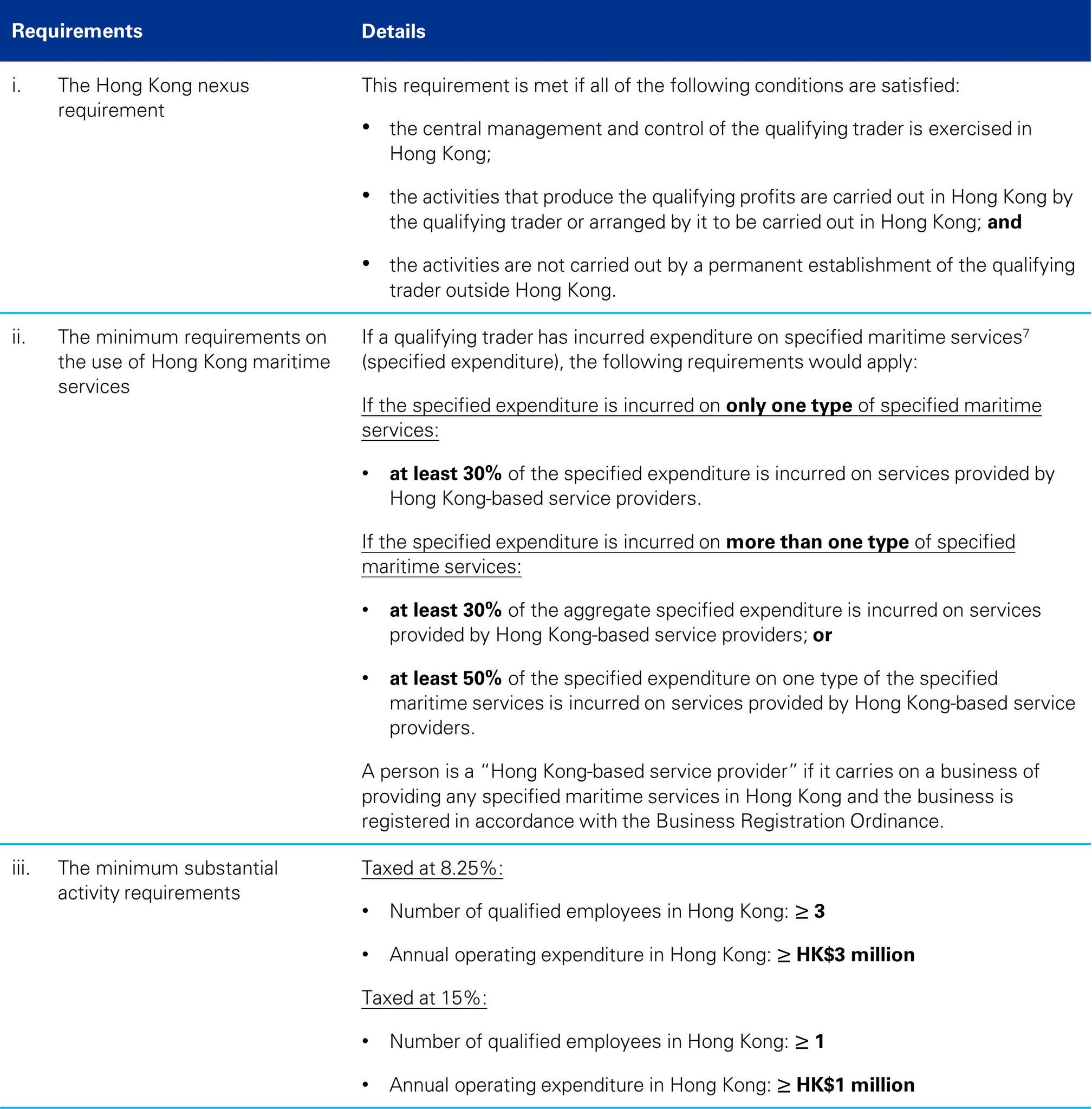
      In addition to being a qualifying trader and carrying out qualifying trading activities, the tax concession will only apply if all of the following requirements are met

      7. Anti-avoidance provisions

      Similar to the tax concessionary regime for the maritime service industry, the tax concessionary regime for qualifying traders also contains anti-avoidance provisions to (i) apply the arm’s length principle for transactions between a qualifying trader and its associates and (ii) deny the tax concession where one of the main purposes for entering into an arrangement is to obtain a tax benefit under the IRO or a tax treaty (the main purpose test). 

      KPMG observations:

      • Currently, Singapore also offers a tax incentive for commodity trading businesses in Singapore under the Global Trader Programme8 (GTP). The GTP applies to a wide range of commodity trading activities (including physical trading, derivative trading and structured commodity financing activities) and offers preferential tax rates of 5%, 10% or 15%. While there are differences in the scope, incentive period and tax rates offered under the Hong Kong and Singapore regimes, taxpayers should be mindful that the qualifying requirements, the degree of certainty and compliance burden may also be different under the two regimes. 
      • Although the major policy objective of the proposed concession is to bolster the development of the maritime service sector and therefore the current scope of the concession only covers physical commodity trading, we urge the government to consider, as the next step, expanding the scope of the concession to cover derivative trading and other financing activities related to commodity trading to nurture a more sustainable development of the commodity trading ecosystem in Hong Kong. 
      • In the 2026/27 Hong Kong Budget announced in February 20269, the government indicated that it would explore offering tax incentives for eligible institutions conducting gold trading and settlement in Hong Kong. Industry stakeholders should stay tuned on how these tax incentives would supplement the currently proposed tax concession for physical commodity trading (which includes trading of gold ore and concentrates in physical form) in Hong Kong.

      Implementation timeline

      The Bill will be introduced into the Legislative Council on 24 June 2026.  Upon the enactment of the Bill, both the enhanced tax concessions for the maritime service industry and the new tax concession for physical commodity trading will take effect from the YOA 2025/26.

      It has yet to be seen whether any transitional administrative measures will be introduced by the Inland Revenue Department to facilitate taxpayers with a December or March accounting year-end to elect for these enhanced / new tax concessions on their 2025/26 profits tax returns to be filed.

      If you have any questions or require assistance regarding the above developments, please feel free to contact us via taxservicesenquiry@kpmg.com.


      1. The brief can be accessed via this link: https://www.legco.gov.hk/yr2025/english/panels/edev/papers/edev20250708cb3-1045-5-e.pdf. Please also refer to our Hong Kong SAR Tax Alert - Issue 5, July 2025 for more details.

      2. The Bill can be accessed via this link: https://www.legco.gov.hk/yr2026/english/bills/b202606123.pdf

      3. For more details, please refer to our KPMG BEPS Publication issued in January 2026

      4. Based on the Legislative Council Brief issued in July 2025, such incidental income includes interest income, exchange gains and hedging gains.

      5. A corporation satisfies this rule if it meets either the 1-year safe harbour or the multiple-year safe harbour. 

      6. Examples of the specified activities are (i) soliciting the sale or purchase of the physical commodity, (ii) obtaining finance for the sale or purchase of the physical commodity, (iii) arranging transportation of the physical commodity and (iv) arranging insurance for the transportation of the physical commodity.

      7. Specified maritime services are services in connection with any of the following: (i) ship agency activity, (ii) ship broking activity, (iii) ship leasing activity, (iv) ship leasing management activity, (v) ship management activity, (vi) ship repairing, (vii) ship tug-and-tow, (viii) ocean fright booking or chartering, (ix) marine cargo insurance, (x) specified arbitration-related service and (xi) specified legal service. 

      8. For details, please refer to the website of the Enterprise Singapore via this link: https://www.enterprisesg.gov.sg/financial-support/global-trader-programme?utm_source=perplexity

      9. For more details, please refer to our 2026/27 Hong Kong Budget webpage


      Hong Kong SAR unveils draft legislation on enhanced tax concessions for maritime services and new tax concession for physical commodity trading

      Hong Kong SAR unveils draft legislation on enhanced tax concessions for maritime services and new tax concession for physical commodity trading

      Hong Kong SAR Tax Alert - Issue 13, June 2026

      Hong Kong SAR Tax Alerts

      These are ad hoc newsletters covering topical tax issues in Hong Kong


      Submit RFP

      Find out how KPMG's expertise can help you and your company.