The Inland Revenue Department (IRD) of the Hong Kong SAR (Hong Kong) has recently published updated and new FAQs on its website regarding the determination of an individual’s residence under the tie-breaker rules of the comprehensive double tax arrangement between the Chinese Mainland (Mainland) and Hong Kong (HK-Mainland CDTA) in situations where the individual is a resident of both Hong Kong and the Mainland.
Summary
With the strong economic ties between Hong Kong and the Mainland, there has been a growing cross-boundary flow of capital and talent between the two sides. For Chinese nationals coming to Hong Kong to work or start a business through various admission schemes for talent and entrepreneurs, a key tax consideration is how to address the issue of dual residency under the HK-Mainland CDTA.
Rules on individual residency under the HK-Mainland CDTA
The HK-Mainland CDTA contains the following rules for determining the residence of an individual:
- A resident of the Mainland is defined as any person who, under the laws of the Mainland, is liable to tax in the Mainland by reason of his or her domicile, residence, or any other criterion of a similar nature, but does not include any person who is liable to tax in the Mainland in respect of Mainland-sourced income only.
- A resident of Hong Kong is defined as:
- an individual who ordinarily resides in Hong Kong; or
- an individual who stays in Hong Kong for more than 180 days during a year of assessment (YOA) or for more than 300 days in two consecutive YOAs.
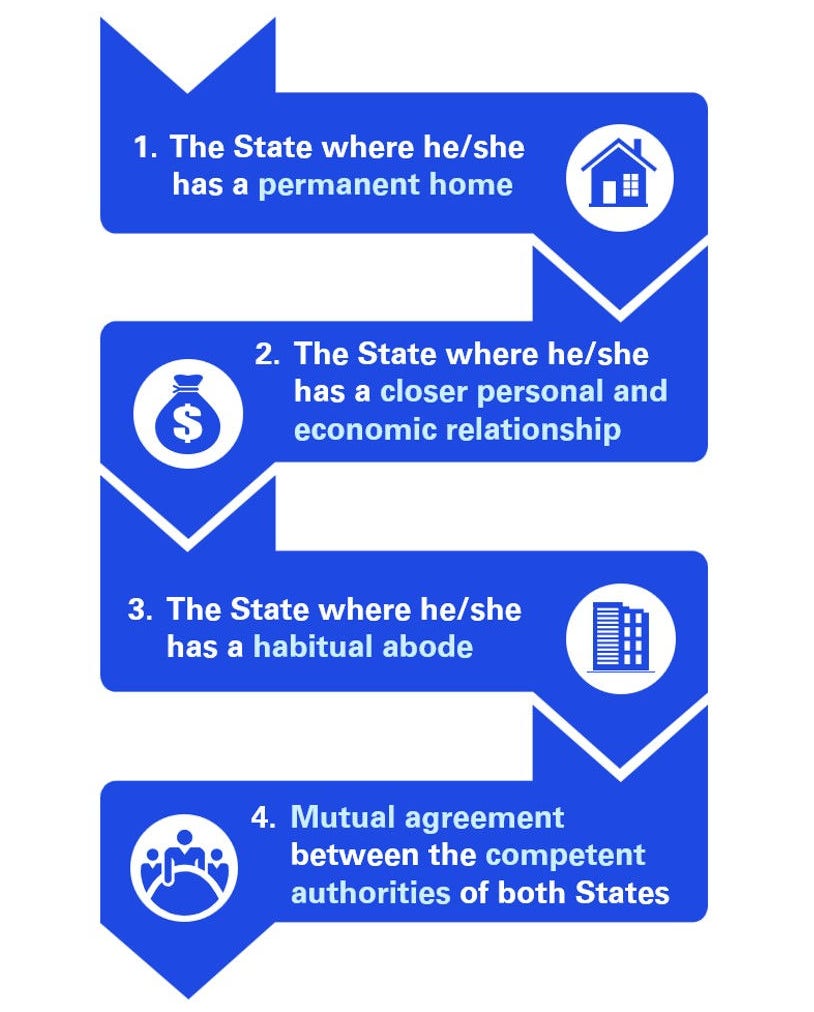
- The tie-breaker rules - When an individual is a resident of both Hong Kong and the Mainland, his/her residence will be determined based on, in order of priority, the factors indicated in the diagram below:
The dual residency issue for individuals
The Mainland tax authorities will normally treat an individual holding a domiciliary registration in the Mainland as a resident of the Mainland. When such individual stays in Hong Kong for more than 180 days in a YOA or 300 days in two consecutive YOAs, the IRD will treat him or her as a resident of Hong Kong at the same time. As a result, the issue of dual residency arises and it is necessary to apply the tie-breaker rules mentioned above to determine whether the individual should be treated as a resident of the Mainland or Hong Kong under the HK-Mainland CDTA.
However, applying the tie-breaker rules may not always be straightforward due to the subjective elements involved and potential differences in interpretation by the Mainland and Hong Kong tax authorities. This creates uncertainties for individual taxpayers, especially in cases where individuals have significant connections to both the Mainland and Hong Kong, and the facts are not clear-cut.
Key messages from the FAQs
On 22 December 2025, the IRD posted on its website an updated FAQ (i.e. FAQ 8) and five new FAQs (i.e. FAQs 17 to 21)1 on the application of the tie-breaker rules under the HK-Mainland CDTA in various scenarios where an individual is a resident of both Hong Kong and the Mainland.
Scenarios covered by the FAQs include an individual who is employed by a Hong Kong company but needs to frequently work in the Mainland (see FAQ 19), and an individual who works in Hong Kong on weekdays and returns to the Mainland on weekends (see FAQ 20).
A few key points to note from the updated and new FAQs are:
- As far as Chinese individual income tax treatments are concerned, the Chinese tax authorities’ interpretation of the tie-breaker rules and residency determination is important. Circular 2010 No.75 issued by the State Taxation Administration (STA)2 includes the STA’s detailed interpretation of the tie-breaker rules under the tax treaty between the Mainland and Singapore. Such interpretation applies equally to the HK-Mainland CDTA.
- The fact that an individual holds a domiciliary registration in the Mainland is not itself a decisive factor in determining the individual’s residence under the tie-breaker rule. According to FAQ 17, there could be situations where an individual will be regarded as a Hong Kong resident under the HK-Mainland CDTA despite having domiciliary registration in the Mainland.
- The FAQs do not provide definitive answers on whether the individual will be regarded as a resident of the Mainland or Hong Kong in the various scenarios described. Instead, they indicate the facts and circumstances that would be considered in determining residency, and in some cases, indicate the more probable conclusion. Such facts and circumstances include:
- whether the individual’s residence in Hong Kong is of a permanent nature,
- whether the individual’s spouse and children have come to Hong Kong to live with him or her,
- whether the individual’s children are studying in Hong Kong, and
- whether the individual needs to frequently work in the Mainland despite having a Hong Kong employer.
KPMG Observations
- The new FAQs provide a useful reference for Mainland talents who have relocated to Hong Kong.
- It is a common perception that individuals with domiciliary registration in the Mainland are automatically regarded as Mainland tax residents. Financial institutions may use domiciliary registration to determine whether an individual is a tax resident of the Mainland for information exchange purposes under the Common Reporting Standard.
- While this may be the case under the Mainland’s domestic individual income tax law, the FAQs are clear that there could be situations where an individual holding a domiciliary registration in the Mainland can be ascribed as a Hong Kong resident under the HK-Mainland CDTA. A comprehensive assessment is necessary to determine whether an individual resident in both the Mainland and Hong Kong can “tie-break” to be regarded as a Hong Kong resident.
- Regarding the determination of an individual’s closer economic ties with a particular jurisdiction under an employment arrangement, the locations of the employment and where services are provided are key considerations. FAQ 19 suggests that, in the cited scenario, economic ties may lean more towards the Mainland than Hong Kong. However, it remains silent on the amount of time spent in the Mainland providing services that would shift an individual’s economic ties, nor does it elaborate on whether factors such as the location and management of other assets, family, or social ties of an individual (as referenced in STA Circular 2010 No.75) should be considered in the economic ties test.
- Since the FAQs discuss the tie-breaker rules under the HK-Mainland CDTA, we would welcome any additional guidance from the Mainland tax authorities following the release of the information by the IRD.
If you have any questions or require any assistance regarding the above development, please feel free to contact us via taxservicesenquiry@kpmg.com.
1 The FAQs on the IRD’s website can be accessed via this link: https://www.ird.gov.hk/eng/faq/dta_2006.htm
2 STA Circular 2010 No.75 (in Chinese only) can be accessed via this link: https://fgk.chinatax.gov.cn/zcfgk/c100012/c5194181/content.html