Summary

The Court of Appeal (COA) recently upheld the lower court’s judgment in the Chapman case. The COA reaffirmed that a portion of the management fees paid by a Hong Kong SAR (Hong Kong) company to its related company in the BVI are not deductible under the general expense deduction rule, while the remaining portion is disallowed under the general anti-avoidance rule.

In this news alert, we summarise the COA judgment and share our observations from the case.

The COA handed down its judgment in Chapman Development Limited v Commissioner of Inland Revenue1 on 30 October 2025. The COA upheld the Court of First Instance (CFI)’s judgment2 and dismissed the taxpayer’s appeal. 

Background

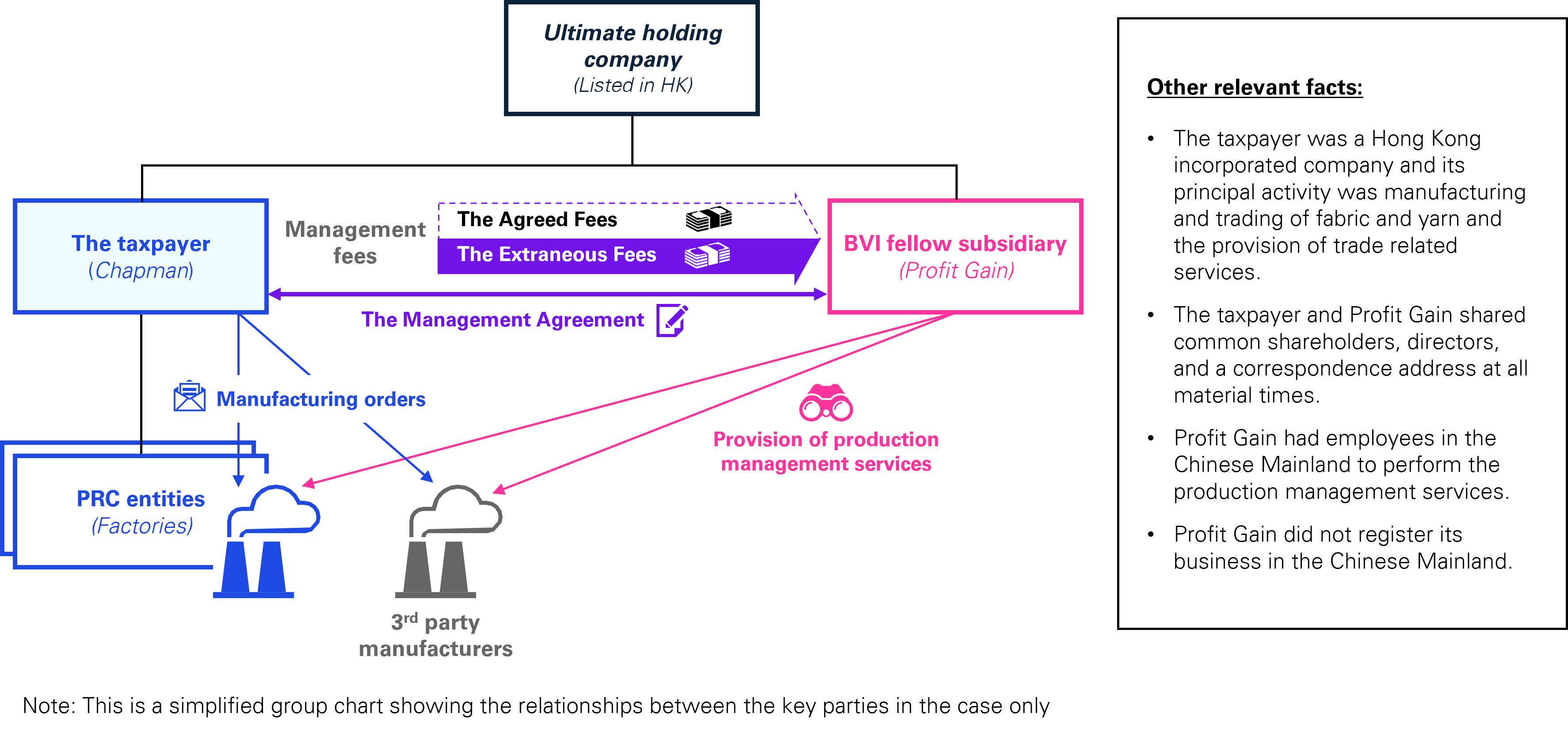
The diagram below sets out the relevant facts of the case.

alt

The CFI3 upheld the Board of Review (BOR)’s decision that:  

  • the portion of the management fees paid in accordance with the contractual terms of the Management Agreement (the Agreed Fees) that represented the operating profits4 of Profit Gain was held as non-deductible under the general anti-avoidance rule (i.e. section 61A of the Inland Revenue Ordinance (IRO)), and
  • the management fees paid in excess of what was agreed in the Management Agreement (the Extraneous Fees) were held as non-deductible under the general expense deduction rule (i.e. section 16(1) of the IRO).

The taxpayer then lodged a further appeal to the COA. 

The COA’s judgment and analysis

Below is a summary of the COA’s judgment and analysis:

Issue 1: Whether the Extraneous Fees were expenses incurred in the production of the taxpayer’s assessable profits?

  • Given the Extraneous Fees were not calculated according to the written terms of the Management Agreement, the taxpayer had initially claimed that there was an oral agreement to vary the terms of the Management Agreement but subsequently shifted its case to claim that the agreement had been varied by conduct.
  • The COA reaffirmed that whether a variation agreement by conduct exists is a question of fact, which is determined based on the totality of evidence. The COA may only interfere with the BOR’s findings when the findings are irrational or perverse and contrary to the true and only reasonable conclusion.
  • The COA noted that the BOR did not reject the possibility that the taxpayer could vary the terms of the Management Agreement by conduct but held that sufficient and credible evidence is required to prove it.  The taxpayer failed to discharge the burden of proof as the evidence presented by the taxpayer in front of the Board was unsatisfactory.
  • The COA further observed that, in the absence of satisfactory evidence, the BOR refused to draw a factual inference that (1) the variation of the Management Agreement by conduct was the only reason giving rise to the Extraneous Fees, or that such fees represented payments for actual service performed by Profit Gain under the Management Agreement.
  • Based on the above, the COA upheld that the BOR’s conclusion is not irrational or perverse and that it cannot disturb the BOR’s conclusion that the Extraneous Fees were not deductible under section 16(1) of the IRO.

Issue 2: Whether section 61A was applicable to the arrangement of the Agreed Fees?

  • Section 61A empowers the Inland Revenue Department to disregard or counteract a transaction if the following three intersecting conditions are satisfied: (1) a transaction has been entered into; (2) the transaction has, or would have had, the effect of conferring a tax benefit on a person and (3) having regard to the seven factors set out in section 61A, the sole or dominant purpose of entering into the transaction is to obtain a tax benefit.
  • Regarding condition (2), the COA considered that the issue is whether the taxpayer’s current tax position was better than what it would have been under the Alternative Hypothesis (i.e. the taxpayer would have performed the production management work itself had Profit Gain not been used).
  • The taxpayer argued that under the Alternative Hypothesis, it would have earned additional profits attributable to Profit Gain’s production management work in the PRC, and such hypothetical profits would be offshore-sourced and not taxable. As such, the taxpayer’s position was not worse off under the Alternative Hypothesis.
  • The COA rejected the taxpayer’s argument and held that under the Alternative Hypothesis, the taxpayer would not have earned any additional profits from the production management services as no party would have paid the taxpayer for the services. In addition, any such production management work carried out by the taxpayer would not render any part of its trading profits to be sourced outside Hong Kong as they are ancillary and incidental to the profit-generating trading activities entirely carried out by the taxpayer in Hong Kong. 
  • The COA also observed that, under the Alternative Hypothesis, the taxpayer would not have paid the Agreed Fees to Profit Gain but would have directly incurred the administrative expenses and bank interest incurred by Profit Gain.  Those expenses had already been allowed for tax deduction.
  • Accordingly, the COA considered that both the BOR and CFI made no error of law in finding that there was a tax benefit (i.e. deduction of additional expenses equals to the operating profits of Profit Gain) to the taxpayer.
  • For condition (3), the taxpayer argued that the BOR failed to take into account the relevant factors in concluding that the transaction was carried out for the sole or dominant purpose of enabling it to obtain a tax benefit (e.g. there are legitimate commercial reasons for the taxpayer to separate its Hong Kong and offshore operations, it is not unusual for related parties to not strictly follow the terms of the Management Agreement for payment of management fees, etc.).
  • The COA reiterated that it is not permissible for the court to re-weigh the evidence to arrive at its own conclusion unless the BOR’s conclusion was irrational or perverse and was contrary to the true and only  reasonable one.
  • Based on the above, the COA upheld the BOR’s finding that section 61A was applicable and the portion of the Agreed Fees representing the operating profits of Profit Gain should be disallowed.


KPMG observations

A key takeaway from this case is the importance of understanding and adhering to the legal principles governing tax appeal cases. Such legal principles are highlighted in the COA’s judgment and include:

  • When lodging an appeal against a tax assessment, taxpayers must provide satisfactory evidence to support their claims, as the IRO imposes the burden of proof solely on taxpayers. An appeal will plainly be dismissed if the taxpayer cannot present positive findings to prove its contentions. The Commissioner of Inland Revenue does not need to prove anything or obtain any positive findings in his favour.
  • There is no legal basis for an appellate court to overturn the BOR’s findings of facts unless it considers that the BOR has erred in law because the contrary conclusion is the true and only reasonable one (which is a high threshold to meet). Therefore, it is essential to identify the precise questions of law, rather than questions of facts, when pursuing an appeal. 
  • The appellate courts are bound by the specific questions of law on which leave to appeal has been granted and cannot consider issues beyond those questions. Those questions will define and limit the scope of the appeal proceedings. As such, taxpayers should carefully consider what questions of law to put forward and how to formulate those questions in the early stage of planning an appeal. 

The COA judgment can be accessed via this link to the Judiciary website: https://legalref.judiciary.hk/lrs/common/search/search_result_detail_frame.jsp?DIS=173845&QS=%28Chapman+Development+Limited%29&TP=JU

The CFI judgment can be accessed via this link to the Judiciary website: https://legalref.judiciary.hk/lrs/common/ju/ju_frame.jsp?DIS=163048&currpage=T

For previous coverage of the case, please refer to our Hong Kong Tax Alert – Issue 14, October 2024.

4 The IRD had allowed the taxpayer to deduct the portion of the Agreed Fees that represented the expenses directly incurred by Profit Gain, being administrative expenses and bank interest.