Swiss GAAP FER is a Swiss accounting framework that provides principles for sound and transparent financial reporting.

      The standard aims to present a true and fair view of an entity’s financial position and performance. It is applied by small and medium-sized enterprises, corporate groups, and listed companies across Switzerland.

      This page explains the framework and offers practical tools for day-to-day application – including our high-quality publications, checklists, factsheets and interpretation guidance.

      Prof. Dr. Reto Eberle

      Partner, Member of the Department of Professional Practice

      KPMG Switzerland

      Dr. Silvan Loser

      Partner, Head of DPP Swiss Accounting

      KPMG Switzerland


      Quick access: Key Swiss GAAP FER Publications

      If you already know what you are looking for, here are our core documents on Swiss GAAP FER:

      Swiss GAAP FER broschure – 11th Edition


      A concise overview of all Swiss GAAP FER standards, including illustrative consolidated financial statements and a checklist for standalone and consolidated financial statements.

      Swiss GAAP FER Brochure

      Swiss GAAP FER (11th edition)

      Overview, illustrative consolidated financial statements and checklist (in German)

      Swiss GAAP RPC (11e édition à venir)

      FER 16 (revised)


      FER 16 deals with the accounting for pension obligations. The revised recommendation, adopted on 2 December 2025 and effective from 1 January 2027, aims to enhance transparency, clarify available accounting options and reduce volatility in reported results.

      Swiss GAAP FER Brochure

      Swiss GAAP FER 16 - Key points of the revision

      Key points of the revision and notes for first‑time use (in German)

      Swiss GAAP FER Brochure

      Swiss GAAP RPC 16 - Points clés de la révision

      Points clés du remaniement et conseils pour la première application (in French)


      What is Swiss GAAP FER?

      Swiss GAAP FER (French: Swiss GAAP RPC) is a modular accounting standard that defines recognition, measurement and presentation requirements for financial statements in Switzerland. It promotes transparent financial reporting and applies to SMEs, corporate groups, listed companies and sector-specific entities such as non-profit organizations.

      All entities apply the framework concept and core FER standards. Groups preparing consolidated financial statements follow FER 30, while listed companies must additionally comply with FER 31.


      Who is Swiss GAAP FER for?

      Swiss GAAP FER is commonly used by:

        • Small and medium-sized enterprises

          that require recognized reporting beyond the Swiss Code of Obligations

        • Listed companies

          reporting under the Swiss Reporting Standard

        • Corporate groups with a national focus,

          preparing consolidated financial statements

        • Non-profit organizations, pension funds and insurance companies,

          following sector-specific recommendations

        The framework provides flexibility while ensuring consistency and comparability across organizations.

        How the Swiss GAAP FER structure works

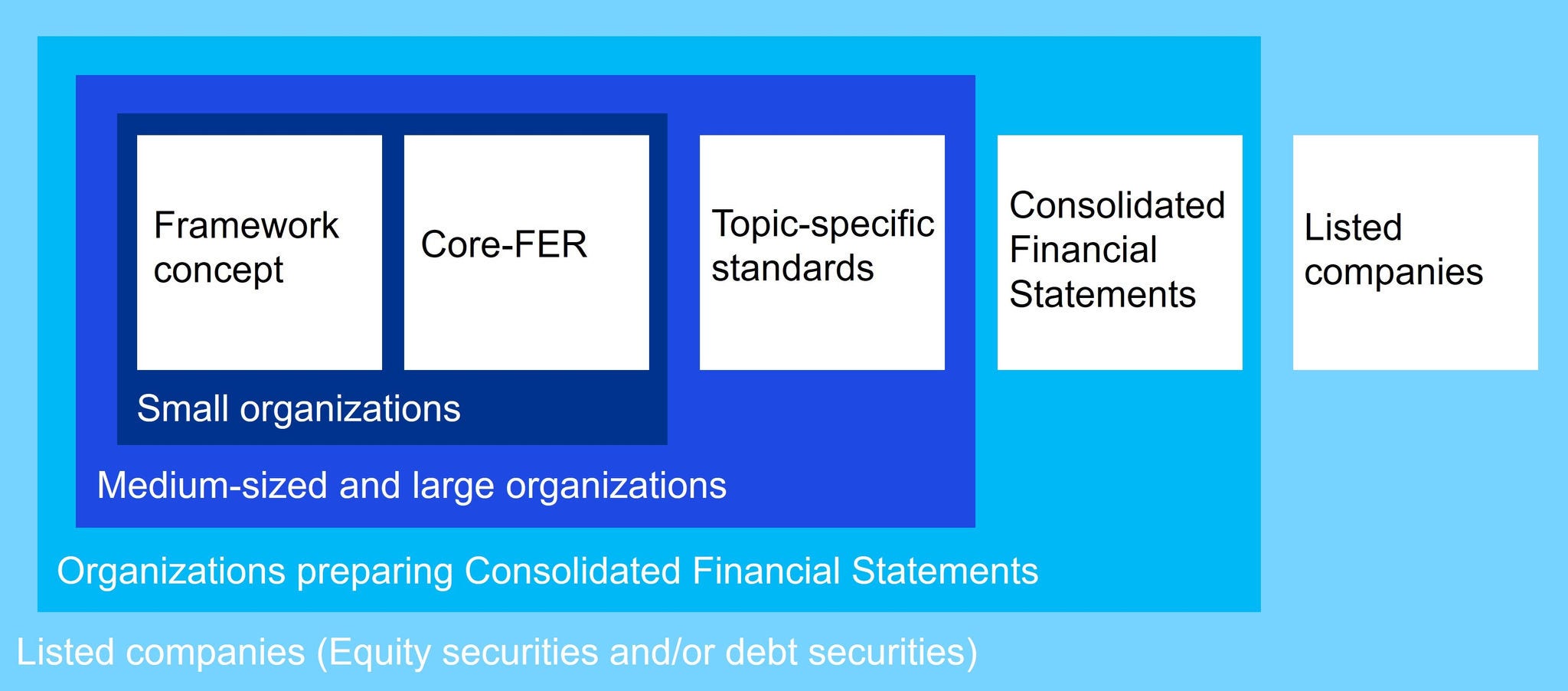
        Swiss GAAP FER is built on a modular structure, allowing organizations to apply the standards based on their size, complexity and reporting needs. The framework is built in several layers that expand as the reporting requirements increase:

        • Framework Concept (Rahmenkonzept)

          applies to all organizations and forms the conceptual foundation for recognition, measurement and presentation.

        • Core FER Standards (Kern-FER)

          required for small, medium-sized and large organizations applying Swiss GAAP FER. These cover fundamental principles such as valuation rules, the presentation of the balance sheet, income statement, cash flow statement as well as basic disclosures.

        • Topic-specific Standards

          additional standards required for medium-sized and large organizations (e.g., pension obligations, provisions, intangible assets, derivative financial instruments).

        • Consolidated Financial Statements (FER 30)

          mandatory for organizations preparing consolidated financial statements.

        • Listed Companies (FER 31)

          additional requirements for listed companies, including earnings per share, segment reporting and interim reporting.


        This layered structure ensures proportionality: smaller organizations apply only the core components, while groups and listed companies apply additional standards reflecting their higher transparency requirements.

        sample

        Figure: Structure of Swiss GAAP FER


        Swiss GAAP FER vs. IFRS vs. Swiss Code of Obligations

        When choosing an accounting standard in Switzerland, companies typically compare Swiss GAAP FER, International Financial Reporting Standards (IFRS), and the Swiss Code of Obligations (CO)

        The decision depends on reporting objectives, stakeholder expectations, complexity, and cost considerations. All three frameworks are accepted in Switzerland, but they differ in scope and level of detail.

        • Swiss GAAP FER: modular, principles-based, Swiss true and fair view standard
        • IFRS: globally oriented, more detailed, suitable for internationally active or capital market-oriented companies
        • Swiss CO: statutory minimum requirements aimed at creditor protection

        Comparative overview

        Criterion

        Swiss GAAP FER

        IFRS

        Swiss Code of Obligations (CO)

        Primary objective

        Transparent financial reporting based on a recognized Swiss accounting standard aiming to present a true and fair view

        Globally comparable financial reporting

        Statutory financial reporting under Swiss law

        Regulatory nature

        Private standard recognized in Switzerland

        International standard issued by the IASB

        Swiss statutory law

        Typical users

        SMEs, corporate groups, listed companies

        Internationally active and capital

        Companies preparing statutory financial statements under Swiss law

        Use in consolidated financial statements

        Yes

        Yes

        Limited

        Use for listed companies in Switzerland

        Yes (only Swiss Reporting Standard)

        Yes

        No


        Key Swiss GAAP FER topics in practice

        Swiss GAAP FER is principles‑based and concise. This provides flexibility but also requires sound judgment where transactions are complex or the available guidance is limited.

        The following topic areas highlight common challenges and link directly to key factsheets and publications.

        Consolidated financial statements (FER 30)

        Consolidation remains one of the most judgment-heavy areas under Swiss GAAP FER. Group structures, acquisitions and ownership changes often raise questions that go beyond mechanical consolidation rules.

        Typical focus areas include step acquisitions, the treatment of minority interests, goodwill accounting and changes in control.
         

        Related insights and factsheets


        Listed companies (FER 31)

        Listed companies face heightened transparency and comparability requirements. FER 31 introduces disclosure and presentation rules that go beyond the core FER standards.

        Common questions related to earnings per share, segment reporting, interim reporting and share-based payments.
         

        Related insights and factsheets

        Swiss GAAP FER Brochure

        FER 31

        Supplementary recommendations for listed companies (in German)


        Swiss GAAP FER Brochure

        RPC 31

        Recommandation complémentaire pour les sociétés cotées (in French)


        Cash flow statement (FER 4)

        Cash flow statements are a recurring challenge in practice. Errors often arise in connection with business combinations, foreign currency effects or cash-pooling arrangements. Careful analysis is required to appropriately distinguish operating cash flows.
         

        Related insights and factsheets


        Financial instruments (FER 27)

        Swiss GAAP FER provides limited guidance for financial instruments. Classification, measurement and disclosure decisions require careful judgment, particularly when dealing with derivatives or hedging relationships.
         

        Related insights and factsheets


        First-time adoption and switching to Swiss GAAP FER

        Most companies transition to Swiss GAAP FER from the Swiss Code of Obligations or IFRS.

        A successful first‑time adoption requires a structured assessment of the applicable requirements and the definition of appropriate accounting and reporting policies.

        This includes setting Swiss GAAP FER‑compliant policies, preparing an opening balance sheet at the transition date and implementing the required disclosures in the first financial statements.

        For organizations that prefer guidance through this process, our Swiss GAAP FER conversion services provide tailored support from initial assessment through to go live.

          Swiss GAAP FER Brochure

          Swiss GAAP FER conversion

          Scope of action and practical design options


          Swiss GAAP FER Brochüre

          Umstellung auf Swiss GAAP FER

          Handlungsspielraum und praktische Gestaltungsmöglichkeiten (in German)


          How can KPMG help?

          KPMG supports companies throughout the entire Swiss GAAP FER implementation process, from the initial assessment and conversion planning to the preparation and audit of financial statements.

          Our services include guidance on selecting the appropriate accounting standard, support in converting stand-alone and consolidated financial statements, clarification of implementation questions, and the provision of audit services under Swiss GAAP FER.

          diversity_3

          Swiss GAAP FER governs key accounting issues. We support with implementation and audit.


          Experience our expertise in practice

          At our annual Swiss GAAP FER client event, you benefit from direct access to the individuals shaping the standards.

          Prof. Dr. Reto Eberle – Chairman of the Foundation Board – and Dr. Silvan Loser – member of the Executive Committee and the Commission – share first-hand insights into current interpretations, upcoming developments and key challenges for companies applying Swiss GAAP FER.

          Through keynote updates and industry-specific workshops, you receive practical guidance on emerging FER topics and have the opportunity to discuss your own accounting questions directly with our experts.

          FAQ on Swiss GAAP FER

          No. It is not mandatory but is a recognized accounting standard. Companies may choose Swiss GAAP FER if they require financial reporting beyond the Swiss Code of Obligations.

          Yes. Listed companies in Switzerland may apply Swiss GAAP FER if they report under the Swiss Reporting Standard. In this case, FER 31 must also be applied.

          Swiss GAAP FER is a principles-based Swiss accounting standard. IFRS is a comprehensive international accounting framework that – in particular – requires more extensive disclosures.

          Yes. Groups preparing consolidated financial statements under Swiss GAAP FER must apply FER 30, which sets out the consolidation requirements.

          Companies switching to Swiss GAAP FER typically perform a gap analysis, define Swiss GAAP FER-compliant accounting policies, and prepare an opening balance sheet. Additional disclosures are required in the first year of application.

          Yes. The standard includes specific standards for sectors such as non-profit organizations, pension funds and insurance companies.


          Meet our experts

          Prof. Dr. Reto Eberle

          Partner, Member of the Department of Professional Practice

          KPMG Switzerland

          Dr. Silvan Loser

          Partner, Head of DPP Swiss Accounting

          KPMG Switzerland

          Related articles and more information

          Swiss GAAP FER explained: scope, key standards, FER 30/FER 31 requirements and practical insights for financial reporting in Switzerland.

          Your trusted partner in GAAP conversions, IPO readiness assessments, accounting for M&A and solving demanding accounting & reporting challenges.

          Technology-enabled audit, financial reporting, reporting, and internal audit - we support you in all aspects of audit services.