Skip to navigation

      Switzerland is set to shorten its securities settlement cycle from T+2 to T+1, with the change scheduled to take effect on 11 October 2027.

      This timeline has been deliberately aligned with the EU and the UK to ensure consistency across European markets and avoid operational fragmentation.

      The transition is being supported by the Swiss Securities Post-Trade Council (swissSPTC), which has issued industry-driven guidance to facilitate a coordinated and harmonized implementation of T+1.

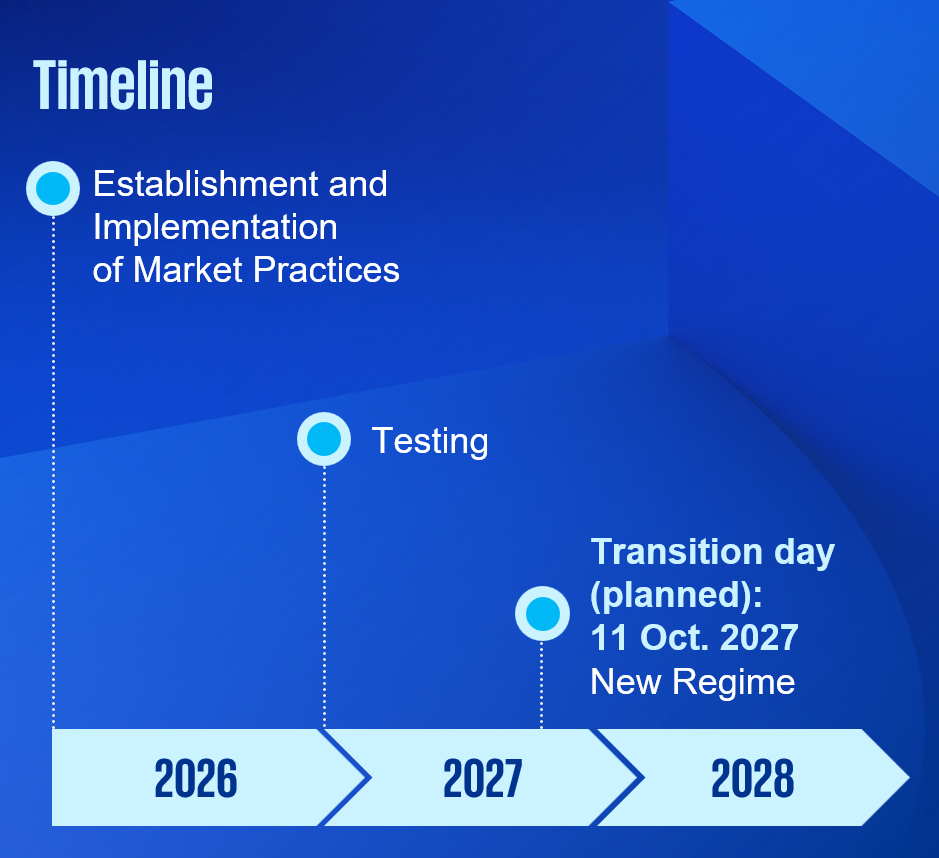
      To ensure readiness for this change, implementation preparations must commence in 2026, with industry best practices defined and adopted ahead of market-wide testing in 2027.

      Olivier Gauderon

      Partner, Financial Services

      KPMG Switzerland

      Adrian Walder

      Partner, Financial Services Audit & Regulation

      KPMG Switzerland


      How you benefit


      • Reduced settlement risk

        A shorter settlement window reduces counterparty exposure and the likelihood of fails.

      • Increased efficiency

        T+1 tightens cut-offs and pushes more straight-through processing across post-trade workflows.

      • Enhanced liquidity

        Faster settlement improves cash predictability and supports more efficient funding, collateral and FX.

      Timeline

      Implications

      Transitioning to T+1 fundamentally shortens the post-trade lifecycle, reducing the time between trade execution and final settlement by one full business day. To operate effectively within this compressed timeframe, market participants must ensure that trading, clearing, and settlement processes are closely aligned and operate on harmonized timelines.

      Scope of impact:

      • Shortening of settlement timelines 
      • Redefinition of standards in the confirmation and matching process
      emoji_objects

      Designing for T+1 – and beyond

      The T+1 solution must be designed in a future-proof manner, with a view toward a potential transition to T+0

      Affected instruments

      Who is impacted

      The T+1 settlement cycle will apply to all transferable securities traded on Swiss regulated trading venues and settled through the Swiss central securities depository, SIX SIS.

      This includes equities, fixed income instruments, exchange-traded funds (ETFs), warrants, and structured products. In addition, certain products will be indirectly affected by the shortened settlement cycle - most notably non-exchange-traded funds and special purpose vehicles (SPVs) that invest in T+1-settled securities - due to consequential changes in the net asset value (NAV) calculation process.

      The move to T+1 has implications across the entire settlement value chain. This not only includes financial market infrastructure, but all market participants trading T+1 securities. 

      Within asset management, this includes management companies, administrators, investment managers, and custodians. Issuers of T+1 securities are also in scope, particularly in the planning and execution of corporate actions. 

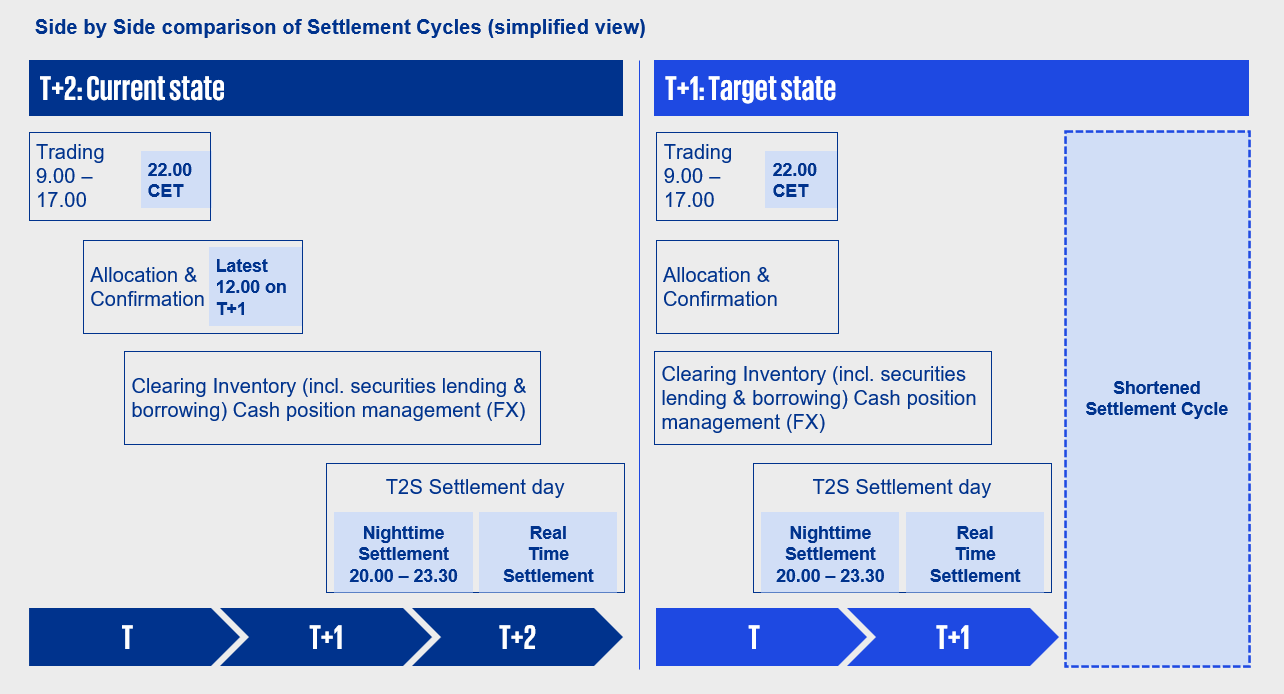
      From current state T+2 to target state T+1

      Accelerating the settlement cycle will necessitate implementing straight-through processing, advancing the timing of trade matching and affirmation, and aligning cut-off times across the system.

      In a T+1 environment, the automation of operational and IT workflows will take on heightened significance – particularly for direct clearing members – ensuring efficiency and reliability despite the compressed timeline. 

      Comparison settlement cycles > Click on the image to enlarge it

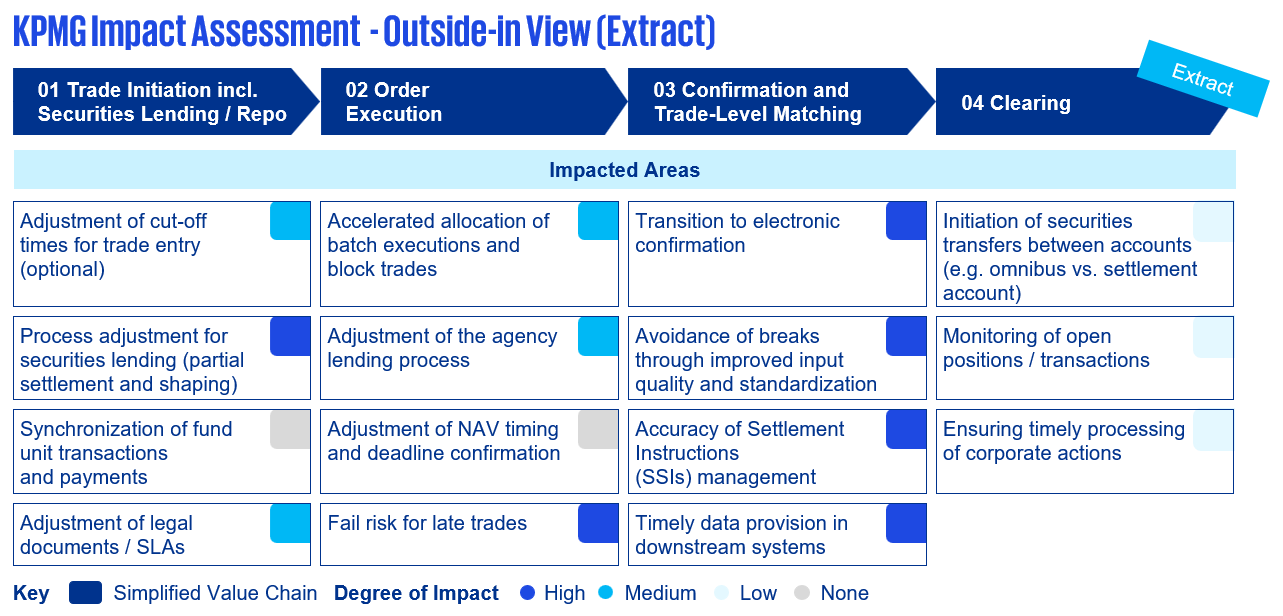
      KPMG Impact Assessment – Outside-in View (Extract)

      This extract provides an outside-in view of where the shift to T+1 creates operational impact across the early post-trade lifecycle – from trade initiation and order execution through confirmation/matching and clearing – highlighting the typical adjustments along the settlement cycle corresponding to the level of impact.

      KPMG Impact Assessment  - Outside-in View (Extract) > Click on the image to enlarge it

      How can KPMG help

      KPMG can support your T+1 transition end-to-end – from assessing impacts across the post-trade lifecycle to closing gaps in processes, governance and technology, and executing the required transformation ahead of the 2027 go-live.

      • Impact assessment
        • Trade and settlement lifecycle
        • Liquidity management
        • Foreign Exchange (FX)
        • Investment management
        • Securities lending/collateral management
        • Fund lifecycle
        • Exchange Traded Funds (ETFs)
      • Detailed gap analysis by impacted areas
        • People and organization
        • Processes and operations
        • Business partners
        • Clients and products
        • Policies and documents
        • Regulation and compliance
        • Technology and connectivity
      • Transformation support
        • Solution development
        • Definition of a detailed action plan
        • Program management and governance
        • Stakeholder management
        • Testing

      Navigate the transition to T+1 with confidence

      KPMG is a market leader in advising, auditing and structuring for the investment fund industry.

      Our extensive knowledge and experience in a myriad of areas allow us to offer a customized approach that fits your unique needs. Our seasoned team of experts can also help you implement your solution at the organizational and product level in a targeted and efficient way.

      Meet our experts

      Olivier Gauderon

      Partner, Financial Services

      KPMG Switzerland

      Adrian Walder

      Partner, Financial Services Audit & Regulation

      KPMG Switzerland

      Thought leadership and related articles

      picture_as_pdf

      The Swiss asset management industry is navigating a dynamic landscape marked by operational challenges and rapid legal and regulatory change. Find out more about key developments and emerging trends.

      picture_as_pdf

      Discover strategies  to manage regulatory divergence more effectively. Our annual analysis provides asset managers with actionable insights for aligning different global regulations to ensure operational consistency across borders. 

      picture_as_pdf

      The launch of the Limited Qualified Investor Fund (L-QIF) in Switzerland marks a significant development in the investment landscape, offering qualified investors a flexible, time- and cost efficient investment vehicle. Our factsheet outlines the key features, legal forms, and fundamental structure of this innovative investment vehicle

      picture_as_pdf

      Explore how asset management CEOs are shaping the future. Our publication discusses strategies for innovation, talent development and adapting to regulatory change to ensure long-term growth.