Unlocking productivity starts with data, but not just any data. To drive productivity, organizations must transform raw information into actionable insights that empower people to make informed decisions at the speed of business.

But building this capability takes time. It requires running pilots and establishing best practices, which can then be rolled out to other parts of the organization. By moving away from reactive approaches and taking a proactive stance, Canadian organizations can maximize the value of their information and boost team productivity.

How to turn data and analytics into a powerful asset

Many organizations already possess vast amounts of data, and with the rise of Generative AI, this now includes large volumes of unstructured data such as heavy text, audio and video. The true value comes from integrating and connecting these sources. This enables organizations to uncover inefficiencies and identify new opportunities for value creation.

For instance, Canadian transportation companies are applying predictive analytics to fleet management by analyzing sensor data—such as GPS routes, fuel consumption, braking patterns, and wear indicators—to predict brake failures weeks in advance. This proactive approach reduces costly roadside repairs, prevents delivery delays, and improves safety.

In private equity, firms increasingly rely on advanced analytics, AI, and generative AI during due diligence to process large data sets at a faster pace, uncover hidden risks, and validate performance metrics. Strong data governance and readiness are now essential for achieving target valuations and securing deals.

Data underpins everything from advanced analytics to artificial intelligence, helping to streamline operations and drive innovation. When Canadian businesses invest in their data, they give their people a competitive edge. Proactively preparing and connecting data enables organizations to maximize the impact of their teams.

What’s hindering impact

While interconnected data can boost productivity, fragmented data often has the opposite effect. Siloed data across departments and platforms makes it harder to glean actionable insights. Duplication of data leads to duplicated effort and higher costs, such as increased cloud computing, while poor data quality can result in conflicting “sources of truth”, leading to flawed decision-making that hinders productivity. Deciding on a single source of truth often becomes a tedious exercise that requires tracing data lineage and performing quality checks, which can be a significant challenge for organizations.

Many leaders expect analytics and AI to deliver instant results or magically produce clean, organized data. AI can help, but not solve everything. Without proper data discovery and preparation, these tools are underutilized. The real value comes from integrating and connecting data sources, not just accumulating them.

Where to start

As your organization becomes more data-driven, consider asking the following strategic questions about your organization and your people:

  • Do we have a clear, organization-wide data strategy and a roadmap for integrating fragmented sources? How mature is our data? How effectively are we collecting, managing, analyzing, and using data?
  • How often are our decisions truly informed by data rather than intuition or approximations?
  • Are our people receiving periodic data and AI literacy training?
  • Are we as innovative as we could be and are we using data to its fullest potential?
  • Do we know what data we have and the ones we are missing?
  • Will our infrastructure support our data maturity transformation?
  • How are we standardizing data formats, centralizing data, and connecting different systems?
  • Do we have a robust and scalable data governance framework that defines rules and ownership?
  • How are we integrating data sources into multimodal generative AI tools?
  • Are we following a responsible AI framework for data accuracy, confidentiality, and privacy in AI tools and models?
  • Do we have the right controls in place to monitor this framework?
  • Do we need a Chief Data Officer (CDO), and do we have the requisite skills in-house?
  • Do we have a formal data policy and, if so, has it been communicated to our people?

By addressing these questions, leaders can lay the groundwork for a formal data strategy that effectively supports advanced analytics and AI efforts. A strong data strategy should be rooted in, and cascade from, the business strategy to ensure alignment. If you’ve recently refreshed your strategic plan, that’s an ideal starting point. Begin by clarifying your objectives—are you focused on growth, enhancing customer or employee experience, or driving efficiency? Identify the strategic initiatives tied to those objectives and determine which data is essential to bring them to life or to assess your current position. These insights form the foundation of your data strategy and help maintain focus during execution. Once your strategy is defined, secure leadership approval, communicate it broadly, and reinforce it consistently across the organization.
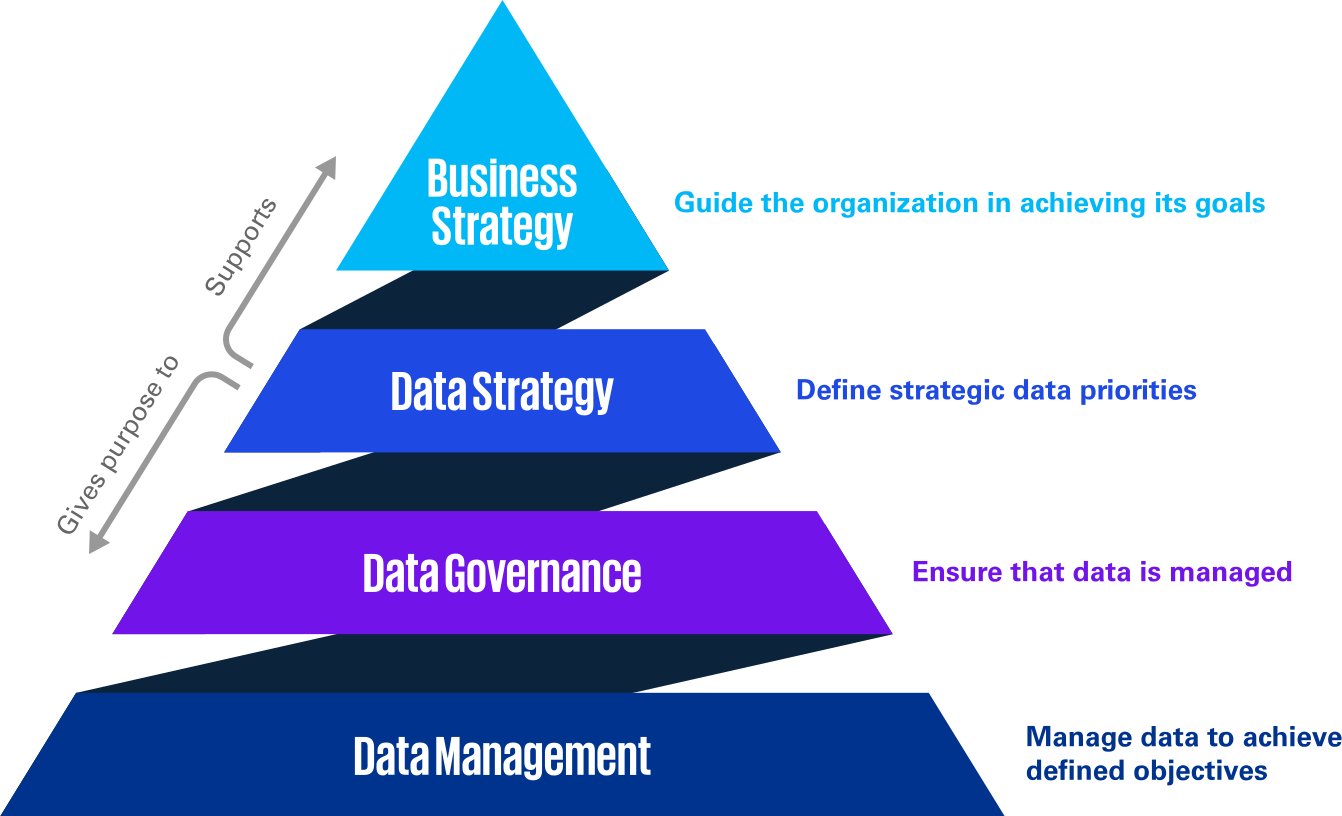
Connecting data and business strategy to achieve organizational objectives


AI Adoption Level

What you can do – A productivity blueprint

Canadian leaders can take the following targeted, measurable actions to improve productivity through data maturity:

  • Evaluate your data strategy: Understand your organization’s data maturity by conducting maturity assessments across different operating companies, department, and functions. Establishing a baseline for data maturity helps you prioritize quick wins and set the stage for larger initiatives, all while continuously working on your foundations and strengthening data literacy and governance.
  • Tie strategy to productivity objectives: Understand how teams are using data and identify use cases that drive productivity. Prioritize based on business value, level of effort, and risk—leveraging frameworks that link actions to outcomes and data sources. Share results and highlight the value delivered to reinforce adoption and build momentum.
  • Create a trusted data management framework: Ensure data is accurate, reliable, secure, and compliant through formalized policies and procedures. Trust in data is key for compliance and competitive advantage.
  • Build out your technology: Invest in cloud-native architecture to accelerate your data efforts and integrate diverse data into a single, scalable platform. Evaluate which data management platforms and tools integrate best with your environment, skillsets and objectives. Incorporate data architecture concepts such as data mesh, and thoughtfully deploy advanced analytics and AI to unlock new insights.
  • Designate data champions: Create a Data Office and appoint a CDO to drive business value through maturing data practices. Empower them to enforce data governance throughout the organization. Engage champions, including executives and teams passionate about data and analytics, to drive adoption and innovation.
  • Understand and map your data: Take stock of your organization’s data landscape by mapping sources, assessing data quality, and pinpointing gaps. Use process mapping and surveys to uncover how data is used and where bottlenecks exist.
  • Build data literacy: Conduct a skills gap analysis and offer ongoing training to your people. This helps to democratize data access, build competencies, and cultivate a data-driven mindset.
  • Monitor and measure: Track your progress, measure improvements, and report progress to stakeholders. Move beyond superficial KPIs and measure what matters, such as time saved, improved insights, and risk reduction. This can help to secure ongoing support for data initiatives.
  • Leverage AI to structure and organize your data: While AI isn’t a cure-all, it can streamline critical tasks such as classification, labelling, taxonomy standardization, and data discovery. It also helps create stronger alignment between how structured and unstructured data is governed and managed.

What NOT to do

Avoid common traps that can hinder data maturity:

  • Don’t assume that collecting more data will drive productivity. This can lead to information overload without generating meaningful insights or results. It’s about what you do with that data that counts.
  • Don’t look for a silver bullet. Quick fixes can result in wasted resources and missed opportunities for sustainable improvement. A successful data strategy execution requires discipline, focus, encompassing people, data, process, and technology.
  • Don’t wait to start training your people. Delaying upskilling widens the skills gap, slows adoption of new tools, and limits your organization’s ability to use data effectively.
  • Don’t jump into AI at scale without ensuring data literacy, quality, and governance across the organization. This risks poor outcomes, low trust in analytics, and potential compliance issues.
  • Don’t ‘boil the ocean’. Avoid waiting until all your data is perfectly organized before taking action. Adopt an agile, iterative approach. Start small, focus on high-value areas, and invest time where it delivers the greatest impact.

In summary

Organizations that invest in data maturity set themselves apart, unlocking new levels of productivity, innovation, and resilience. By integrating data sources, strengthening governance, and building skills across teams, leaders create a foundation for meaningful business results. The real difference comes from moving beyond passive data collection to actively discovering, mapping, preparing, connecting, and leveraging data. When insights drive decisions and progress is measurable, organizations are equipped to thrive in a rapidly changing environment.

How KPMG can help

Our Canadian cross-functional team combines expertise in data risk management, deal analytics, and data foundations to help organizations unlock productivity and value from their data. Utilizing our Trusted Data framework, we support clients in proactively protecting and governing data, uncovering opportunities for value creation, and automating data across both new and legacy systems. With advanced analytics, intelligent automation, and responsible AI frameworks, our solutions are secure, scalable, and tailored to Canadian businesses. Backed by our global network, we help organizations build trusted data assets and achieve lasting productivity gains.

If your organization is looking to turn data into measurable business impact, KPMG can help you integrate sources, strengthen data foundations, implement robust governance, and optimize your tech stack.

Connect with us

Stay up to date with what matters to you

Gain access to personalized content based on your interests by signing up today

Connect with us