

In the modern enterprise the demand for data-driven decision-making frequently outpaces the capacity of available data teams, leading to an analytics bottleneck. Business employees find themselves waiting for weeks for minor dashboard modifications or custom reports to address specific, time-sensitive needs. While dashboards are powerful for tracking established metrics, their curated nature means that any deviation from a "standard" view requires manual development that can slow down agility. As organizations rely more on their data and insights, the data agent is emerging as a desired solution enabling quick ad-hoc analyses, shifting the "request-and-wait" model to immediate conversational insights.
Enter the data agent: Active, conversational insights
In contrast to conventional business intelligence (BI) tools that depend on predefined visualizations, data agents utilize natural language processing to interpret user intent. Rather than navigating through multiple pages and filters to obtain information, users are able to query their data dynamically using business terminology.
Data agents offer distinct benefits over traditional dashboards. With their advanced AI capabilities, users asking questions in natural language will instantly retrieve insights, even those details that aren’t already visualized or structured in a dashboard. This approach empowers business users to explore data freely and eliminates reliance on the data office for every query. By democratizing access, data agents lighten the workload for data teams and transform the time to insight from weeks to just minutes.

Data agents instead of dashboards?
Some might say that traditional dashboards are “dead”, but we see that data agents are not a replacement for traditional dashboards, they are a complementary layer designed to address distinct business needs.
Dashboards remain the gold standard for supporting recurring key business processes and driving a narrative through a centralized vision. When there is no margin for error in decision-making, the curated nature of a dashboard provides a "single source of truth" and a sense of trust that remains stable over time. By focusing on the metrics used around 80% of the time, dashboards ensure that end users interpret core data in a consistent and controlled environment.
Data agents excel at managing the remaining chunk of analytical ad-hoc needs. When dashboards want to cater to every business need, this can result in an overwhelming number of pages. In the past, self-service BI (SSBI) was proposed as a solution to this issue, but it introduced challenges in its own right. While SSBI could alleviate the pressure on central data teams, it required proficiency with BI tools across the business, adding a technical barrier. Moving to decentralized data analytics also brings about new challenges regarding data governance. This is where data agents can make a difference. By allowing rapid, ad-hoc analyses data agents can bridge the gap between having access to information and being able to find the information.
Ultimately, a comprehensive BI solution can leverage both: dashboards to maintain the centralized control and stability and data agents to provide the flexibility and direct action required for modern, agile operations.
The endless ad-hoc queue
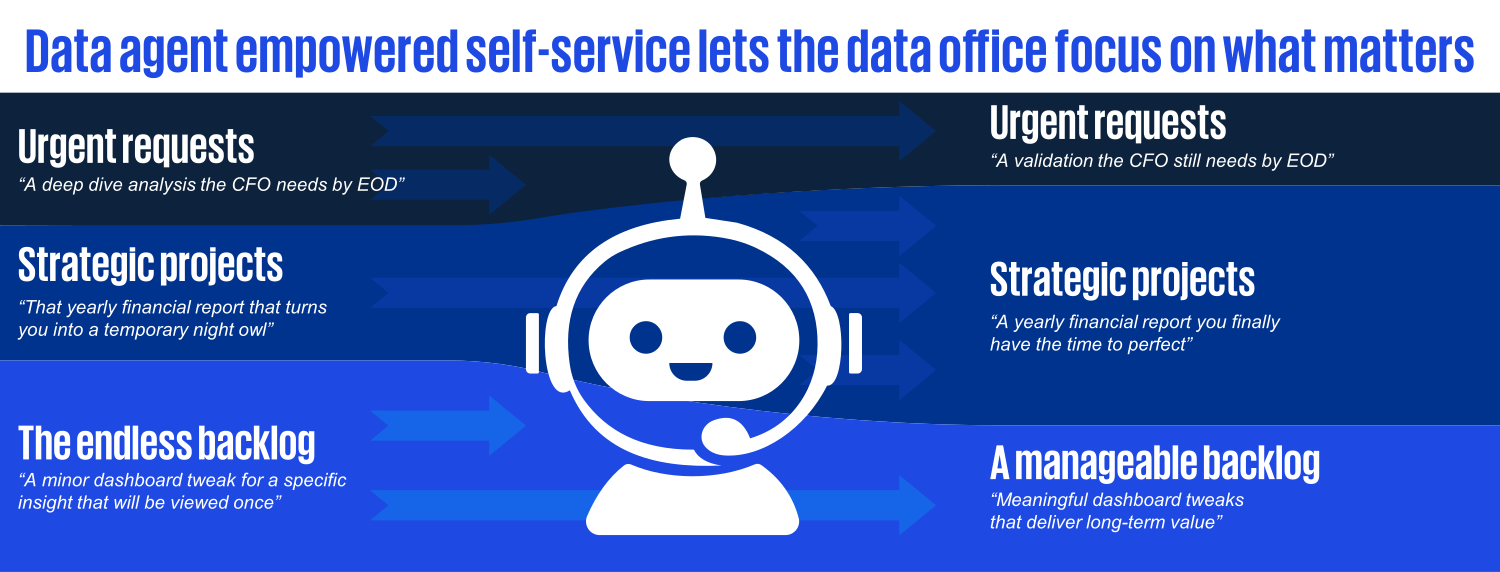
Within a typical data office, a significant portion of the workload is consumed by the "endless ad-hoc queue." Highly skilled data analysts and engineers, who are hired for their ability to build complex models and scalable architecture, find their time increasingly spent on minor, repetitive reporting requests. This cycle can introduce some unforeseen consequences for the organization: business users face delays in receiving critical information, while technical talent is diverted from high-value strategic projects to perform routine data extraction and formatting. Additionally, there’s the risk that delays force managers to rely on outdated information or to build their own workarounds which could eventually reduce trust in the data.
Empowering self-service at scale
The introduction of data agents represents a potential shift in how BI is viewed and used within an organization. Moving from a model where BI analysts fulfill requests to one where business users can partly serve themselves using natural language. By automating the basic ad-hoc data requests, data agents enable the business to receive insights at an instant. This shift doesn't just lighten the load on the data office, it ensures that decisions are based on the most current data available. Ultimately, this transition is a lever for shrinking the data office backlog and boosting enterprise-wide agility.
Storytime: A data agent saves the day of the CFO
To better understand the value of a data agent, consider this scenario in the insurance sector. The CFO of the fictional company BeneAuto Insurance NV is preparing for a pivotal quarterly board meeting. Looking at the standard executive dashboard, the CFO sees that the overall loss rate incurred has been spiking up above 100% over the last few years. The CFO needs to get a better understanding of this issue before bringing it to the board.
The dashboard serves its purpose by highlighting the macro-level problem, but it stops there. It doesn’t explain why the loss ratio is so high. Is it a specific customer segment? A surge in weather-related claims? Or something more systemic?
In a traditional setup, the CFO would have to email the data office, requesting a deep-dive analysis slicing claims by region, car brand, dealer, and coverage type. As we explored above, this request enters the "endless ad-hoc queue," taking days or weeks to process, time the CFO simply does not have.
This is where a data agent comes into play. Instead of waiting, the CFO turns to a data agent built on top of the company's finance semantic model. The CFO can immediately start interrogating the data using everyday business language to find the hidden patterns driving the losses.
The CFO starts the conversation by asking about the loss ratio for the last three years. The data agent confirms the executive dashboard's numbers, highlighting that the 127% loss ratios in 2023 and 2024 are far above the 85% threshold and represent a major concern.
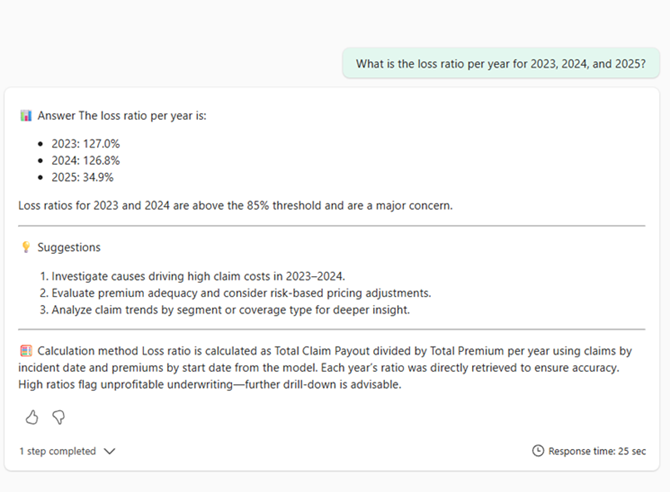
Examples from a conversation with a data agent configured in MS Fabric
With the baseline confirmed, the CFO asks a follow-up question regarding specific coverage types. The data agent quickly identifies the culprit: “Third Party Liability" coverage has an abnormally high loss ratio of 168.6%.
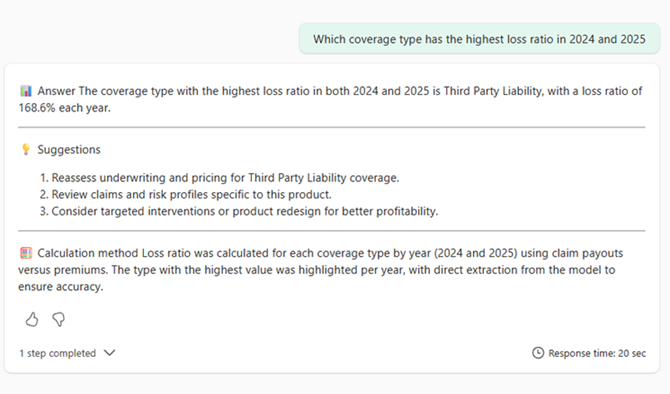
Examples from a conversation with a data agent configured in MS Fabric
Drilling even deeper into the source of these specific claims, the data agent uncovers a glaring anomaly. It flags a single dealer that initiated 204 Third Party Liability claims. To put that into perspective, the next highest dealer only initiated 44.
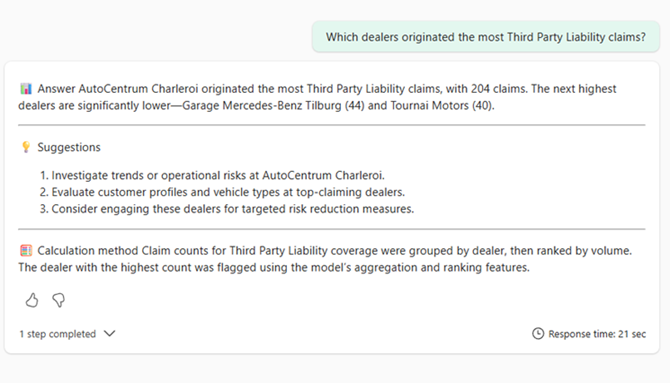
Examples from a conversation with a data agent configured in MS Fabric
In a matter of minutes, the CFO has moved from a generalized dashboard metric to identify a highly suspicious pattern indicative of potential dealer fraud at AutoCentrum Charleroi. The board meeting presentation changes entirely: from a defensive report on shrinking margins to a proactive strategy on fraud mitigation.
Preparing for the agentic future
While the promise of instant, conversational insights can be enticing, it is crucial to remember that a data agent is only as intelligent as the data it relies upon. Realizing an agentic future requires prioritizing a robust data foundation. High-quality data, governance, security, and well-defined semantic models should be established to optimally integrate data agents into your daily workflows and existing platforms. Ultimately, while dashboards serve as the reliable "single source of truth", data agents act as an essential agile partner, empowering your workforce with self-service analytics.
Is your data foundation designed for the AI era? Reach out to discover how we can help you build and deploy data agents.
Authors: Dario Verschueren, Advisor & Olivier Mees, Manager Advisor

