Refundable tax credits

      diagram

      Typically, companies benefit from refundable tax credits in the form of:

      • a reduction in the tax liability; or
      • a direct cash payment from the government (if the company does not have a tax liability or its tax liability is less than the value of the credit).

      Some refundable tax credits may also be transferable – i.e. companies can receive a cash payment from the transfer (sale) to an unrelated third party.


      Your questions answered


      In our view, these tax credits meet the definition of government grants and therefore should be accounted for under
      IAS 20 Accounting for Government Grants and Disclosure of Government Assistance. This is the case regardless of whether:

      • the tax credits are transferable; and/or
      • a company expects to make a direct-pay election.

      We believe that these tax credits meet the definition of government grants because they are refundable through the direct-pay election, and the amount refundable is not limited by the company’s taxable income or tax liability – e.g. a company may receive the refund despite being in a taxable-loss position. As a result, these refundable amounts are not income taxes.

      Generally, no. The recognition and measurement requirements are the same for government grants related both to income and assets. However, for government grants related to assets, companies can apply two approaches to present them in the balance sheet (see Question 4). These approaches are not relevant for government grants related to income.

      Applying IAS 20, a company recognises refundable tax credits when there is reasonable assurance that:

      • the company will comply with the relevant conditions; and
      • the tax credits will be received.

      Under IAS 20, a government grant is recognised in profit or loss on a systematic basis as the company recognises as expenses those costs the grant is intended to compensate. 

      Tax credit relates to…

      The benefit is recognised in profit or loss as…

      Depreciable asset

      The asset is depreciated or amortised

      Non-depreciable asset

      Conditions related to the refundable credit are met. For example, if a refundable credit relates to the purchase of land on the condition that the company constructs and operates a building on that land, then the refundable credit is recognised in profit or loss as the building is depreciated
      Income to compensate for specific costs

      The related costs are recognised as expenses

      Income to compensate for expenses or losses already incurred, or to provide immediate financial support with no future related cost

      The tax credit becomes receivable

      A company chooses a policy to present refundable tax credits related to assets by applying one of the following approaches.

      • Net presentation: Under this approach, a tax credit reduces the carrying amount of the asset in the balance sheet. In the income statement, the benefit is recognised through reduced depreciation or amortisation expense.
      • Gross presentation: Under this approach, a tax credit is presented separately as deferred income in the balance sheet. In the income statement, in our view a company should choose an accounting policy and apply it consistently – i.e. to present these tax credits either as income or as a reduction in the related expense.

      A company chooses a policy to present refundable tax credits related to income by applying one of the following approaches.

      • Net presentation: Under this approach, a tax credit reduces the related expense in the income statement.
      • Gross presentation: Under this approach, a tax credit is presented separately as income in the appropriate line item in the income statement.

      Non-refundable, non-transferable tax credits

      diagram

      Typically, companies use non-refundable, non-transferable tax credits to reduce the tax liability and can realise their benefits only if they have sufficient taxable income.


      Your questions answered


      In our view, these tax credits are akin to tax allowances and therefore it is generally appropriate to account for them applying IAS 12 Income Taxes by analogy1. Although the amount of the tax credits received is independent of a company’s taxable profit, the economic benefit a company can realise by using these tax credits is limited to its income tax liability – i.e. a company needs to have sufficient taxable income to offset the tax credit amount.

      Following IAS 12 by analogy, the tax credits are recognised and presented in the income statement as a deduction in current tax expense to the extent that a company is entitled to claim the credit in the current reporting period. 

      diagram

      Any unused tax credit is recognised as a deferred tax asset (DTA) and income if it meets the DTA recognition criteria in IAS 12.

      diagram

      1 For detailed guidance on how to determine which accounting standard to apply, see Insights into IFRS® 3.13.700.10–720.20.  


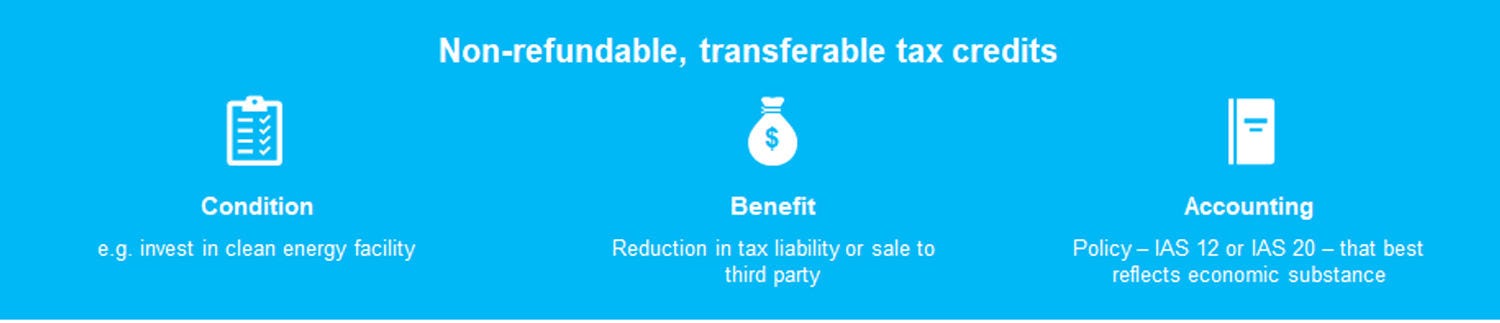
      Non-refundable, transferable tax credits

      diagram

      Typically, companies benefit from non-refundable, transferable tax credits in the form of:

      • a reduction in the tax liability; or
      • a cash payment from the transfer (sale) to an unrelated third party.

      Your questions answered


      There is no specific guidance in IFRS® Accounting Standards for non-refundable, transferable tax credits. Therefore, a company needs to develop an accounting policy that best reflects the economic substance of those credits. This requires judgement in light of all relevant facts and circumstances.

      In our view, in determining the economic substance of these tax credits, a company may consider, among other factors, whether it generally expects to realise the benefits of the credits:

      • through reducing its taxable income; or
      • by transferring the credits to a third party.

      The accounting standard a company applies by analogy to these tax credits will depend on whether it determines their economic substance to be similar to:

      • a tax allowance: we believe that it is appropriate to account for these tax credits applying IAS 12 Income Taxes by analogy; or
      • a government grant: we believe that it is appropriate to account for these tax credits applying IAS 20 Accounting for Government Grants and Disclosure of Government Assistance by analogy.

      Once a company develops its accounting policy, we believe that it should apply it consistently to all non-refundable, transferable credits, regardless of how it realises the benefits of the credits at subsequent reporting dates – i.e. whether they reduce taxable income or are transferred to a third party.

      This depends on the accounting policy applied (see Question 1).

      Tax credit similar to…

      Applicable accounting standard

      Follow recognition and presentation guidance for…

      Tax allowance

      IAS 12

      Non-refundable, non-transferable tax credits (see Question 2)

      Government grant

      IAS 20

      Refundable tax credits (see Questions 2 to 5)


      Accounting for tax incentives

      Your questions answered
      man watering