

- Invoices will be issued, sent and received in a structured XML electronic format.
- They will enable automated electronic processing without manual intervention.
- Companies must ensure the ability to send and receive invoices via a delivery service - so-called digital postmen, who operate access points for the exchange of e-invoices within the Peppol network.
- Data from invoices will be digitally reported to the tax authorities.
Slovakia is changing its VAT rules, introducing a fundamental shift in invoicing. Paper and PDF invoices will be replaced by structured electronic invoicing in XML format, which will become the mandatory standard for communication between businesses (B2B) and between businesses and government (B2G).
From 1 January 2027, all VAT registered payers based in Slovakia will be required to issue, send, and receive invoices exclusively in electronic form for domestic transactions. They must ensure the capability to send and receive electronic invoices via a delivery service that complies with European e-delivery standards, specifically meeting the legal requirements of the OpenPeppol AISBL standard. All parties who are legally entitled to receive an invoice from VAT payers must be able to accept electronic invoices.
Implementing electronic invoicing and electronic reporting will bring additional costs for companies, the need for technological adjustments, adaptation of accounting systems, cooperation with accredited access point providers for the exchange of e-invoices and staff training.
This represents a significant step towards the digitalization of tax processes, which will gradually extend to cross-border transactions across the EU under the VAT in the Digital Age (ViDA) initiative.
What e-invoicing will mean in practice
Standard PDF invoices or scanned documents sent by email will not qualify as electronic invoices, as they do not meet the requirements for structured format, delivery conditions, or data reporting to tax authorities.
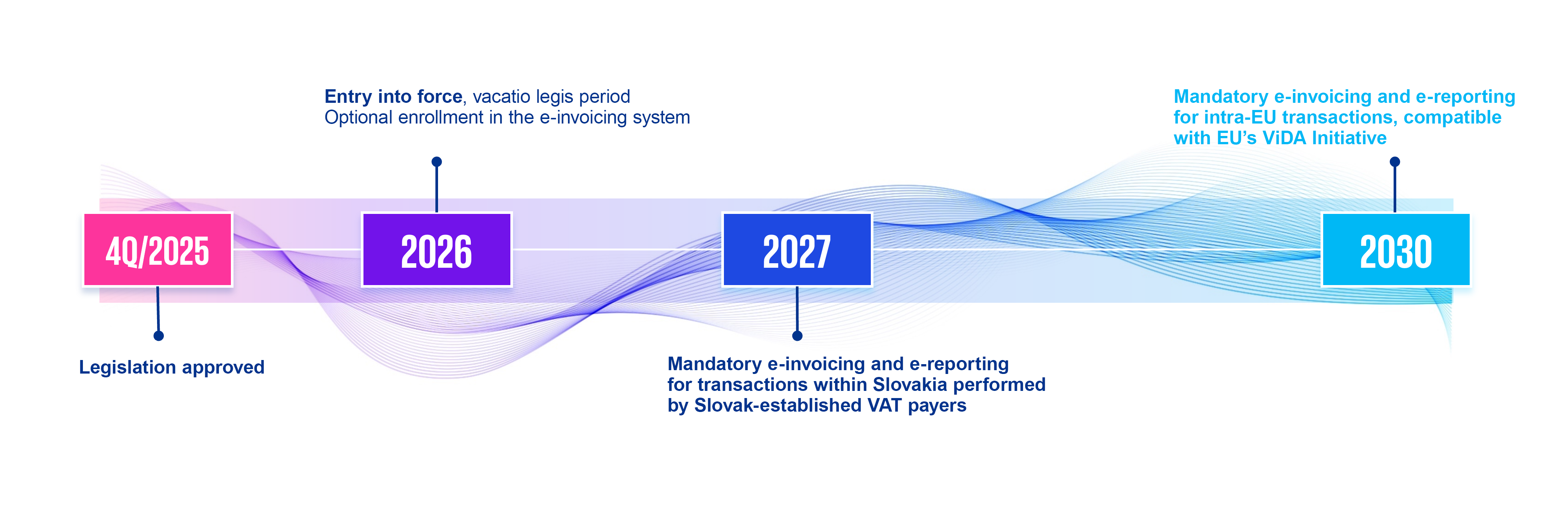
Timeline for implementing e-invoicing
- From 1 January 2027: Electronic invoicing will become mandatory for all VAT registered payers domiciled in Slovakia (including Slovak fixed establishments) for domestic taxable transactions. All recipients legally entitled to receive invoices must be able to accept them electronically.
- From 1 July 2030: The obligation will extend to cross-border EU transactions and transactions involving non-resident taxable persons, with the planned elimination of the VAT Ledger Statement and VAT Recapitulative Statement.
- Year 2026: Serves as a transition period for technical preparation, software updates, and testing connections with digital postmen. Voluntary implementation of electronic invoicing is possible.
Technological framework for e-invoicing
Invoices will be created, sent and received in structured XML format according to EN 16931, enabling automated and accurate data processing without manual entry.
Before launching electronic invoicing, companies must verify their readiness to create and receive invoices in Peppol BIS format, which defines the structure and rules for e-invoices within the Peppol system in line with the relevant technical standard.
It is also necessary to select a certified Peppol delivery service provider. The network includes certified „digital postmen“ who ensure secure and reliable electronic exchange of invoices between senders and recipients. Certified delivery services can be accessed via accounting software, web portals, or mobile applications.
Accounting and ERP systems will be able to automatically read and process data from electronic invoices without manual intervention. The new legal and technical requirements are expected to simplify administration, reduce errors and ensure smooth and secure information transfer.
How can we help you
Transitioning to mandatory electronic invoicing is not just a technical change. It combines legislative, tax and process adjustments. Our experts in tax advisory, financial transformation, and technology solutions will guide you through the full implementation process.
We monitor Slovak and EU e-invoicing regulations and guide you through compliance requirements. We help design processes in line with legislation, assist with VAT obligations, and prepare you for relevant regulatory changes.
We assist in selecting suitable solutions, integrating them with your existing accounting systems, and ensuring a smooth transition to electronic invoicing with minimal costs.
We offer tailored training for finance, accounting and IT teams. Your employees will gain practical knowledge and skills for day-to-day handling of electronic invoicing in compliance with current legislation.
Our experts support SAP system preparation, configuration, process adaptation, and thorough testing. The result is a reliable and seamless operation of electronic invoicing within your SAP environment.

Contact us
Should you wish more information on how we can help your business or to arrange a meeting for personal presentation of our services, please contact us.


