
Organisations are adopting artificial intelligence at a rapid pace, but the governance, oversight and testing processes needed to support it are developing more slowly. This is the central finding of AI Red Teaming in Practice: From Awareness to Action, a joint study by KPMG professionals and the MIT Sloan School of Management. The study examines how organisations use AI red teaming as part of their AI security programmes.
AI red teaming is a specialized, proactive, and continuous practice where experts simulate adversarial attacks against AI ecosystems to discover unique vulnerabilities and weaknesses, and test response and detection capabilities, aiming to ensure the security, fairness, transparency, trust, and robustness of AI models and algorithms.
More than half of respondents said their organisations were actively using, exploring, and piloting enterprise AI solutions. However, the authors found that relatively few organisations had implemented comprehensive governance and oversight mechanisms.

AI use is advancing faster than governance maturity
As enterprises rapidly adopt and embed AI into business operations, many are still evolving the governance, testing and lifecycle management capabilities required to support it. Key gaps include limited oversight of shadow AI, inconsistent testing practices, and immature lifecycle controls. These observations do not suggest a lack of interest in responsible AI. Rather, they highlight how quickly AI adoption has progressed relative to the organizational processes designed to govern it.
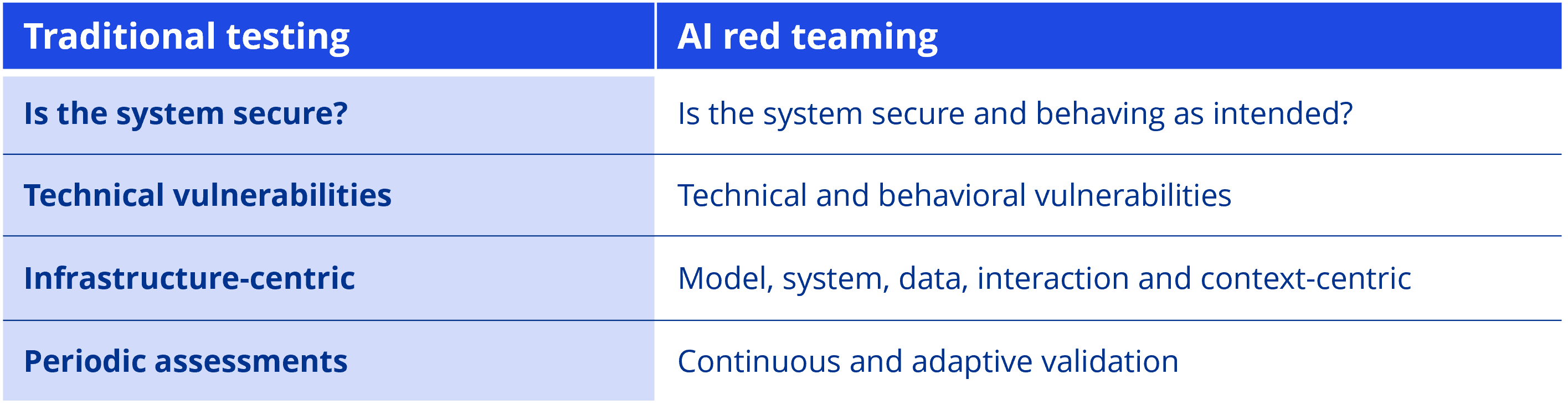
Traditional security testing practices are not equipped to fully address the specific risks associated with AI systems, the study says. These risks may include prompt manipulation, data poisoning, unauthorised extraction of data or models, and risks arising from the autonomous decision-making of AI agents. This is why AI red teaming is becoming increasingly important.
AI red teaming remains an emerging capability
The research found that the use of AI red teaming remains sporadic and fragmented, if it occurs at all. The authors describe current adoption as nascent and inconsistent. The main barriers include the early stage of AI adoption, limited expertise and resources, and reliance on third-party technology providers. Even among organisations that conduct AI red teaming, the scope and frequency of testing vary considerably. Testing often covers only a portion of AI systems and is more likely to be periodic than a continuous process embedded throughout development.
Regulation is enhancing the focus on AI testing and risk management
The growing regulatory focus on AI risk management is also reinforcing the importance of systematic testing. The EU AI Act sets out risk management requirements for high-risk AI systems, including testing. The study points to AI red teaming becoming increasingly integrated into broader AI governance and control frameworks.
Organisations will increasingly need to demonstrate that their AI solutions have undergone appropriate testing and that mechanisms are in place to prevent security, ethical and operational issues.
AI is changing the balance of power in cybersecurity
The study also highlights how AI is changing both the way cyberattacks are carried out and the way organisations defend against them. It creates new opportunities for protection but also expands the capabilities available to attackers. AI can increase the speed, scale and variability of attacks, support automated vulnerability discovery, and enable more targeted phishing and other forms of social engineering.
As AI adoption expands, so do the demands on organisations’ cybersecurity capabilities and their ability to identify and respond to emerging risks. Strong foundations are therefore essential, particularly in identity governance, system monitoring, vulnerability management, incident response and third-party risk controls.
About the study
AI Red Teaming in Practice: From Awareness to Action was produced by KPMG professionals and the MIT Sloan School of Management. The research examined how organisations approach AI security testing and the management of related risks. Data was collected from November 2025 to April 2026. The sectors most represented included higher education, healthcare and biotechnology, financial services and professional services.
AI Red Teaming in Practice: From Awareness to Action
More information is available in the full study


