Despite economic and geopolitical uncertainty and increasing regulatory pressures, CEOs remain optimistic. As many as 84% are confident in their organisation’s growth, up six percentage points from last year, according to KPMG’s latest global survey, the CEO Outlook 2026.
Businesses are strengthening their resilience
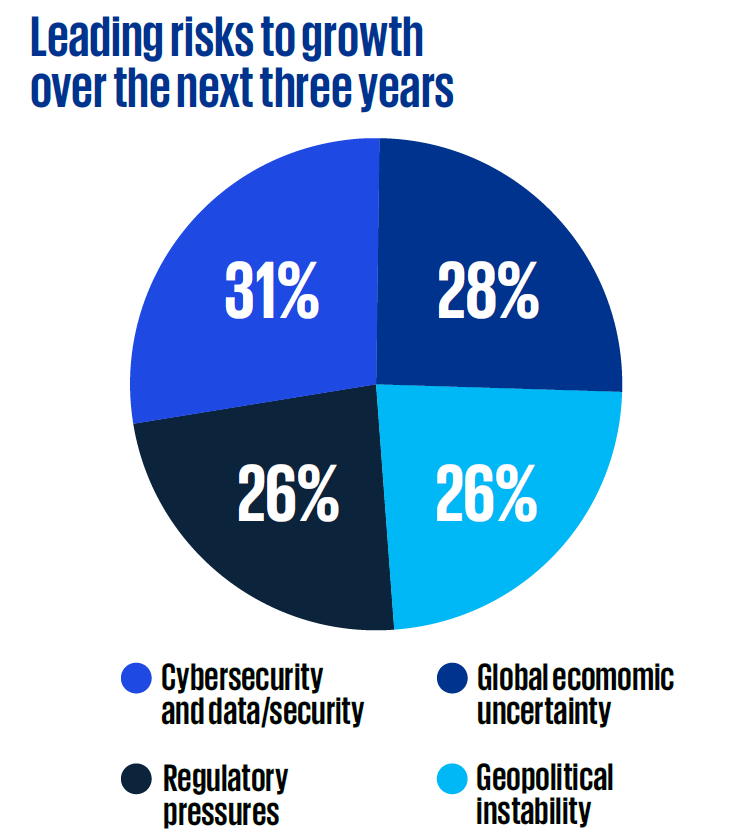
Despite high confidence in future growth, business leaders are navigating an increasingly complex risk environment, and their investment decisions reflect this. Almost half of CEOs (45%) have increased investment in cybersecurity and digital resilience, making it their top investment priority for mitigating business risks over the next three years. More than a third (36%) are also investing in regulatory and compliance reporting.
While the majority of leaders (61%) are maintaining their current risk appetite, a third are reassessing their approach. While 16% of CEOs are prepared to take greater risks to capitalise on new opportunities, 17% are taking a more cautious approach. Geopolitical developments and growing regulatory requirements are also playing an increasingly important role in companies’ decision-making.
Source: KPMG Global CEO Outlook 2026

AI remains a key investment priority
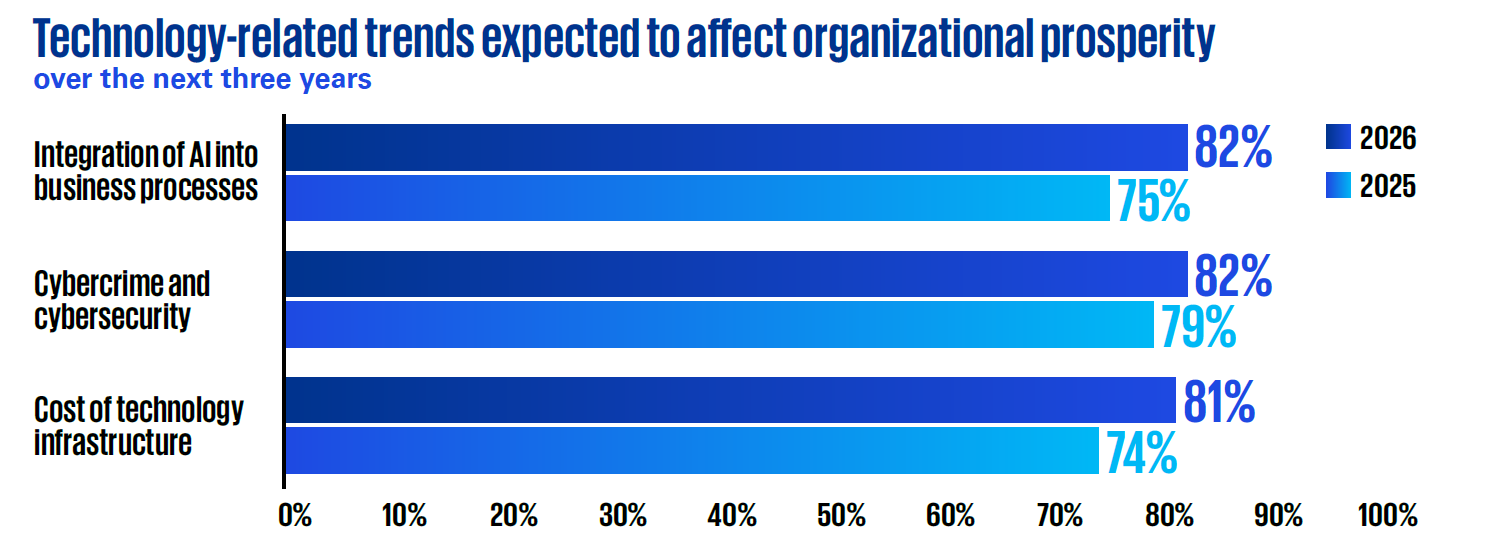
Artificial intelligence continues to strengthen its position among businesses’ strategic priorities. Despite ongoing economic uncertainty, 79% of CEOs agree that driving value through AI remains a top investment priority for the next three years, an increase of eight percentage points compared with 2025.
Most leaders also take a positive view of their organisations’ progress on AI. Two-thirds (66%) say they are moving at the right pace or are ahead of the curve. A further 29% are cautiously optimistic and learning as they go, while only 5% say they are struggling to keep pace.
However, accelerating AI adoption also brings new challenges. In addition to ethical considerations around AI implementation, cybersecurity and rising costs, businesses must navigate an evolving regulatory landscape. As many as 41% of CEOs see varying levels of regulation as a barrier to implementing AI within their organisations, while two-thirds expect the pace of progress on AI regulation to pose a barrier to their organisation’s success. In response, 59% of CEOs are increasing their focus on internal data governance controls as part of their AI and data sovereignty strategies.
Source: KPMG Global CEO Outlook 2026
Expectations of employees and leaders are changing
Technological transformation is also changing the skills businesses need. Skills gaps were identified by 56% of CEOs as their biggest workforce challenge, followed by upskilling and training employees in AI systems (52%) and attracting and retaining talent (47%). Businesses are therefore looking for ways to prepare their people for change, with more than half of leaders saying they are having open conversations about what the future of work will look like.
However, these changing expectations do not apply only to employees. The role of leaders themselves is also evolving. For the second year in a row, CEOs identified greater agility and faster decision-making under pressure as the most important leadership capability, cited by 47% of respondents this year. This is followed by stronger strategic foresight and scenario planning capabilities (44%) and the ability to identify, prioritise and manage risks (39%). More than a third of CEOs (36%) also see digital and technology literacy as an increasingly essential leadership capability.
AI as both a climate challenge and an opportunity
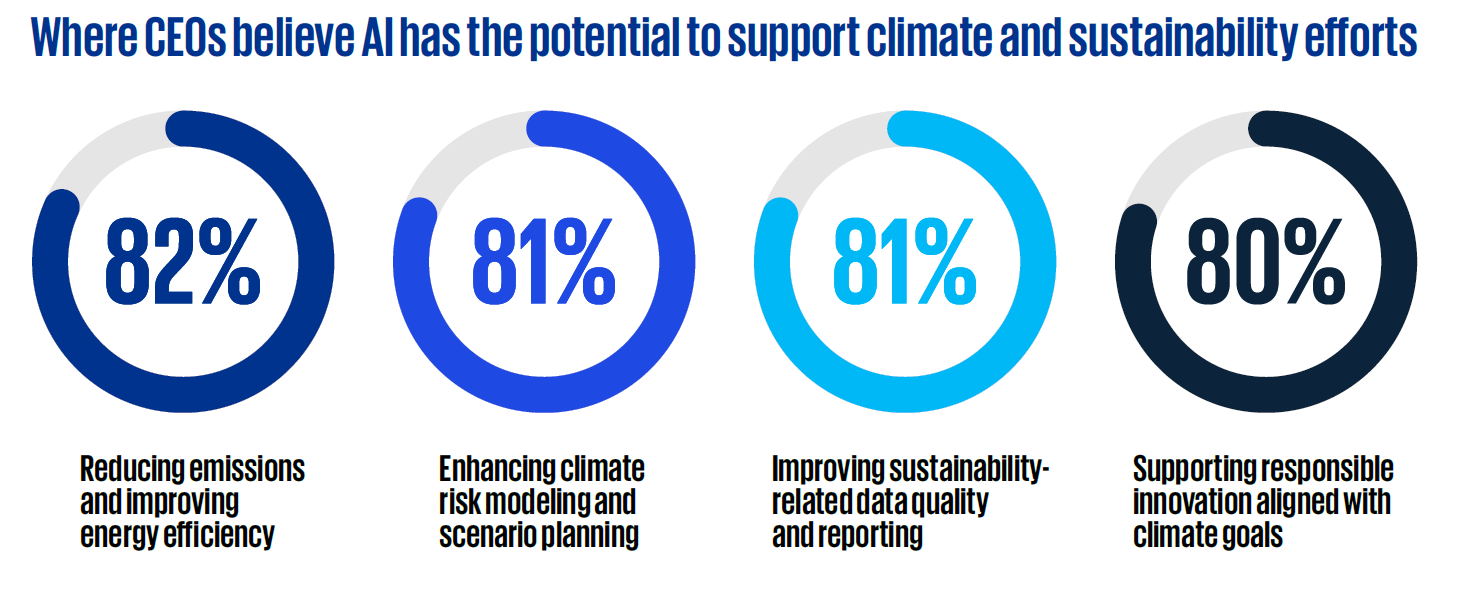
The rapid growth of AI is also creating a new paradox when it comes to sustainability. As many as 95% of CEOs agree that there is concern within their organisations about the environmental impact of increased AI usage. At the same time, leaders see significant potential for AI to help address environmental challenges.
As many as 82% of CEOs believe AI can help reduce emissions and improve energy efficiency. A further 81% believe it can improve the quality of sustainability-related data and reporting, while the same proportion see potential for AI to enhance climate risk modelling and scenario planning.
However, significant barriers remain on the path to carbon neutrality. Leaders most frequently cite the complexity of decarbonising supply chains, increasing but inconsistent regulatory requirements across jurisdictions and the higher costs associated with decarbonisation.
Source: KPMG Global CEO Outlook 2026
About the survey
The KPMG CEO Outlook 2026 is the 12th edition of the global survey exploring the perspectives, strategies and priorities of CEOs. Conducted between 11 August and 21 September 2026, the survey gathered insights from 1,400 business leaders across 12 major global markets and 13 key industries. Respondents represented companies with annual revenues of more than US$500 million.