Regulators and industry continue to be challenged by implementation of the EU Taxonomy Regulation — the dictionary of what is environmentally sustainable (the E in ESG) — and the drafting of further detailed rules to underpin it. Firms and customers seek further clarity around disclosures and how to assess the sustainability credentials of potential investments. At global level, the work of the new International Sustainability Standards Board (ISSB) on climate change reporting standards is underway, and the UK continues to develop its own green taxonomy.
Meanwhile, initial policy work on defining “socially sustainable” (the S in ESG) suggests that an “S” Taxonomy will present even more challenges than the “E”. S objectives may prove more difficult to draft and agree, quantitative measures will need to be formulated from scratch in many areas, and the availability and reliability of the data needed to calculate those measures are largely absent at present. It is recognised that S factors can be the most difficult to analyse and embed in investment strategies.
There is also a fundamental question about how the S Taxonomy will sit with the E Taxonomy. For example, the closing of heavily-polluting industries, while helping the achievement of E objectives, can have a negative impact on workers and local communities, at least in the short term. And will there be one combined disclosure on taxonomy-alignment, or two separate disclosures, or a dashboard approach? A recent report by the EU Platform on Sustainable Finance (Platform) describes these and other challenges, and paves the way for a legislative proposal from the European Commission.
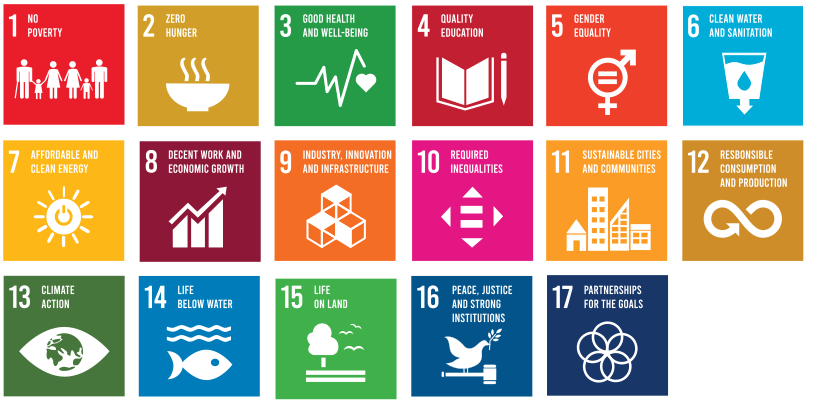
Despite the considerable challenges, there is strong political will behind an S Taxonomy in the EU, in part due to the impact of COVID-19. According to the UN Sustainable Development Goals 2021 report, the pandemic reversed much of the progress made previously, with extreme poverty rising in 2020 for the first time since the Asian financial crisis of the late 1990s. Projections suggest that the global poverty rate will be 7 per cent (approximately 600 million people) by 2030, unless “immediate and significant” action is taken. Other indicators, for example around hunger, health, education and gender equality have also declined.
It is essential that the financial services industry and other interested stakeholders join the social taxonomy debate at this early stage to help policymakers move towards requirements that are operationally workable and result in meaningful disclosures for investors and customers.