

A tracked four-year progress of WealthTech developments from 2017 to 20211 by Endowus and KPMG has unveiled Singapore’s mettle when it comes to capturing Asia’s growing wealth. Local WealthTech venture funding hit more than US$161 million in 2021 - while slightly less than the record-high in 2020, which saw WealthTech venture funding hit US$164 million, it represented a seven-fold increase from just US$23 million in 2017. This surge drastically outpaced the corresponding three-fold increase seen globally (from $2.63 billion to $8.8 billion) and Asia’s two-fold increase (from $1.1 billion to $2.2 billion) in the same period.
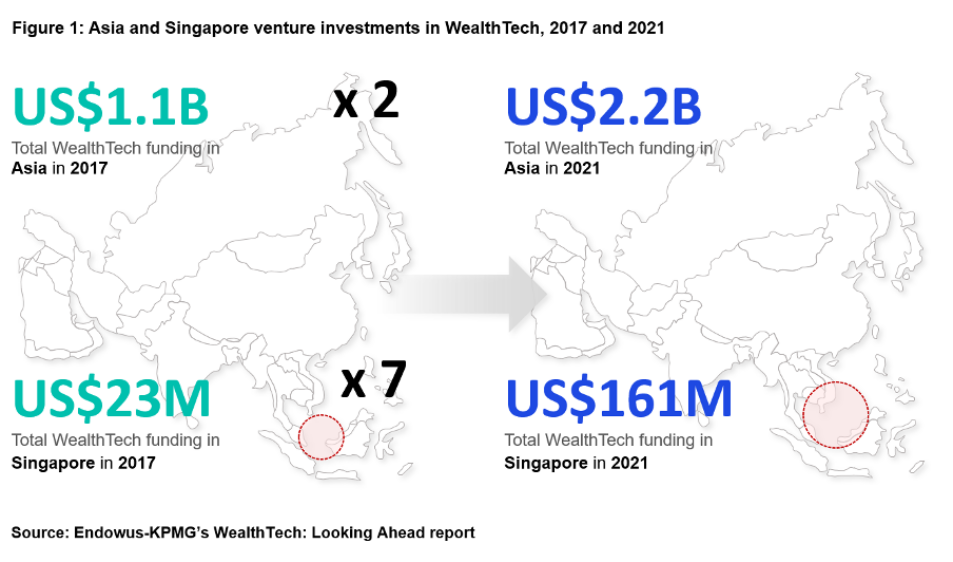
The Endowus-KPMG WealthTech: Looking Ahead report also noted that the key to the growth of WealthTech funding in Singapore was the rise of prominent WealthTech players providing online investing tools and digital advisory capabilities. This upward trend came in response to the rapidly growing pool of High-Net-Worth-Individuals (HNWI) and Ultra-High-Net-Worth-Individuals (UHNWI) which rose by 126 per cent and 158 per cent respectively between 2016 and 2021. The inflow of wealth from other leading hubs in Asia was boosted by a robust ecosystem for innovation and fintech development attributed to strong government support and the established reputation of Singapore as a global financial hub.
Launched at the Endowus WealthTech Conference – a hybrid event which saw the participation of more than 2500 delegates virtually and in-person, the WealthTech: Looking Ahead report provides an analysis of the WealthTech landscape in Asia, perspectives from industry leaders across the WealthTech space and the trends which are shaping wealth management.
Anton Ruddenklau, Partner & Global Head of Fintech at KPMG International said, “WealthTech is relatively young in Singapore, with key players in the space sprouting up in the mid to late 2010s. Through combining contemporary technologies with a digital-first experience, they have brought new models that embed wealth management into daily lifestyles and empowered the average layperson that traditional wealth management had mostly left out. Aligned with this is a generational shift in consumer behaviour, where the Gen Z demographic are truly digitally native and concerned about their current and future well-being. WealthTech firms that are able to scale services and products to address the mass affluent while creating a secure, intuitive and customised experience will be the frontrunners in redefining the future of wealth management.”
Samuel Rhee, Chairman and Chief Investment Officer of Endowus said, “While uncertainties may remain given the current macroeconomic conditions, we anticipate massive growth opportunities for the WealthTech sector. There is a unique opportunity for WealthTech players to transform and reform the current state of the wealth management industry to improve outcomes for all clients regardless of demographics and wealth levels. Technology can enable and accelerate great improvement in advice, access and cost -- the three pillars of success in building long term wealth. Greater transparency, alignment and personalisation of wealth services are needed to meet the increasingly sophisticated demands of investors. I foresee greater excitement around new and emerging WealthTech players as they penetrate deeper into services and client segments that previously had little or no digital adoption.”
Asia driving significant share of wealth growth across the globe; high-net-worth and ultra-high-net-worth individuals (HNWI/UHNWI) continue to bring opportunities
Globally, wealth management is witnessing tremendous growth opportunities contributed by a combination of factors including growing household and entrepreneurial wealth, intergenerational wealth transfer and underfunded retirement savings.
Asia has come out tops with the highest five-year growth rate in financial wealth at 68 per cent, amid massive wealth creation in recent years. This is compared with 26 per cent in Europe and 55 per cent in North America. Unsurprisingly, venture funding to WealthTechs headquartered in Asia grew to over US$2.2 billion in 2021, constituting a quarter of total global WealthTech venture funding. The region is forecast to overtake Europe as the world’s second largest wealth hub by 2026, with both HNWI and UHNWI populations expected to grow at the quickest pace compared across all regions.
In particular, Singapore has seen its pool of HNWI and UHNWI grow by 126 per cent and 158 per cent respectively between 2016 and 2021. Driven by a perceived outlook of increased political stability, the country is also seeing further inflow of wealth from other leading Asian hubs and is the third largest wealth centre globally, having amassed over US$1.5 trillion in cross-border wealth in 2021.
A survey of more than 600 private bankers, wealth advisors, intermediaries and family offices found that 49 percent cited wealth transfer to the next generation as a key opportunity. As HNWI and UHNWI families in Asia are relatively young – led by first- or second-generation individuals, succession planning will become increasingly important as these families grow. COVID-19 has also served as a key trigger event for families to act on their wealth transfer plans. The large transfer of wealth across generations will drive innovation and development of unique wealth management solutions.
Singapore a prime location for WealthTech startups and venture capital inflows
With its political stability, tax incentives and a supportive regulatory environment, Singapore has positioned itself as a key wealth management hub both regionally and globally. Along with a promising outlook on wealth management, Singapore also has a well-established IT infrastructure in place and the general population is tech-savvy and attuned to digital applications as part of their lifestyles. Singapore’s readiness as an innovation and financial hub is nowhere more apparent than during the COVID-19 driven fintech funding boom in 2020 and 2021.
Early-stage and late-stage average venture deal sizes in Singapore each surged to a record-high of over US$15 million in 2021, indicating boosted investor confidence in the Singapore WealthTech venture ecosystem. This increase in average early-stage deal size was partly attributed to US$44 million raised across two venture rounds by Endowus, one of the largest digital wealth platforms in Singapore that spans both private wealth and public pension savings ((Central Provident Fund (CPF) and Supplementary Retirement Scheme (SRS)).
WealthTech venture deals here have also begun to shift from angel and seed to early-stage deals, with angel and seed deals decreasing from a 60% share of all deals in 2017 to 39% in 2021. As the city state cements its position as a global wealth hub in the coming years, more firms are expected to move into late-stage venture funding and receive mega-round fundings (of over US$100 million).
Accelerated digitalisation and changing customer preferences give voice to underserved mass affluent
High rates of internet penetration in Asia, especially in Singapore, have led to an increase in the adoption of digital financial services. This has made wealth management products accessible to the large and growing middle-class population at lower costs. In an Endowus Wealth Insights report2 which captured the responses of 680 Singapore respondents, it was noted that digital investment platforms are popular among respondents, with 90% of them currently using digital wealth platforms and robo-advisors, and 74% of them currently using online brokerages. Comparatively, only 1 in 5 respondents are tapping the services of traditional financial advisors, while 1 in 4 noted that they are using the investment services offered by banking institutions and traditional brokerages.
With a preference for investing digitally, this new generation of investors also has greater access to information, driving them to desire not only more sophisticated products, but also greater control over their investment portfolio. Clients with relatively smaller investment capital, which had not been considered highly important by wealth managers, now collectively form a key potential market.
The challenge in serving this segment lies with effectively scaling investment offerings at mass, balancing low costs to remain competitive whilst retaining a high-level of service levels and diversity in products expected by these investors. Additionally, these clients are expecting greater pricing transparency. For a long time, pricing approaches in wealth management firms have remained obscure. Some robo-advisors have directly addressed the issue of the lack of transparency by charging investors an “all-in” access fee, which is typically a percentage of the total value of their assets managed by the platform. Increasingly, investors are empowered with the knowledge of how much and what they are paying for.
Demand for digital assets and ESG products will shape offerings
An increasing number of investors, especially among the younger generation of millennial and Gen Z investors, want to play their part in creating a more inclusive and sustainable world. The report indicated that in a survey of millennials, more than 85 per cent indicated interest in climate-related investments. This insight corroborates with findings from a separate survey conducted by Endowus last year. While the concept of Environmental, Social and Governance (ESG) investing to do both good and gain returns resonates with over 93 percent of respondents, only 28 percent currently hold any ESG funds.
As a result, priorities are shifting from purely maximising financial returns to other qualitative considerations such as “impact”, “purpose” and “sustainability” when formulating investment strategies. With ESG investing quickly moving from being niche to mainstream, there is an urgency for wealth managers to be agile and adaptable in meeting investor demand by providing access to ESG products, reporting tools and capabilities.
Digital assets, such as cryptocurrencies and non-fungible tokens (NFTs), also continue to be an asset class with strong consumer interest among both institutional and retail investors. The report showed that 91 per cent of respondents in a survey conducted in June 2022 indicated an intention to purchase crypto in the second half of 2022. Despite market volatility and the onset of the crypto winter, wealth managers are cautiously expanding their offering of digital assets to anticipate forward demand. To safeguard consumer interest and build investor confidence in the digital assets industry, regulators have also commenced on building regulatory frameworks around digital assets, particularly crypto activities, to ensure that these activities are conducted in a safe and secure manner.
Other key findings of the report include:
- Digitalisation will continue to increasingly shape investor independence and autonomy, as it empowers the ‘man on the street’ with the required investment tools. Free access to information will subvert the role of the traditional advisor, as investors place less reliance on paid advice given greater financial literacy and changing lifestyle preferences.
- The ability to effectively leverage artificial intelligence (AI) and data analytics in delivering personalised insights and recommendations based on individual needs and preferences will be a key differentiator for wealth managers in capturing market share moving ahead.
- Tokenisation will become widely adopted to offer niche products to retail investors. More partnerships between wealth managers and asset managers to increase accessibility to niche products can be expected.
- Privacy and cyber-security concerns will become an increasingly important factor in choosing between wealth managers; building trust by addressing these concerns will be vital.
1Only full year data were taken into consideration. Hence, year 2022 data has been excluded from this report
About KPMG
KPMG in Singapore is part of a global organisation of independent professional services firms providing Audit, Tax and Advisory services. We operate in 144 countries and territories with more than 236,000 partners and employees working in member firms around the world. Each KPMG firm is a legally distinct and separate entity and describes itself as such. KPMG International Limited is a private English company limited by guarantee. KPMG International Limited and its related entities do not provide services to clients.
For more information, visit KPMG in Singapore's website or LinkedIn
About Endowus
Endowus is Asia’s leading fee-only wealth platform. Licensed by the Monetary Authority of Singapore and Securities & Futures Commission of Hong Kong, Endowus is the first digital advisor in the region to span both private wealth (Cash) and public pension savings (CPF & SRS in Singapore), helping investors grow their money with expert advice and access to institutional financial solutions at low and fair fees, through a personalised digital wealth experience.
Founded in 2017, Endowus has raised a total of S$67 million in funding from investors such as UBS, EDBI, Prosus Ventures, Z Venture Capital, Samsung Ventures, Singtel Innov8, and global leading venture capital firms Lightspeed Venture Partners and SoftBank Ventures Asia. As of August 2022, Endowus has more than S$2 billion in assets under advice.
Endowus’ leadership and growth have been recognised by the industry and it has attained numerous awards including , Singapore’s Fintech Innovation in Asset Management, CEO of the Year, CIO of the Year (Asia Asset Management’s Best of the Best Awards 2022), Singapore’s Fintech Startup of the Year (The Asset Triple A Digital Awards 2022), and WealthTech of the Year (Asia FinTech Awards 2021). Endowus is also one of the firms named in Forbes’ “100 to Watch” list for 2022 and LinkedIn Top Start-ups 2021.
For media enquiries, please contact:
Jeanie Lee
Associate Director, Marketing & Communications
KPMG in Singapore
Email: jeanielee@kpmg.com.sg
Edmund Quek
Associate Communications Manager
E: edmundquek@kpmg.com.sg