Challenges From All Angles

      The manner in which firms meet their Know Your Customer (KYC) obligations has grown more complex and difficult to manage over the years. This is often compounded by the addition of more controls or process layers with increased programmatic complexity over time. Firms are expected to keep up with a regulatory landscape that expects them to remain compliant with everchanging regulations. In addition, there are increasing expectations and complex criminal threats in an evolving social, environmental, and economic climate, as outlined in Financial Crime: A Paradigm Shift1. Simultaneously, firms battle rising labor costs, pressure to reduce overhead, and inconsistent supply of publicly available information. Firms need a more strategic approach to meet regulatory expectations and navigate these internal and external pressures and perpetual KYC (p-KYC), a dynamic approach to risk management, can help firms do just that!


      A More Dynamic Approach to KYC PDF

      A more dynamic approach to KYC


      What Is p-KYC?

      P-KYC may also be called “Continuous KYC” or “Dynamic Customer Due Diligence (CDD)".

      Industry leaders have vastly different opinions on how to define p-KYC, leaving some compliance professionals confused as to where to begin. It is critical to break through that confusion and demystify the approach firms can take to shift towards p-KYC. P-KYC is an innovative, proactive, and ongoing approach to KYC which moves away from conducting traditional, often considered burdensome, periodic reviews on set schedules, in favor of real-time refresh of information. This approach uses data to drive decision-making and form an updated understanding of customer risk. P-KYC is an attractive option for firms navigating the evolving financial crime landscape with an interest in new technologies that are increasingly considered viable options by regulatory authorities and a need to reduce costs. Implementing aspects of p-KYC allows firms to gain a heightened understanding of customer risk profiles and improve operational efficiency. This in turn can drive improved customer experience and a more meaningful Return On Investment (ROI).


      Small Steps Make Big Changes

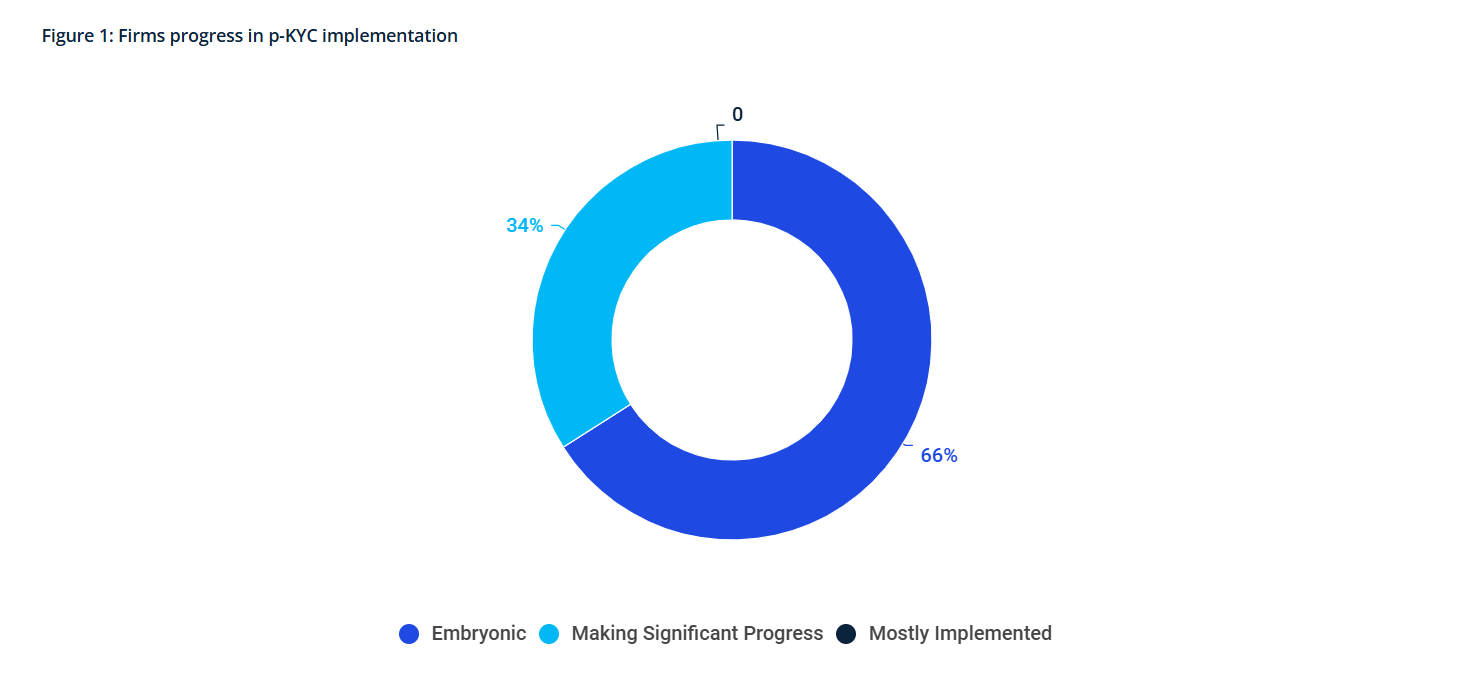
      Many firms have already embarked on a p-KYC transformation journey, whether they fully realise it or not. A survey by 1LoD2 shows that two-thirds (2/3) of firms indicate they are in the embryonic stage, while the other one-third (1/3) indicate they are making significant progress in p-kyc implementation, as seen in Figure 1. Notably, no firms in the survey self-identify as having “mostly implemented” p-KYC processes.


      Although, the results of the survey highlight that most companies have not yet committed to investing in a p-KYC transformation, many organisations are focused on enhancing their KYC processes with varying levels of transformation. At this stage, it is important to be strategic and formulate a road map to get you where you want to go.


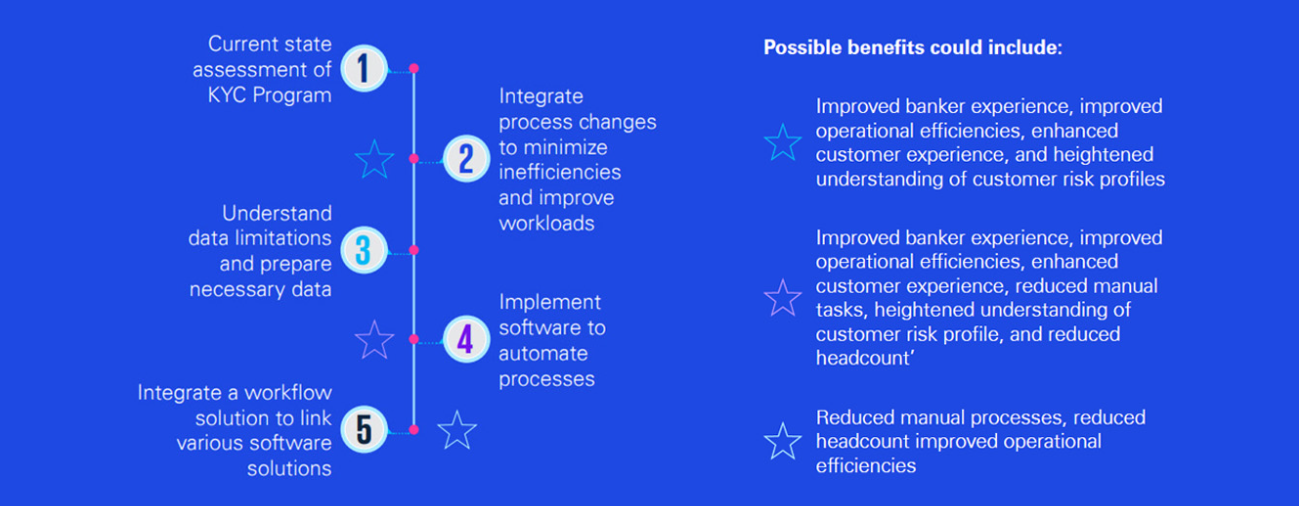
      Figure 2: A Journey Towards P-KYC

      P-KYC can present itself as a spectrum of solutions to provide both short-term and long-term positive outcomes, as shown in Figure 2. A tactical initial step for a firm to undertake is a holistic program review and current state assessment to identify redundancies and consider solutions which could streamline processes, utilise available data and systems more efficiently, and provide a better experience for customers. This allows firms to begin p-KYC integration, while not necessarily requiring the implementation of complex technical solutions and a big financial investment on day one.

      After opportunities for improvement are identified and processes enhanced, technology solutions can be contemplated to support operations more effectively. Technologies can provide the ability to automatically verify documents upon customer onboarding, perform negative news related searches and sanctions screening, automatically update global watchlists, or even perform aspects of trigger-based KYC. These solutions can allow firms to integrate automated processes yet minimise the costly upfront investment. Once a firm has optimised processes and adopted relevant technology solutions, a workflow solution can enhance the connectivity between various elements of a KYC program. In practice, this can look like automated customer verification upon onboarding, a customer due diligence program leveraging artificial intelligence to make decisions, an automated risk scoring mechanism, and periodic reviews completed based on risk scores, all with minimal human touch points.


      Allow your journey through p-KYC to begin one step at a time in the timeframe that works for you.


      Don’t Make Data Your Roadblock

      Technology plays a key role in most p-KYC transformations, and it is critical to carefully examine technology solutions to help prevent conflict with data restrictions and provide the functionality desired. Transitioning to p-KYC can be daunting, especially when considering issues and limitations with data quality and availability. A recent poll4 of industry professionals indicated that 43% of firms struggle to source the right data and 24% indicated that forming a robust and comprehensive view on customer profiles is their toughest challenge. To meet these issues head on, firms should strive to have a keen understanding of what data exists, what data they need, and how they can use data they already have more effectively.

      It is important to recognise there is no “one size fits all” solution, and solely relying heavily on data-driven approaches can pose its own problems. For example, some approaches to p-KYC are designed to capture a seemingly infinite amount of data; however, the collection of more data is not necessarily better and often exposes firms to more risk if they are not understanding and/or using that data appropriately.


      Collect the information you need to manage risk, but not so much that you create additional risks.


      The Final Destination

      Approaches to p-KYC will continue to evolve based on regulatory changes and trends, as well as the development and improvement of technology solutions; however, one thing is certain – traditional methods to combat emerging financial crimes trends are a losing game, as outlined in Reimagining of Know Your Customer (KYC)5. Firms should approach p-KYC in a risk-based, flexible, dynamic, and holistic manner, focusing on individual tasks and outcomes that simplify KYC activities, which will make the implementation easier to plan and execute.

      A well-manicured KYC program with elements of p-KYC can allow firms to achieve better ROI, reduce risks of human decision making or oversight, minimise the amount of client touchpoints, and provide real-time intelligence on high-risk customers. Successful p-KYC transformations can allow firms to better understand customer risk and how it is changing in real-time. This transition will happen at different intervals for every firm, but this paradigm shift will more likely be seen to a greater extent over the next five (5) to ten (10) years and have impacts globally across the financial services industry. Looking ahead, firms should take care to understand their current KYC processes and tools, evaluate where they have room to improve and appetite to innovate, and consider short-and long-term steps to move their organisations further along the p-KYC journey.


      1. Source: KPMG LLP US, “Financial Crime: A Paradigm Shift” (November 2022).
      2. Source: The Financial Crime Summit, “Must Do Better: A Financial Crime Scorecard” (April 19, 2023).
      3. Source: The Financial Crime Summit, “Must Do Better: A Financial Crime Scorecard” (April 19, 2023).
      4. Source: The Financial Crime Summit, “Must Do Better: A Financial Crime Scorecard” (April 19, 2023).
      5. Source: KPMG LLP US, “Reimaging Know Your Customer (KYC)” (2023).

      Our people

      Feargal De Burca

      Partner, Financial Services Consulting

      KPMG in Singapore