

      Industry clouds are a growing trend among businesses, but what exactly are they? In short, they allow businesses operating in the same sector to share capabilities, products, tools and data to address hard-to-tackle vertical challenges.

      The emerging technology offers industry players a more agile way to manage workloads and accelerate change — speeding up time to value, while enhancing flexibility, efficiency, resilience, business value and competitiveness.

      We regularly see clients building bespoke solutions, rather than leveraging pre-tailored optimised industry-specific components and services. Industry clouds help seize this opportunity to shift businesses to an integrated model. One that can improve access to data storage, drive business agility, build networking opportunities and increase security. 
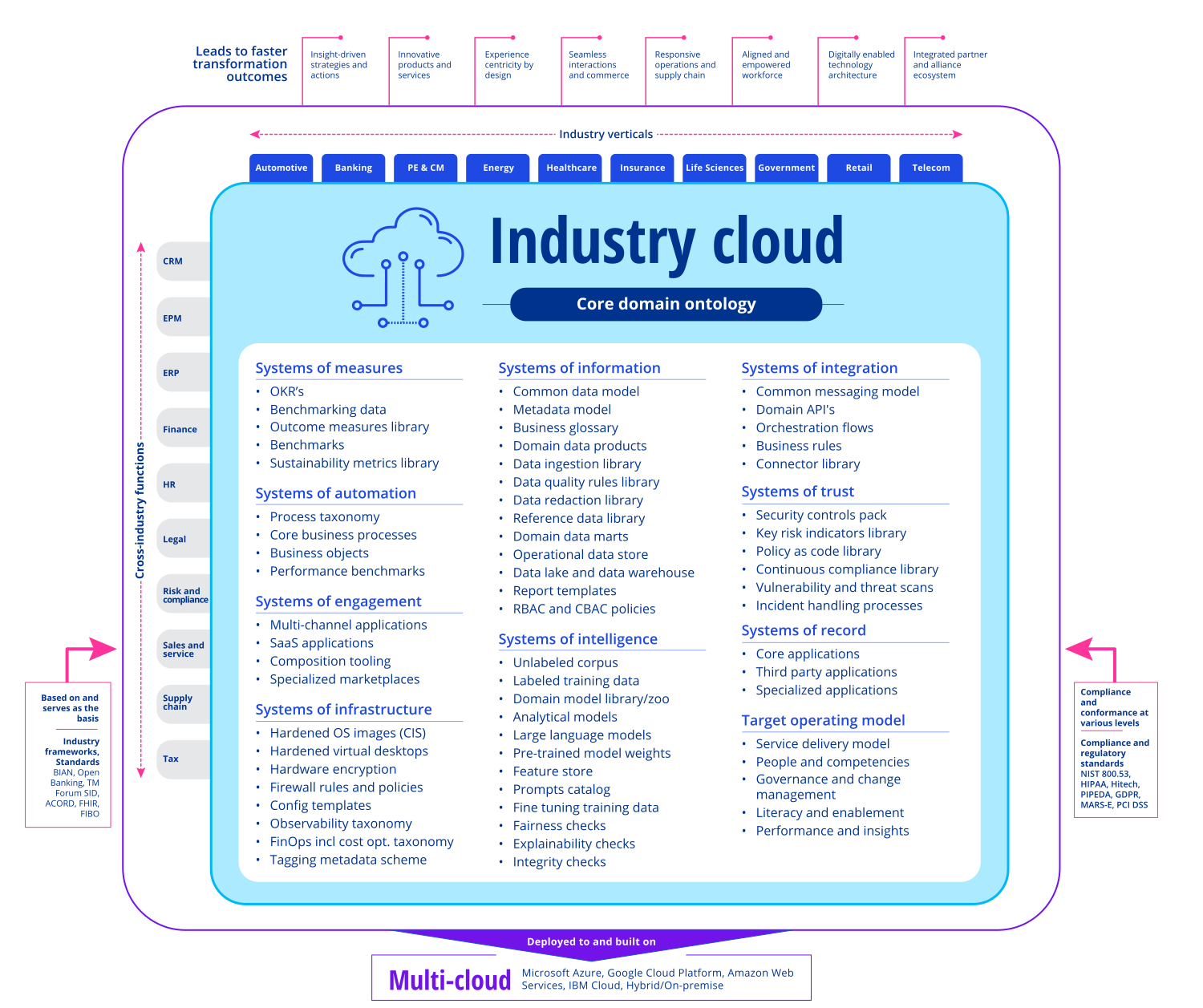
      What makes up an industry cloud?

      Industry clouds are a specialised and optimised set of cloud services, applications and related cloud tools and resources, designed to meet the specific needs of a particular industry or function. They can bring multiple aspects of technology and operating models together, offering an approach that’s designed to move the entire business forward.

      Industry cloud platforms turn a cloud platform into a powerful business platform, enabling technology-innovation tools to also serve as powerful business-innovation tools.

      Moving to these platforms offers a breakthrough opportunity to drive business advantage by capturing the best of two worlds: exploiting economies of scale via outsourced commodity functionality, while preserving the system, services and processes that make your business unique and achieve measurable outcomes.

      Calibrating just how much vertical expertise is enough is a critical challenge for industry clouds. The key is finding the sweet spot between exploiting the advantages of ‘lifting and shifting’ your technical infrastructure to the cloud, while accommodating your organisation’s unique and proprietary needs.

      Below is a representation of what makes an industry cloud:


      Build and scale with industry clouds

      Getting a vertical cloud implementation right and deploying it efficiently and cost-effectively requires more than business acumen and sector-specific savviness.

      Beyond technology and tailored vertical industry solutions, there are regulatory considerations, strategy considerations, processes and data models unique to your business that must be incorporated to make an industry cloud solution work as designed. 

      Key considerations for a successful industry cloud shift:

      • Strategic industry cloud implementation should ideally position you to evolve and innovate critical capabilities, optimising and scaling technology and the business operating model on a continuous basis. This includes integration of various applications, application programming interfaces (APIs), payment systems, operations and trading partners for internal and external use. For example in the banking sector, this represents a modern open banking framework. A set of accelerators that help set up, integrate and comply with PSD2/PSD3 (a.k.a open banking in Europe) regulations will help banks achieve this regulatory milestone much faster than building it bespoke for each bank.
      • Implementing competitive new products and services is pivotal to business growth and industry clouds pave the way, enabling organisations to accelerate speed to market with new products and services that enhance the customer experience. Companies in many cases are moving to these products on Software-as-a-Service (SaaS) or Platform-as-a-Service (PaaS) platforms, adopting pre-built cloud native solutions while relying less on legacy applications running on Infrastructure-as-a-Service (IaaS) or containers.
      •  IT modernisation and optimisation via industry cloud promises: better monitoring and management of risk and regulatory pressures; hardened infrastructure; improved resilience; increased availability of operational data; application portfolio modernisation; and enhanced business value.
      • A modern technology stack and capabilities via IaaS, PaaS and other game-changing services can take efficiency, security and value to a new level while simplifying IT management and enabling automation.

      What's next?

      The potential benefits and competitive advantage that businesses stand to gain from industry clouds are clear. But harnessing and tapping into the full potential of industry clouds requires a well-developed plan.

      Our professionals are helping many enterprises build a realistic and achievable roadmap to this journey. We can help you create a modern strategy that considers the trade-offs and supports you in achieving the outcomes that are right for your business.

      In today’s hypercompetitive global environment, where the pace of change continues to accelerate, we believe there is no time to lose in keeping your head in the clouds.


      Related content

      Cybersecurity considerations 2023

      Towards a secured digital future
      abstract 3d structure

      Our People

      Eddie Toh

      Partner, Cyber, Advisory and Head of Forensic Technology, Asia Pacific, Advisory

      KPMG in Singapore


      Connect with us

      KPMG combines our multi-disciplinary approach with deep, practical industry knowledge to help clients meet challenges and respond to opportunities. Connect with our team to start the conversation.