


      AI has the power to transform business—but also raises challenges around ethics, security, privacy and regulation.

      At KPMG, trust is at the core of everything we do. We believe AI should be developed and used responsibly, with transparency, integrity and respect for its impact on people and society.
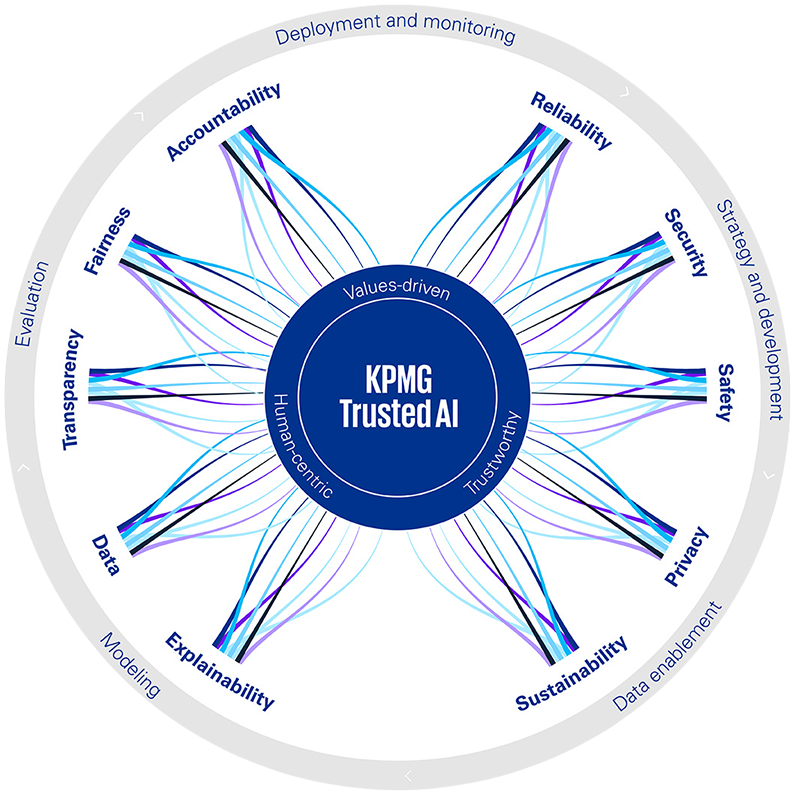
      KPMG Trusted AI Framework

      Across KPMG member firms, our approach to artificial intelligence includes foundational principles that guide our aspirations in this space, demonstrating our commitment to using it responsibly and ethically:

      • Values-driven

        We implement AI guided by our values and ethical standards.

      • Human-centric

        We prioritize human impact and aim to augment human capabilities.

      • Trustworthy

        We ensure ethical data use, privacy protection and regulatory compliance.

        We recognize that AI is evolving rapidly—and so is our approach.


      How we drive the KPMG Trusted AI ethical pillars into practice

      AI systems should perform consistently and at the desired state of precision within their intended scope.

      AI systems should be managed across the AI lifecycle in a manner that safeguards against bad actors, misinformation or adverse events.

      AI systems should be managed across the AI lifecycle in a manner that safeguards against harm to people, business, property and societal well-being.

      AI systems should be managed across the AI lifecycle to comply with applicable privacy and data protection legal requirements.

      The use of AI systems across the AI lifecycle should be warranted by their purpose, and they should be designed to optimize energy efficiency and minimize carbon emissions.

      AI systems should provide an understandable explanation for their output, actions, or decisions across the AI lifecycle, with that explanation being appropriate to the use case, context and audience.

      Data used in AI systems across the AI lifecycle should be acquired and handled in compliance with contractual obligations, applicable laws, and regulations, and assessed for accuracy, integrity, completeness, relevance and quality.

      Across the AI lifecycle, AI systems should include reasonable disclosures so stakeholders are informed when they are interacting with AI, content was AI-generated, or a decision was influenced by AI.

      AI systems should be managed across the AI lifecycle to mitigate bias and promote inclusive engagement for all people.

      AI systems should be governed across the AI lifecycle with appropriate levels of human oversight, upholding standards of professional responsibility and quality.


      Trusted AI Services

      troubleshoot

      AI Risk Assessment

      • AI model risk assessments
      • Policy and framework development
      transform

      AI Risk Transformation

      • Governance models
      • Lifecycle monitoring
      content_paste

      AI Regulation and Compliance

      • Regulatory alignment
      • Continuous monitoring

      Insights

      Discover our research and insights and explore trends, facts, and inspiration to support you in each decision-making process.

      Discover how AI and technology are transforming organisations with confidence.


      KPMG applies artificial intelligence ethically and strategically to generate business value. Explore our intelligent solutions for your business.

      We support companies in their digital transformation with robust technological solutions. Explore our vision for the digital future.

      Solutions for the financial sector with a focus on regulation, risk, and innovation. See how we support the transformation of the sector and what services can help your business.

      Welcome to the KPMG knowledge base of research that demonstrates KPMG professionals' understanding of complex business challenges faced by organizations around the world.


      Want to identify AI opportunities?

      Speak to KPMG to explore how AI can support your organization.