The pressure on financial institutions (FIs) and retailers to modernize payment systems and infrastructure is immense. The payments environment is evolving rapidly with a range of new payment alternatives and channels competing for market share; new technologies like contactless payments and QR payments are gaining traction (particularly in emerging markets); and new ancillary services like Buy Now, Pay Later (BNPL) are growing in popularity.

      Modernizing payments: Global perspectives from financial and retail executives on payment modernization strategies and trends, presents findings based on a survey of 810 financial institutions and 690 retailers, conducted by KPMG International in September 2024, to assess current payment modernization programs and progress.


      Explore global perspectives, regional analysis and country spotlights, and the challenges and opportunities shaping payment modernization around the world.


      Findings at a glance

      Financial institutions

      Horizontal bar chart titled ‘Key factors driving payment modernisation for financial institutions.’ The bars, from left (longest) to right (shortest), represent the percentage of respondents (out of a total of 750) who identified each factor as a key driver. The factors listed are: Total (n = 750) Covid-19 Competitor Actions Inability to Innovate To Reduce Costs Legacy Systems / Obsolete Technology Regulatory Requirements Change in Customer Expectations The most cited factor, with the longest bar, is ‘Change in Customer Expectations’. The ‘Total’ bar serves as a reference for the complete set of responses. Source: KPMG International, ‘Modernising payments’ January 2025.
      Horizontal bar chart titled ‘Key factors driving payment modernisation for financial institutions.’ The bars, from left (longest) to right (shortest), represent the percentage of respondents (out of a total of 750) who identified each factor as a key driver. The factors listed are: Total (n = 750) Covid-19 Competitor Actions Inability to Innovate To Reduce Costs Legacy Systems / Obsolete Technology Regulatory Requirements Change in Customer Expectations The most cited factor, with the longest bar, is ‘Change in Customer Expectations’. The ‘Total’ bar serves as a reference for the complete set of responses. Source: KPMG International, ‘Modernising payments’ January 2025.

      Retailers

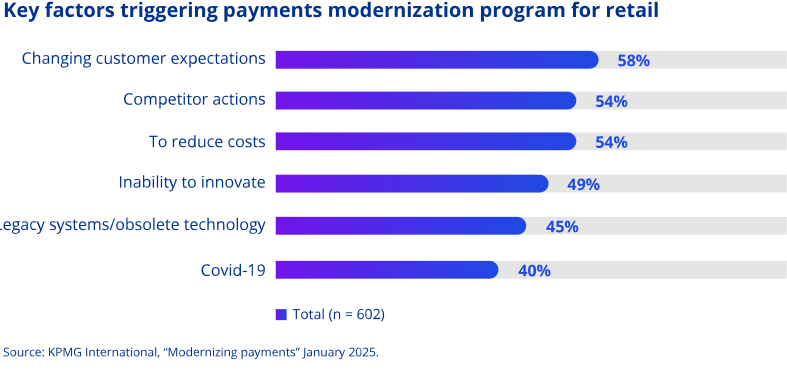
      Horizontal bar chart titled ‘Key drivers of retail payment modernisation.’ The bars, from left (longest) to right (shortest), represent the percentage of respondents (out of a total of 602) who identified each factor as a key driver. The factors listed in order of importance are: Change in Customer Expectations: 58% Competitor Actions: 54% To Reduce Costs: 54% Inability to Innovate: 49% Legacy Systems/Obsolete Technology: 45% Covid-19: 40% Total (n = 602) The most cited factor, with the longest bar, is ‘Change in Customer Expectations’ (58%). The factors ‘Competitor Actions’ and ‘To Reduce Costs’ share the same percentage (54%). Source: KPMG International, ‘Modernising payments’ January 2025.
      Infographic listing the top five benefits of a payment modernisation programme for the retail sector. Each benefit is presented with the percentage of respondents (out of a total of 602) who identified it as a key advantage. The list is as follows, in order of importance: Improved customer service - 66% Faster transaction processing - 59% Long-term cost savings - 55% Enhanced security - 45% Competitive advantage - 41% The most cited benefit is ‘Improved customer service,’ with 66% of mentions. Source: KPMG International, ‘Modernising payments’ January 2025.

      Key takeaways

      Urgency

      The vast majority — 93 percent of financial institutions and 87 percent of retailers — are either currently modernizing their payments infrastructure or are planning to do so (on average, they will begin within the next six to eight months).


      Motivation

      Changing customer expectations ranks as the top driver for Fis and retail organizations. FIs are motivated by regulatory requirements and the need to update legacy systems, while retailers are motivated by competitive pressures and cost considerations. 


      Resources

      FIs and retailers are allocating significant resources towards modernization. Survey respondents indicated that on average, FIs plan to spend around US$18 million and allocate 36 people to their programs. Retailers expect to spend an average of US$4.1 million and allocate 23 people to their programs.


      Benefits

      Respondents (both Fis and retailers) agree that payment modernization will deliver improved customer experiences, faster transaction processing and long-term cost savings. Retailers’ top expected benefit is customer experience improvements, while FIs are primarily anticipating cost savings.


      Challenges


      FIs and retailers are concerned about the cost and potential disruption of implementing new payment systems. Retailers are also worried about training staff to manage the transition, while FIs are concerned about the complexities of integrating new platforms across multiple systems.


      Download PDF

      Modernizing payments

      Global perspectives from financial and retail executives on payment modernization strategies and trends

      A implementação e a integração de novas plataformas de pagamentos podem ser complexas e demoradas. Apesar desses desafios, os executivos reconhecem os benefícios da modernização dos pagamentos como um catalisador para o crescimento e a inovação.

      Courtney Trimble

      Lead of Global Payments

      KPMG International


      Related content

      Learn how technology is redefining business with AI and automation. Explore our insights and application cases in this field.


      Solutions for the financial sector with a focus on regulation, risk, and innovation. See how we support the transformation of the sector and what services can help your business.


      We have a solution for your challenge

      Discover how KPMG can help you and your business.