

      KPMG conducted an extensive research program, interviewing executive leaders across eight key global markets to understand the impact of AI on the insurance industry. The emergence of generative AI, along with the next wave of autonomous and agentic AI systems, is unlocking entirely new possibilities for innovation across the sector. Our research provides a detailed blueprint for insurance organizations to harness AI’s potential value.
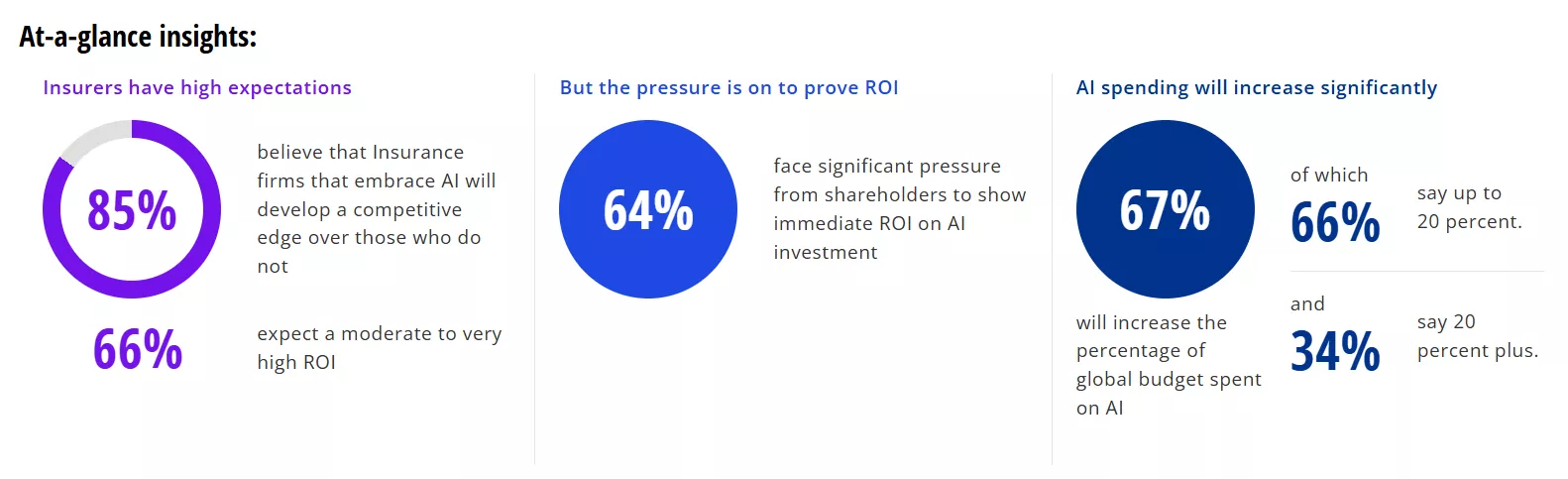
      Infographic with information on the adoption of Artificial Intelligence (AI) in the insurance sector, divided into four sections: Insurers have high expectations: 85% believe that companies that adopt AI will gain a competitive advantage over those that do not. 66% expect a moderate to very high Return on Investment (ROI). But there is pressure to prove ROI: 64% face significant pressure from shareholders to show an immediate ROI on AI investment. AI spending will increase significantly: 67% will increase the percentage of their overall budget dedicated to AI. 34% of these will increase up to 20% of their budget. 66% of these will increase more than 20% of their budget. The data provides insight into insurers' optimism, challenges and investment plans with regard to AI.

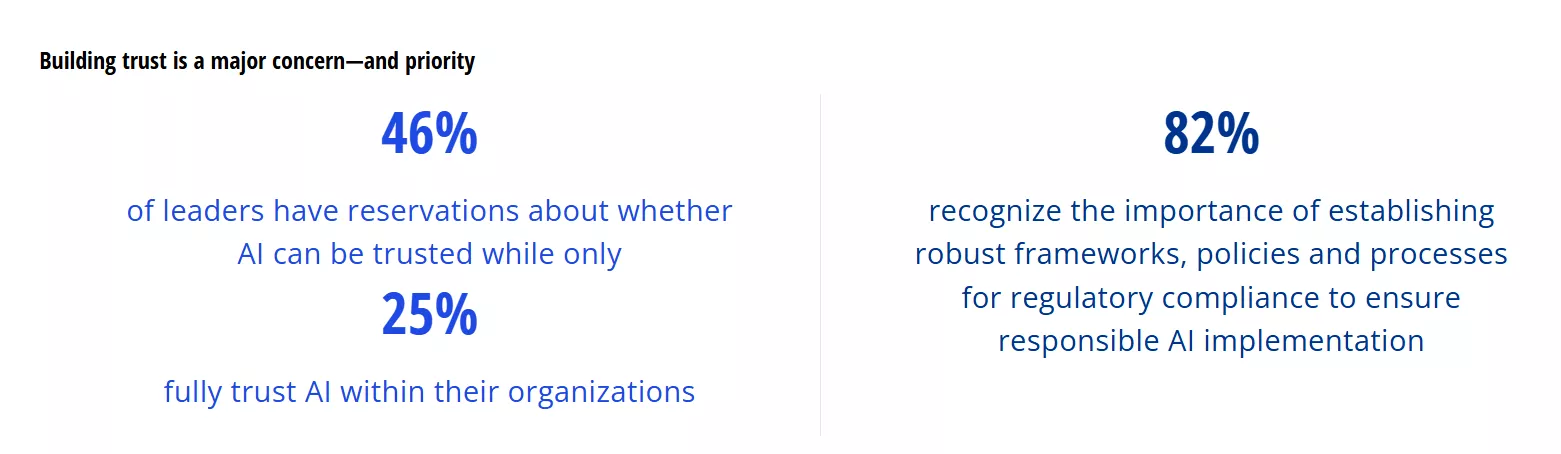
      Infographic on trust in Artificial Intelligence (AI) in the business context. The data is presented in three main points: 46% of leaders have reservations about whether AI can be trusted. Only 25% fully trust AI within their organisations. 82% recognise the importance of establishing robust frameworks, policies and processes to ensure regulatory compliance and responsible implementation of AI. The figures highlight the widespread perception of mistrust towards AI and the strong recognition of the need to create structures for its responsible use.

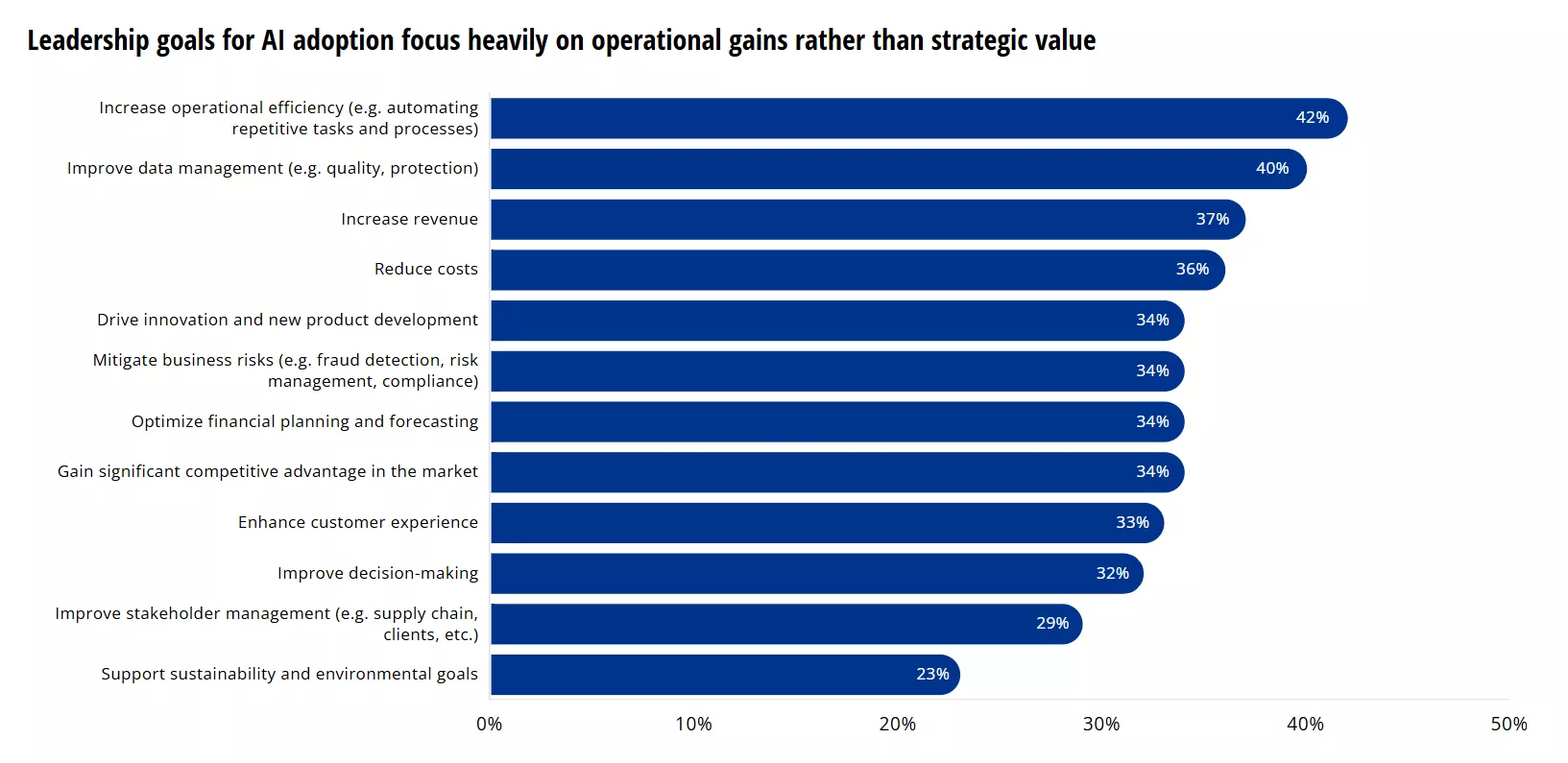
      Horizontal bar chart showing the main objectives of leadership for the adoption of Artificial Intelligence (AI), focusing on operational gains versus strategic value. Each bar represents an objective and the respective percentage of mentions, listed in descending order: Increase operational efficiency (e.g., automate repetitive tasks) - 42% Improve data management (e.g., quality, protection) - 40% Increase revenue - 37% Reduce costs - 36% Drive innovation and new product development - 34% Mitigate business risks (e.g., fraud detection, compliance) - 34% Optimise financial planning and forecasting - 34% Gain a significant competitive advantage in the market - 34% Improve customer experience - 33% Improve decision-making - 32% Improve stakeholder management (e.g., supply chain) - 29% Support sustainability and environmental goals - 23% A scale line at the bottom indicates percentages from 0% to 50%. The chart shows that the most frequently cited objectives are related to operational efficiency and data management, while more strategic goals, such as competitive advantage and innovation, appear slightly lower down.

      How to realize value from your AI transformation journey

      To address these challenges, KPMG introduces the three phases of AI value — a framework designed to guide insurers through the AI adoption journey. This phased approach provides a structured roadmap, helping insurers prioritize investments, align initiatives with business goals, and position themselves effectively in the age of AI in insurance. Click on each of the phases below to find out more.
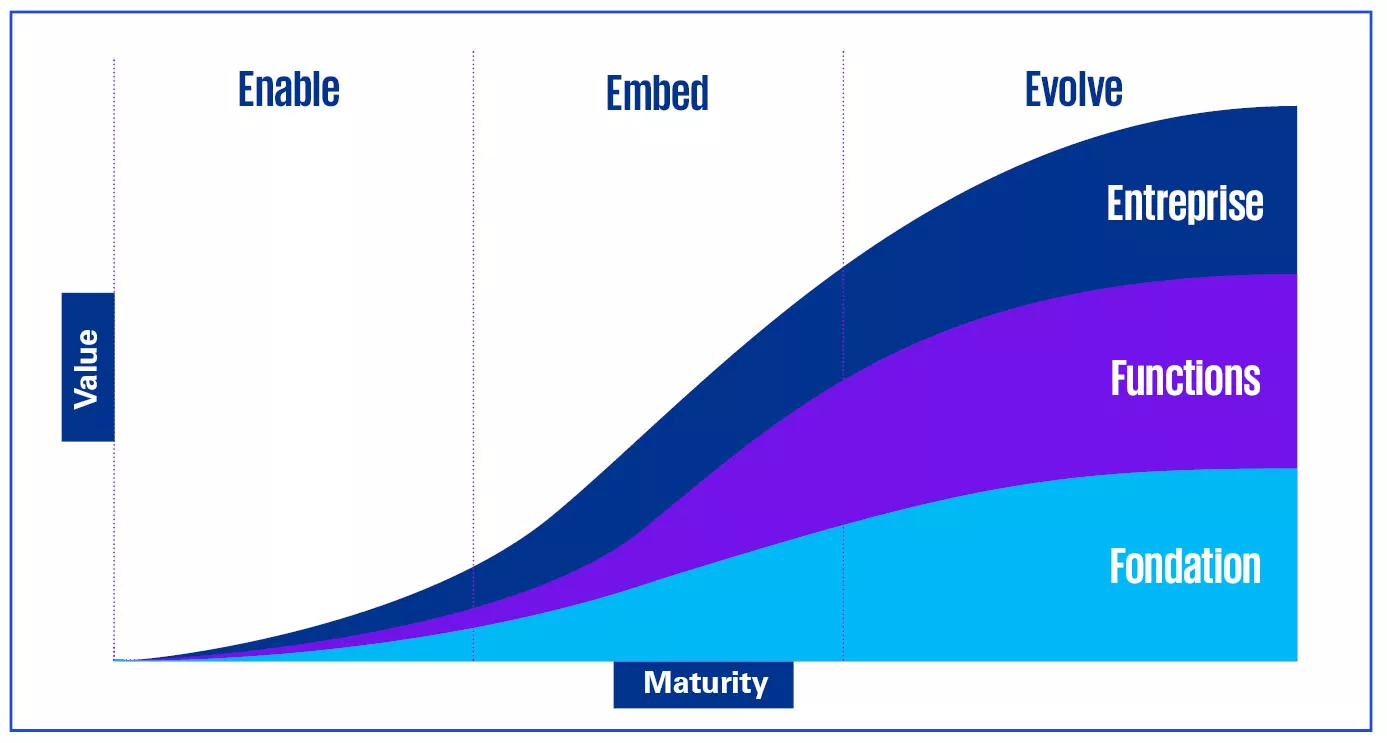
      Diagram illustrating the AI maturity journey for the banking sector, consisting of six elements: Enable, Value, Embed, Evolve, Enterprise, and Functions & Foundation. These elements are arranged in such a way as to lead to ‘Maturity’.

      Enable

      The Enable phase focuses on enabling people and building AI foundations. Organizations appoint a responsible executive, create an AI strategy, identify high-value use cases, boost AI literacy, align with regulations and establish ethical guardrails. AI pilots are launched across functions, while cloud platforms and pre-trained models are leveraged with minimal customization.

      Embed

      The Embed phase integrates AI into workflows, products, services, value streams, robotics, and wearables, delivering greater value. A senior leader drives enterprise-wide workforce redesign, re-skilling and change, embedding AI into operating models with a focus on ethics, trust and security. AI agents and diverse models are deployed, supported by cloud and legacy tech modernization, while enterprise-wide data enhances operations.

      Evolve

      The Evolve phase evolves business models and ecosystems, using AI and frontier technologies like quantum computing and blockchain to solve large sector-wide challenges. AI orchestrates seamless value across enterprises and partners. Emphasizing ethics and trust with real-time security, this phase uplifts human potential with broad and deep workforce training, fostering a creative, innovative and value-driven future.


      Descarregue o PDF

      Intelligent insurance

      A blueprint for creating value through AI-driven transformation

      We help clients harness the power and potential of AI. From strategy to implementation. Small steps to solve seemingly unsolvable problems. Based on trust. Learn more by contacting us below. It's possible with AI. It's possible with KPMG.



      Related content

      Learn how technology is redefining business with AI and automation. Explore our insights and application cases in this field.


      Support for insurance companies in areas such as risk, compliance, and digitization. Discover our solutions for the insurance sector.


      We have a solution for your challenge

      Discover how KPMG can help you and your business.