

Supporting Malaysia MADANI’s global competitiveness agenda
As Malaysia advances its national aspirations under the Malaysia MADANI framework and seeks to strengthen its position as a leading investment and financial hub within the ASEAN region, maintaining an attractive and competitive environment for domestic and foreign capital remains an important policy objective.
Malaysia’s Real Estate Investment Trust (REIT) regime has long been a key component of the Malaysian capital market. Its tax-transparent framework, attractive distribution yields and investor-friendly tax treatment have supported the development of a mature REIT sector, making REITs an established investment vehicle for both domestic and international investors.
Against this backdrop, recent changes to the taxation of REIT distributions have attracted considerable attention from market participants, raising broader questions regarding Malaysia's competitiveness relative to other established REIT markets in the region.
The 2026 change: End of the final withholding tax regime for certain non-resident investors, excluding companies
Historically, income distributions made by a listed REIT out of its tax-exempt income to non-resident unit holders were generally subject to the following withholding tax (WHT) rates.
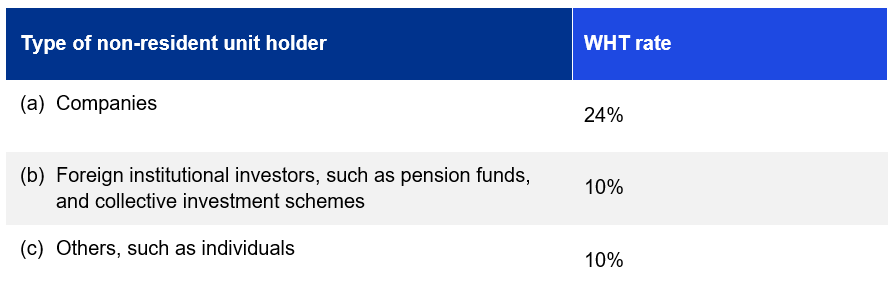
The WHT deducted at source on REIT distributions constituted the foreign investor’s final Malaysian tax liability. This provided a relatively straightforward framework for investors to meet their Malaysian tax obligations without having to undertake any further tax filings in Malaysia in respect of the distribution income.
• From YA 2026, however, the 10% final WHT regime for non-resident investors falling within the categories of (b) foreign institutional investors and (c) other non-resident persons ceased to apply. These investors are now required to report the distribution in their annual income tax return and may be subject to tax at a rate higher than the former 10% final WHT tax rate, while non-resident companies remain subject to WHT at 24%.
The change therefore represents more than an increase in the tax rate for affected investors. It also changes the way their Malaysian tax obligations are administered and managed.
Tax and compliance implications for foreign investors
The move away from the previous 10% final WHT regime introduces additional tax compliance obligations for foreign investors. Depending on their legal form and circumstances, they may be required to register with the Inland Revenue Board of Malaysia (IRBM) and comply with Malaysian income tax filing and reporting requirements.
The compliance burden may be significant for foreign investors structured as limited liability partnerships, trust bodies (including unit trusts) and co-operative societies, which may also be required to:
- submit annual estimates of tax payable;
- comply with the tax instalment payment requirements, where applicable; and
- furnish specified documents via the Malaysian Income Tax Reporting System (MITRS) online platform.
Consequently, these investors are generally required to report the distribution in their annual income tax return, where it will be taxed at the applicable prevailing income tax rates.
The combined effect of a higher tax rate and additional compliance requirements may increase the overall cost and administrative complexity of investing in Malaysian REITs. This is relevant from a competitiveness perspective. For international investors comparing REIT markets, the attractiveness of an investment jurisdiction is influenced not only by headline tax rates, but also by the simplicity, certainty and administrative efficiency of the tax framework.
How do regional REIT markets compare?
Malaysia’s current approach differs from the REIT tax frameworks adopted by several established regional markets, where REIT distributions to qualifying foreign investors can continue to benefit from relatively straightforward tax treatment.
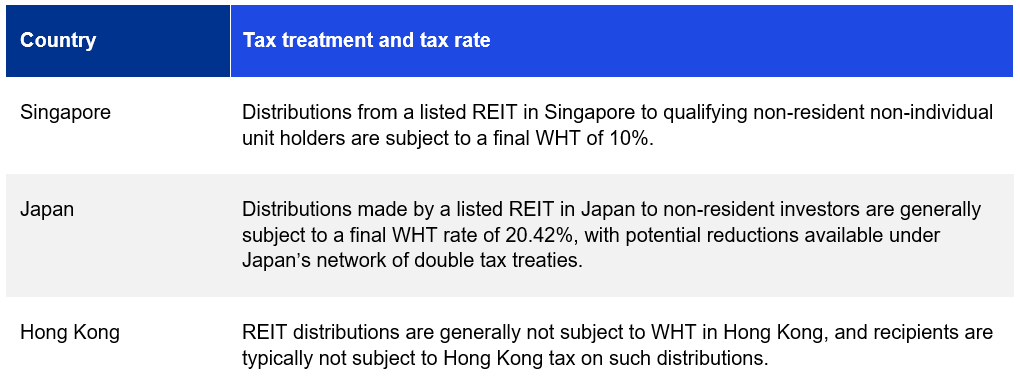
While these tax regimes are not directly comparable in every respect, these examples illustrate the importance of clear and administratively efficient tax treatment for international investors. A relatively simple tax collection mechanism at source can reduce the compliance burden for investors while providing greater certainty over their tax position.
Budget 2027: An opportunity to strengthen Malaysia’s REIT proposition
Malaysia's REIT market has evolved into a mature and integral component of the nation's capital market ecosystem. As the Government continues to strengthen Malaysia's international competitiveness as an investment destination, tax policy should remain supportive of efficient capital inflows and sustained foreign investment in the REIT sector.
The cessation of the 10% final WHT regime for foreign institutional investors and other non-resident persons from YA 2026 has resulted in a more complex and burdensome tax framework. While tax collection objective remains important, it is equally critical to consider whether the tax administration framework supports Malaysia’s broader objective of remaining an attractive destination for international investment.
As Budget 2027 approaches, there is an opportunity to revisit the REIT taxation framework applicable to affected foreign investors. In this regard, we hope the Government will consider:
- reinstating a final WHT regime for foreign institutional investors and other affected non-resident investors;
- considering a WHT rate lower than 30%, taking into account the tax treatment available in other established regional REIT markets; and
- during any transition period, simplifying the relevant tax compliance and administrative requirements, as well as providing further guidance to improve clarity and certainty for affected investors.
Such measures could facilitate efficient tax collection at source while reducing administrative cost, compliance burdens, minimizing the risk of inadvertent non-compliance, and enhancing the overall efficiency of tax administration for both foreign investors and the IRBM.
More broadly, simplicity, certainty and administrative efficiency are key considerations for international investors when deciding where to invest. A REIT tax framework that provides greater certainty and makes compliance easier would not only help strengthen Malaysia’s attractiveness to international investors, but also support the continued development of its capital market.
The views expressed herein are those of the authors and do not necessarily represent the views and opinions of KPMG Tax Services Sdn. Bhd.


