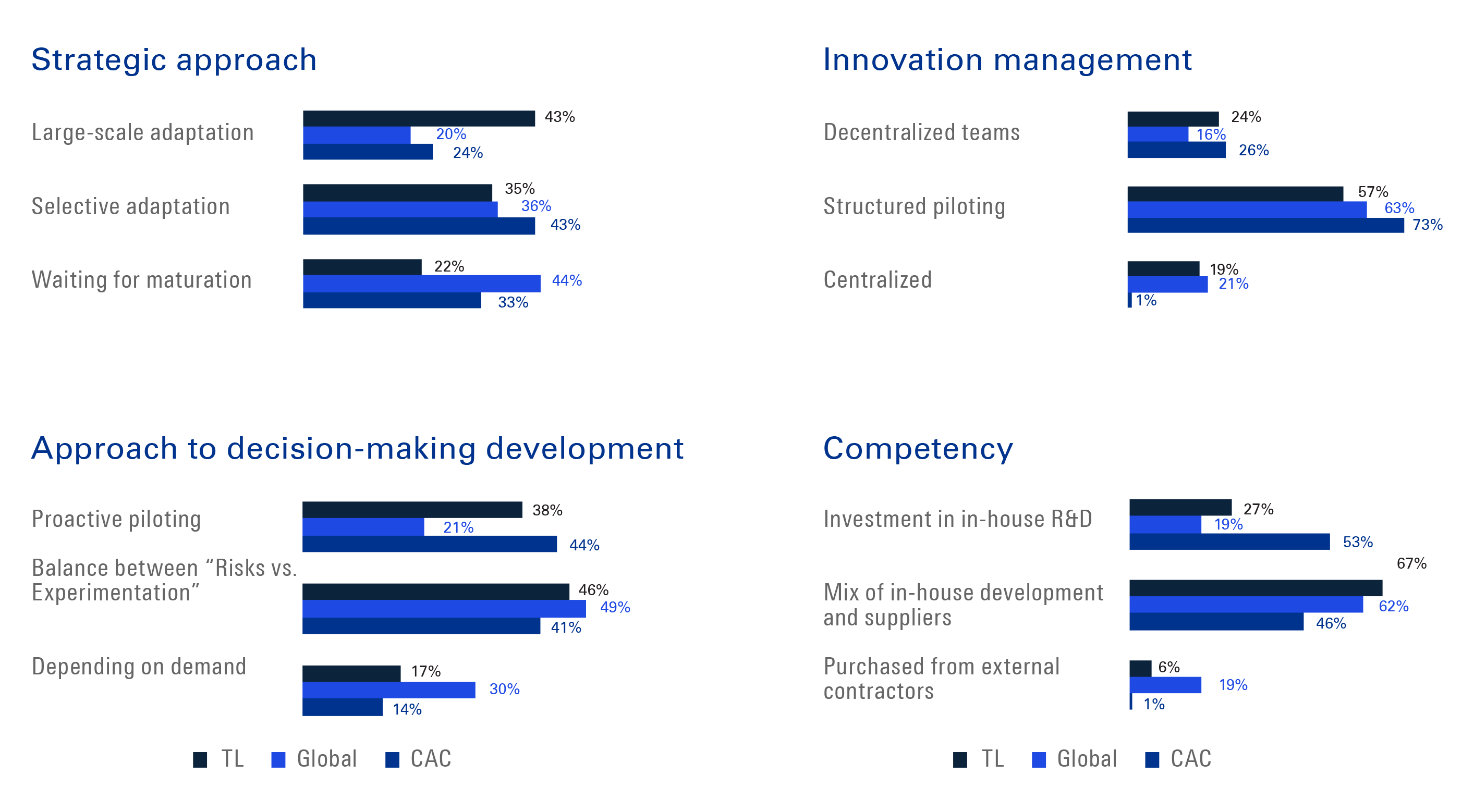
Kazakhstan demonstrates the region’s clearest balance between confidence and caution in technology adoption. The share of companies with pronounced risk aversion and a reactive investment style is higher — 28%, compared with the average of 17% across Central Asia and the Caucasus. In addition, 57% of organizations say that management limits employees’ use of AI tools in the workplace.
At the same time, Kazakhstan shows the highest level of trust in AI recommendations for business decision-making in the region — 86%. Meanwhile, 50% of companies believe that the impact of market, regulatory and technological factors is manageable, compared with only 14% globally.
This points to an important feature of the local approach: companies are ready to accelerate technology adoption when they retain a sense of control, clear governance and well-defined rules.
The report finds that 99% of respondents in Central Asia and the Caucasus consider investment in advanced technologies to be a key driver of competitive advantage over the next three years, compared with 90% globally.
Businesses in the region also remain highly optimistic about growth:
- 91% of companies report revenue growth over the past five years.
- 93% expect revenue growth over the next 24 months.
Against this backdrop, technology is increasingly seen not as a cost optimization tool, but as a growth accelerator.
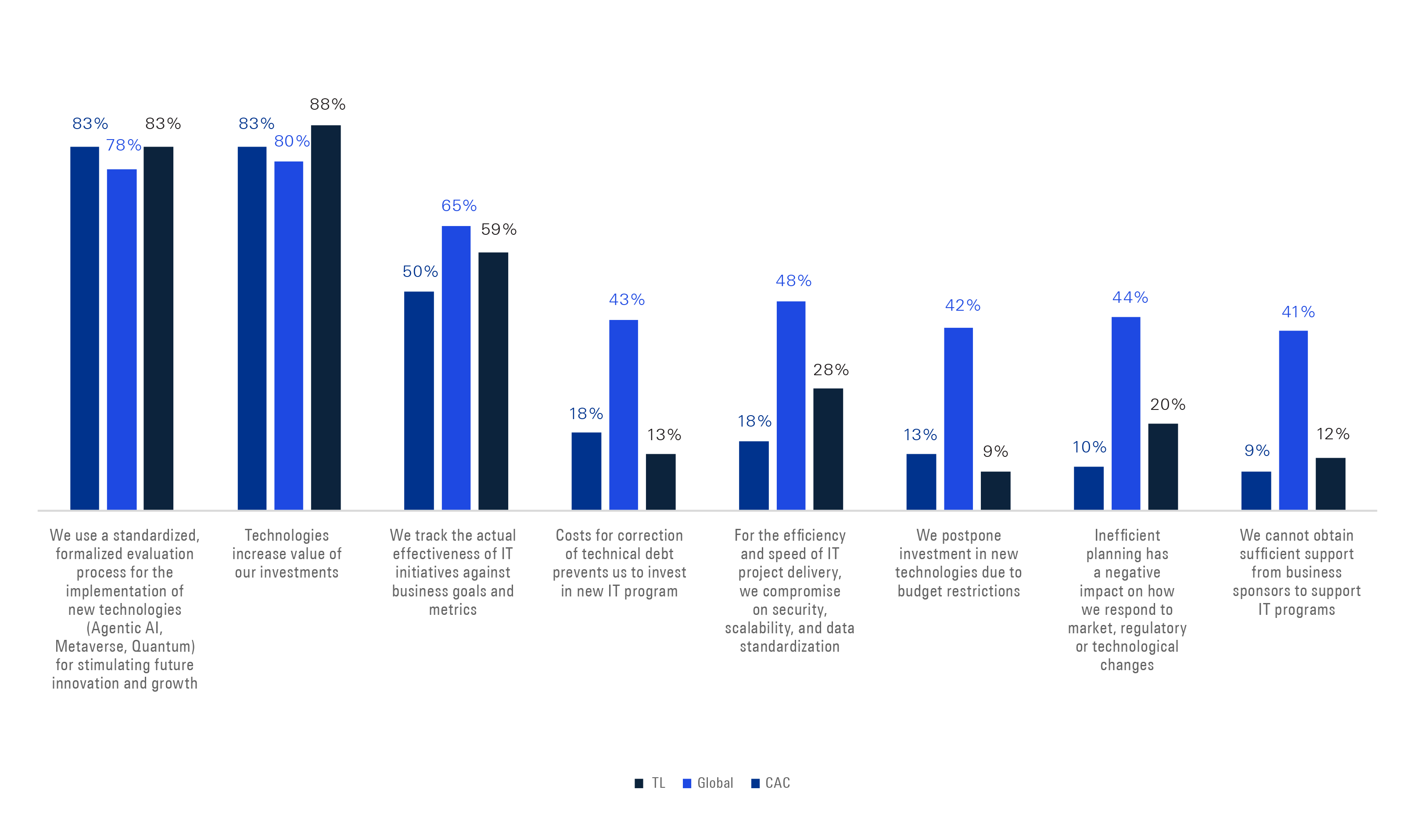
The region’s rapid pace of digitalization also creates new risks. Around 50% of companies in Central Asia and the Caucasus do not systematically track the value delivered by IT initiatives, while 50% acknowledge that their AI strategy is stalling at the scaling stage.
Another risk factor is the accumulation of technical debt. Companies in the region are actively investing in development and AI initiatives, but allocate significantly less of their IT budgets to maintaining existing systems: approximately 21%, compared with around 34% globally.
KPMG experts note that the current stage is a turning point for the region. It will determine whether today’s technology momentum becomes a long-term competitive advantage — or remains a temporary window of opportunity.