
According to the KPMG Global Tech Report 2026, companies in Central Asia and the Caucasus are in a unique position: the region demonstrates a high pace of industrial AI adoption, yet governance models often fail to keep up with technology.
AI as an industrial reality
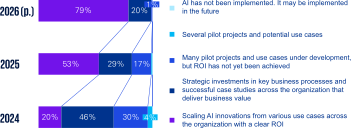
53% of companies in the region use AI in an industrial environment with measurable impact, compared to 24% globally. 79% expect AI to become a key source of competitive advantage over the next 2 years.
By 2025, CAC significantly increased AI adoption in business
The maturity paradox
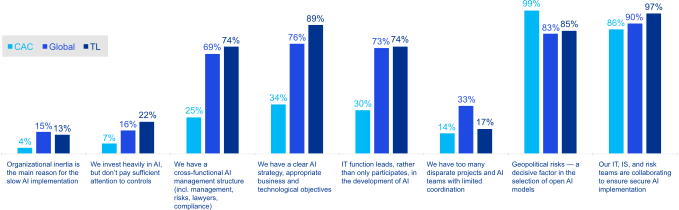
Only 34% of companies in the region have a formalized AI strategy (vs. 76% worldwide). A cross-functional AI Governance model is implemented by just 25% (vs. 69% globally).
Approaches to AI governance in the CAC region appear less systematic and risk-oriented than those used globally, and especially by technology leaders
Decentralization
Only 1% of companies in the region use a centralized approach to managing digital initiatives. Decentralization accelerates solution launches, but makes scaling and risk management more complex.
In-house focus
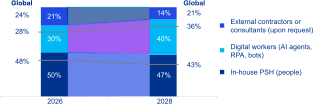
40% of digital capacity is built through a digital workforce, with contractors accounting for around 14%. At the same time, 85% of global leaders use partner ecosystems to scale AI.
In the CAC, there is a stronger tendency toward reducing the number of contractors
What this means for executives
Competitive advantage is shifting from speed of adoption to the ability to manage scale, architecture, and AI business value. Winners are companies with strong governance and a balanced ecosystem
Contacts


Submit RFP
Find out how KPMG's expertise can help you and your company.