

Executive Summary
Impact investing has grown rapidly as a means of addressing social and environmental challenges while delivering financial returns, with healthcare emerging as one of the most prominent sectors. Despite this growth, the lack of standardized and policy aligned approaches to impact measurement remains a major barrier to scaling investment and enabling effective decision making by investors and policymakers.
This report by KPMG Japan’s Healthcare & Well-being Team examines how social impact generated by private sector healthcare initiatives can be measured more rigorously and integrated into public policy evaluation frameworks. Through a pilot impact evaluation conducted with SORA Technology, a Japanese startup implementing technology driven malaria control initiatives in Ghana, the report demonstrates how incorporating cost effectiveness and environmental impact perspectives can enhance the credibility and usefulness of impact assessments.
The findings highlight the potential of policy-linked impact measurement to improve transparency, enable comparisons across diverse interventions, and support more efficient allocation of capital. By aligning corporate impact assessments with national and international policy objectives, impact investing can play a stronger role in advancing sustainable healthcare systems and health equity worldwide.
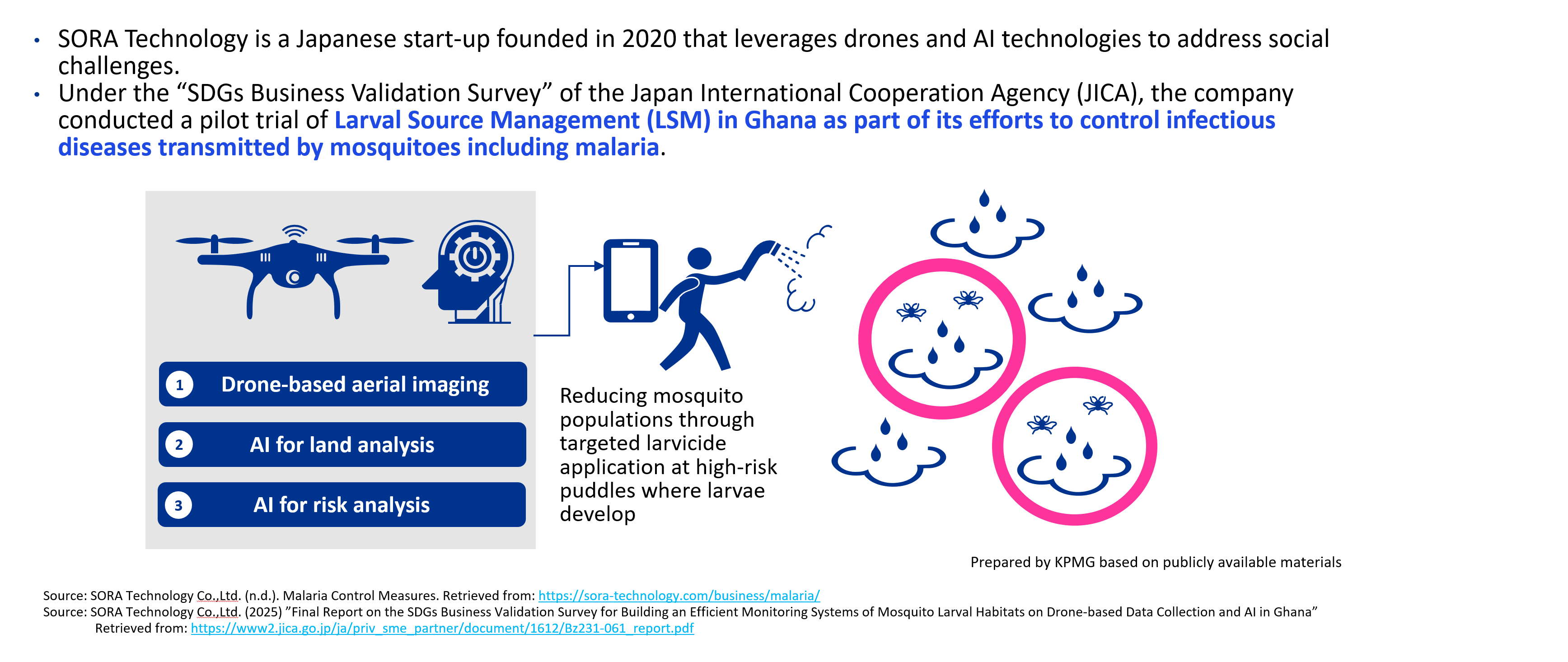
Overview of SORA Technology’s project in Ghana
Overview
As impact investing continues to expand globally, healthcare has emerged as one of the most significant sectors for generating both social impact and financial returns. However, methodologies for measuring impact remain fragmented, and assessments often fail to incorporate perspectives such as cost-effectiveness or environmental burden, limiting their usefulness for policy and investment decisions.
This report explores global trends in impact investing, related policy developments in Japan, and voluntary initiatives by private companies to visualize social impact. It emphasizes the growing expectation that both public and private capital should be assessed based on the social and environmental outcomes they generate.
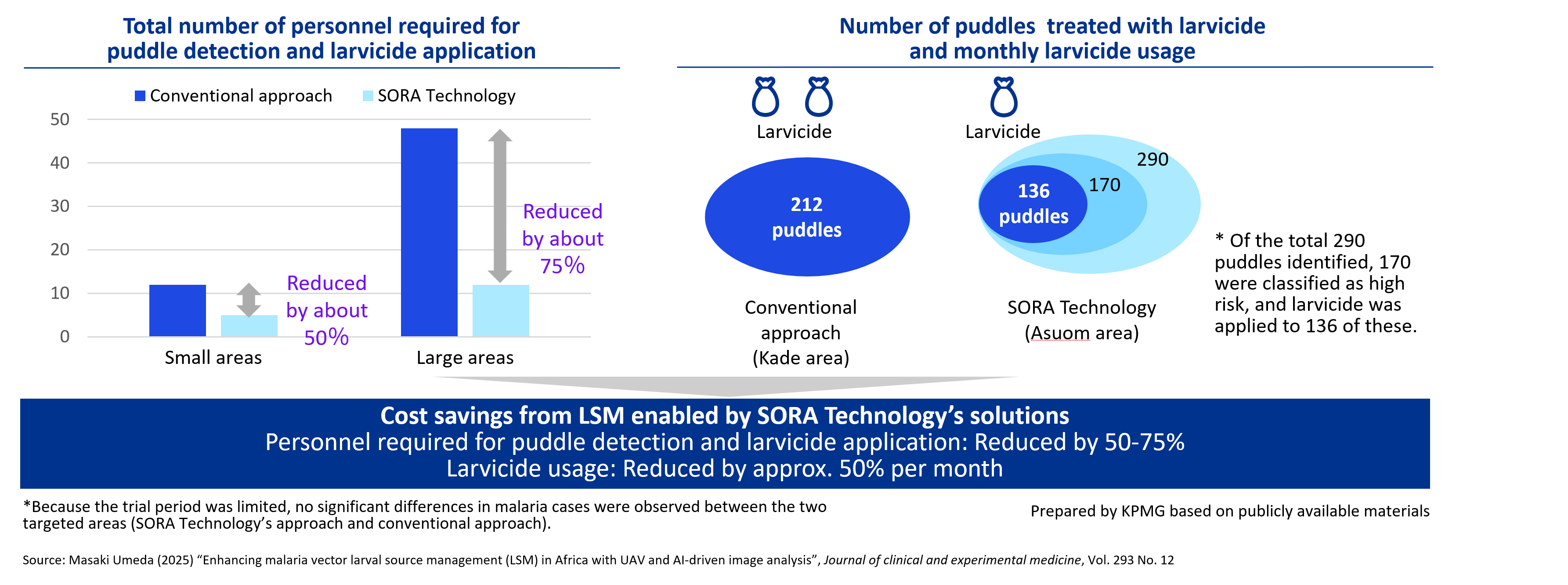
A core feature of the report is a case study of malaria control initiatives in Ghana, focusing on larval source management (LSM) implemented by SORA Technology using drones and AI. The pilot impact assessment shows that the technology-enabled approach significantly reduces labor requirements and larvicide usage compared with conventional methods, leading to lower costs and reduced environmental and human health impacts.
SORA Technology’s Cost-effectiveness of LSM project in Ghana
Looking Ahead
- Technology-enabled larval source management (LSM) has the potential to reduce labor requirements and environmental burden compared with conventional approaches, improving overall budget efficiency.
- Enhanced efficiency may allow malaria control initiatives to be expanded to wider geographic areas or enable resources to be reallocated to other interventions.
- Comparing the relative impact of different malaria control measures remains challenging under current evaluation frameworks.
- Integrating social impact assessments by private companies into policy-based evaluation frameworks - while incorporating cost-effectiveness and environmental impact perspectives - enables more consistent assessment across initiatives.
- Such alignment can enhance transparency for investors and society and support more effective investment in healthcare and well-being.
Access the files below for the full report and illustrative summary.
The Future of Healthcare Enabled by Impact Investing: Toward Policy-Linked Impact Measurement
Full Report

The Future of Healthcare Enabled by Impact Investing: Toward Policy-Linked Impact Measurement
Summary report
Connect with us
Authors
Michikazu Koshiba
Director – Healthcare & Well-being (HC&WB)
Yuka Kato
Manager
Junko Makinouchi
Senior Associate
Akari Yoshida
Associate