As organisations accelerate digital transformation, adopt cloud technologies and embrace increasingly connected ecosystems, cyber security has become a strategic business priority. Evolving threat landscapes, regulatory requirements and rising stakeholder expectations require organisations to embed security into every aspect of their technology environment while maintaining agility, trust and resilience.
KPMG in India's Cyber Security and Technology practice helps organisations strengthen cyber resilience, secure digital transformation initiatives and safeguard critical assets, data and operations. Drawing on deep cyber security expertise, advanced technologies and industry experience, we help clients identify risks, protect systems, detect threats and respond effectively to cyber incidents.
Our capabilities cover cyber strategy and transformation, identity and access management, cloud security, security operations, threat intelligence, cyber defence, incident response, digital forensics, data protection, operational technology security and emerging technology security. Through integrated and business-aligned security programmes, we help organisations enhance trust, resilience and operational effectiveness.
From modernising security architecture and securing cloud environments to strengthening cyber defence capabilities and improving cyber readiness, we help organisations address evolving threats through practical, technology-enabled solutions that support sustainable growth and business resilience.
Creating a trusted digital world together
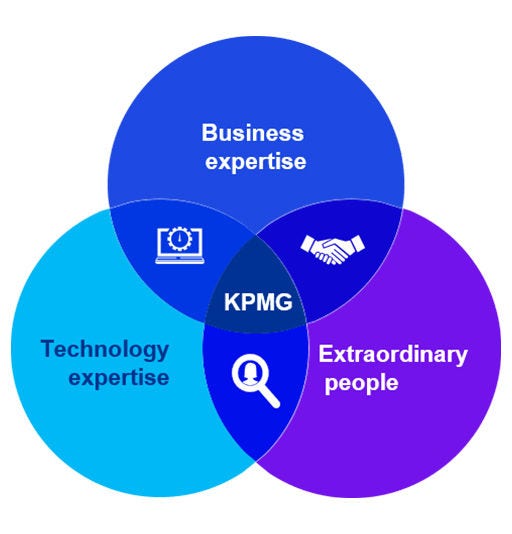
Whether you’re entering a new market, launching products and services, or interacting with customers in a new way, KPMG in India can help you anticipate tomorrow, move faster and get an edge with technology that is secure and trusted. That’s because we can bring an uncommon combination of technological expertise, deep business knowledge, and creative professionals who are passionate about helping you protect and build your business.
Our offerings


Stop playing defense optimise your Security Operations Center for real impact
SOC Efficacy and Maturity Assessment measures your SOC’s effectiveness across people, processes, technology, services, and strategy and governance. It benchmarks maturity against industry standards, identifies gaps, and delivers a phased roadmap with actionable recommendations for continuous improvement.
IRDAI Mandates Incident Response Retainership
As per the recent IRDAI (Insurance Regulatory and Development Authority of India) circular dated 24 March 2025, IRDAI has laid down some guidelines regarding cyber incident and crisis preparedness for all regulated entities.
Driving growth with Cyber and Technology trends
- Secure in India 2026
- Power sector cybersecurity
- India International FinTech Festival 2026
- Zscaler PE event
- Powerline Renewable Watch
- Data privacy and cybersecurity in an evolving AI landscape
- A risk-based approach to cyber budgets
- ET Now Global Business Summit
- Cyber resilience in the age of AI
- Building digital trust with AI
- Srinivas Potharaju
- Shanlini Pillay

In an environment marked by technological disruption, evolving cyber threats and rapid AI adoption, cyber GCCs in India have evolved into trusted partners for cybersecurity and digital risk management. They are increasingly leading innovation, strengthening resilience and enabling global organisations to navigate complexity with confidence. As their role continues to expand, cyber GCCs are poised to play a defining role in shaping the future of secure and resilient global organisations.

India's GCC ecosystem continues to expand, placing cybersecurity at the forefront of business strategy for global organisations. Cyber GCCs are now foundational to global business operations. As India becomes a center for innovation, research, development, and IP creation, robust cybersecurity capabilities are critical to protecting value and supporting global growth.
- Srinivas Potharaju
- Sony Anthony
- Anish Mitra

Operational resilience and cyber resilience are now inseparable. As industrial environments become increasingly connected, organisations must move beyond traditional security approaches and embed cyber resilience into the design, operation, and lifecycle of critical systems. Effective OT security is fundamental to ensuring safe, reliable, and sustainable operations in an increasingly digital world.
Anish Mitra
Partner, Cyber Defense & IR
KPMG in India
The future of grid resilience is inseparable from cyber resilience with increasing interconnectivity across and digital operations. Organisations that proactively strengthen OT governance, secure their supply chains, and modernise cyber defenses will be better positioned to protect critical services and build stakeholder confidence in an increasingly connected ecosystem.
- Atul Gupta
- Sameer Saini
- Vaibhav Pachori

Fintech has played a significant role in the Indian economy and wider societal inclusion. Digital fraud has also grown along with the ease of payments and need is to have measures deployed to enhance trust on a sustained basis.
Sameer Saini
Partner, Cyber Transformation CTFR
KPMG in India
While data sovereignty is critical, digital sovereignty is a much broader challenge encompassing technology, infrastructure, resilience, innovation, and trust. As cyber threats continue to evolve across borders, meaningful progress will depend on stronger international cooperation, shared cyber intelligence, and trusted partnerships.
India is uniquely positioned to lead this dialogue, demonstrating through its digital transformation journey how secure, inclusive, and scalable digital ecosystems can also serve as a model for the Global South.
Vaibhav Pachori
Partner, Cyber Strategy & Governance
KPMG in India
As AI becomes embedded in credit decisions, fraud detection, payments, customer engagement, and financial inclusion, the conversation highlighted a few powerful themes:
- AI is rapidly becoming part of the financial system's critical infrastructure, making resilience and security a national priority.
- Cybersecurity must evolve beyond protecting data to protecting algorithms, models, and AI-driven decisions.
- Deepfakes, synthetic identities, and adversarial AI are redefining the threat landscape, requiring stronger digital identity and trust frameworks.
- Innovation and regulation must move together. Governance, transparency, and accountability can no longer be afterthoughts.
- Trust remains the ultimate currency. Citizens do not need to understand every algorithm, but they must have confidence that AI-driven decisions are fair, secure, and accountable.
India has a unique opportunity to demonstrate that innovation, cybersecurity, privacy, and public trust are not competing priorities, but mutually reinforcing foundations of a resilient digital economy.
As we build the AI economy, one message stood out above all: Trust should be our greatest asset, not our biggest vulnerability.

Akhilesh Tuteja
Partner & National Leader - Clients and Markets and Technology, Media & Telecommunications (TMT)
KPMG in India
- The Proportionality of Risk: The likelihood of a cyber attack is directly proportional to the value of the enterprise. The greater the value you create, the larger the target on your back. High-value targets require high-caliber defense.
- The Reality of Exposure: In a hyper-connected ecosystem, hyper-exposure is the default. Traditional boundaries are gone, and assuming you are safe because you are "hidden" is a dangerous fallacy.
- The Widening 'Cyber Poverty Line': We are seeing a deeply concerning trend where more organisations are falling below the Cyber Poverty Line. The gap between those who understand cyber risks & can defend themselves effectively, and those who cannot is widening, creating massive systemic vulnerabilities.
- Response Over Just Prevention: While prevention is undeniably important, an obsession with perfect prevention is a trap. Preparedness to respond and recover is equally, if not more critical. True resilience isn’t just about stopping the hit; it’s about how fast you get back up.
Manish Tembhurkar
Partner, Cyber Defense & IR
KPMG in India
Digitalisation is no longer optional for power plants because it drives efficiency, reliability, predictive maintenance, and renewable integration. However, every digital connection introduces cyber risk. The challenge is not whether to digitalise, but how to digitalise securely.
- Sony Anthony
- Rupak Nagarajan
As the DPDP Act begins to take effect, organisations are starting to look beyond compliance and focus more deeply on accountability, governance, and trust in how data is managed.
The line between vulnerability discovery and weaponisation has collapsed exponentially. If the security posture still relies on manual triage and weekly patch cycles, you're treating an AI-speed problem with a human-speed solution.
The metric for success is no longer how fast we find exposure, it's how rapidly we translate that intelligence into actionable, risk-based resilience
Rupak Nagarajan
Partner, Cyber Strategy & Govn
KPMG in India
The DPDP Act marks a fundamental shift in how organisations think about handling personal data. The conversation is moving beyond compliance towards building trust, strengthening governance and responsible innovation.
For businesses navigating an increasingly digital ecosystem, privacy is becoming a strategic differentiator that provides competitive advantage.
Akhilesh Tuteja
Partner & National Leader - Clients and Markets and Technology, Media & Telecommunications (TMT)
KPMG in India
Cybersecurity budgets are often built on legacy structures, not real risk. The result is a disconnect between where organisations invest and where their true exposure lies.
A risk based approach shifts this conversation. It starts by aligning every investment to a clearly defined and quantified risk, ensuring that spending directly contributes to reducing exposure. It also calls for adaptability, where budgets evolve alongside changing threats, and transparency, where every stakeholder can see the link between spend and outcomes.
This is not just a financial exercise. It is a fundamental shift in how organisations think about cybersecurity. Moving from static line items to risk led priorities enables smarter allocation, stronger resilience, and clearer communication with leadership.
When budgets are tied to measurable risk reduction, cybersecurity stops being a cost discussion and becomes a value conversation.
- Ambiguity is the new operating environment for CEOs. Navigating fluid global dynamics has become a core leadership capability.
- Resilience is now a strategic differentiator. Organisations that can anticipate, absorb and adapt to shocks will define the next decade.
- Trust is emerging as an economic currency. In a world of rapid digitalisation, trust-driven ecosystems will outperform those built purely on scale or efficiency.
- Innovation must move from the periphery to the core. It can no longer be experimental—it has to be embedded, continuous and enterprise-wide.
- Talent strategies need a reset. Leaders must enable teams to thrive amid constant change, not just manage it.
- Business disruption cycles are compressing. With new and unfamiliar risks emerging, risk intelligence and forward visibility are critical.
- AI represents a generational shift. Its true potential will be realised only when it becomes more human-centric, ethical and responsible.
- Digital and data sovereignty are gaining prominence. Yet, India is uniquely positioned to leverage this moment and accelerate its journey toward Viksit Bharat.
Akhilesh Tuteja
Partner & National Leader - Clients and Markets and Technology, Media & Telecommunications (TMT)
KPMG in India
As AI scales across governance, OT, data platforms, and agentic systems, one fact stands out. Cyber resilience is now a collective responsibility and demands a full 360 degree view.
A few realities we cannot ignore:
- Threat actors have the same tools we do
They move without guardrails or governance. Their speed is increasing. Our defenses must adjust just as fast - AI in operational tech will be the hardest frontier
IT environments are challenging enough, but energy grids, airports, and industrial systems were never built for AI driven autonomy. Securing them will take a very different playbook - Businesses want more data. Cyber teams pay the price
More data fuels better models, but it also expands exposure and complexity.
For years, the easy answer to trust was to keep a human in the loop.
Agentic AI breaks that model. If the agent completes the loop, the human becomes irrelevant. If we force the human back in, the system loses the efficiency it promised.
That is the tension we must solve next. Not with slogans, but with real engineering, governance, and clarity on where autonomy is acceptable.
- Atul Gupta
- Kunal Pande
Trust has been a key pillar and with enhanced adoption of AI and associated digital ecosystem, establishing trust is no longer a “good to have” factor but a necessity. Digital Trust enables in enhancing governance mechanisms and have makeshift from a reactive posture to proactive one, thereby empowering organisations to anticipate risks with confidence and address them as they push hard on proliferation of digital economy.

Boards do not need more static dashboards; they need an up-to-date enterprise-wide view of risk posture with a common language (taxonomy) that aligns SecOps, IRM, privacy, and incident response teams to enable faster, coordinated decision-making.
Hear from the experts


India Insights
Our insights is your gateway to thought leadership and in-depth reports. Explore our curated collection of valuable content, where we delve into complex business challenges, share industry trends, and provide actionable insights.