The thought leadership titled “Building a shock-resilient supply chain” was released today at the 17th edition of ENRich, KPMG in India's flagship Energy and Natural Resources (ENR) conclave. It examines how growing geopolitical uncertainty, energy-linked disruptions, cyber threats, trade fragmentation, climate-related risks and technological shifts are reshaping global supply chains. Based on KPMG International’s Dynamic Risk Assessment (DRA) methodology, expert interviews and a global pulse survey, the study highlights the need for organisations to move beyond traditional risk management and build enterprise-wide resilience to withstand and adapt to increasingly interconnected disruptions.
Key findings:
Anish De, Global Head of Energy, Natural Resources and Chemicals, KPMG International, said “Resilience is no longer just a supply chain function; it has become a board-level imperative shaped by energy-linked disruption and a broader set of interconnected risks spanning technology, financial stability, operations and global value chains. Organisations today must rethink long-held assumptions about how supply chains are designed and managed. As risks increasingly originate outside corporate boundaries, leaders need a multi-level approach that combines risk management, resilience-building and strategic optionality to navigate a more uncertain and interconnected world."
Regina Mayor, Global Head of Clients & Markets, KPMG International, said, “What makes today's business environment particularly challenging is not the scale of any single disruption, but the way multiple risks are converging and reinforcing one another. Geopolitical tensions, resource constraints, cyber threats and energy-linked disruptions are creating ripple effects that extend far beyond their point of origin. Organisations that strengthen resilience, anticipate change and build the agility to adapt in an increasingly interconnected world will be better positioned to navigate uncertainty and unlock long-term growth.”
The report concludes that organisations can no longer rely solely on traditional risk-management frameworks focused on prevention and control. As disruptions become more external, interconnected and fast-moving, businesses must embed resilience into decision-making, strengthen visibility across supply-chain ecosystems, leverage advanced technologies and build the agility required to respond to complex shocks. Those that can anticipate change, adapt quickly and maintain critical operations amid uncertainty will be better positioned to achieve sustainable growth in an increasingly volatile environment.
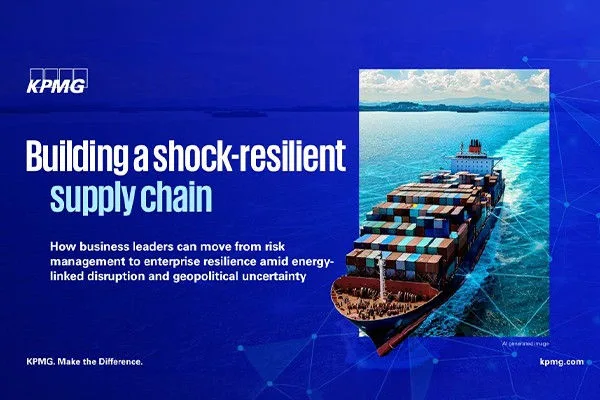
Building a shock-resilient supply chain
How business leaders can move from risk management to enterprise resilience amid energy-linked disruption and geopolitical uncertainty
KPMG Media Contact
Vidya Mohan
KPMG in India
Mobile No - +91 9820770846
Email - vidyamohan@kpmg.com

KPMG Insights Edge
On the go access to KPMG in India’s insights and publications