India's growth as one of the world's largest economies depends significantly on the efficiency and competitiveness of its logistics system. Railways play a central role in supporting economic activity by moving freight across the country in a cost-effective and sustainable manner. As India's economy continues to expand, the discussion on rail freight competitiveness needs to move beyond network capacity, train speeds and freight tariffs alone.

      The analysis reveals that one of the large, untapped opportunities for rail freight growth lies in improving accessibility for Micro, Small and Medium Enterprises (MSMEs). At over 35 per cent of India’s manufacturing output MSMEs are an important customer segment for logistics. However, as per the National Council of Applied Economic Research estimates, they bear a disproportionately high logistics burden, with logistics costs estimated at 16.9 per cent of output for firms with turnover up to INR 5 crore versus 7.6 per cent for firms above INR 250 crore. 

      While rail continues to offer a cost advantage over long distances, many smaller businesses face challenges related to cargo aggregation, terminal access, rolling stock availability, first- and last-mile connectivity and service predictability. These factors often determine whether rail remains a viable alternative to road transport.
      The paper uses secondary research, examples from Japan and China, and inputs from stakeholder consultations to support these findings. It also sets out recommendations for implementation of a terminal led agenda that includes demand led planning for modernisation of common user terminals and acquisition of suitable freight wagons, freight aggregation platforms, digital systems, and new business models that can help make rail more accessible to smaller businesses. 

      Our intent is to ignite debate and bring MSMEs to the limelight in rail freight and logistics. MSMEs are spread across the length and breadth of the country. Indian Railways’ network with route length of over 69,000 kms and more than 3500 freight handling locations provides a strong foundation for expanding rail access to these enterprises. A symbiotic relationship can be incubated to expand rail’s role in India’s freight sector and offer greater market access to MSMEs.


      Key highlights of the report

      • Untapped rail freight opportunity

        MSMEs represent a major untapped rail freight opportunity, contributing over 31% of India's GDP, 35% of manufacturing output, and nearly 50% of exports, yet remain underrepresented in rail freight usage

      • Serviceable Obtainable Market (SOM)

        It is estimated an annual Serviceable Obtainable Market (SOM) of 100 million tonnes (MMT) of MSME freight that could potentially shift to rail through improved accessibility and logistics interventions

      • Total Logistics Cost and Impact (TLCI)

        The paper introduces the Total Logistics Cost and Impact (TLCI) Framework, which assesses logistics decisions through four dimensions namely direct logistics costs, time-related costs, uncertainty costs and strategic business impacts. Even though the direct logistics cost of rail logistics is low, it loses competitiveness to other modes of transport due to the impact of other factors.

      • Market Aligned Terminal Accessibility (MATA) and Wagon Access and Availability (WAA)

        To identify the access gap of rail-based logistics for MSMEs, the paper further introduces two models. The Market Aligned Terminal Accessibility (MATA) Model, which evaluates terminal readiness across technical fit, commercial fit, access fit, and institutional fit, thereby assessing whether terminal infrastructure is aligned with the operational and logistics requirements of MSME freight. A second model, the Wagon Access and Availability (WAA) Model, highlights that future rail growth also depends on whether wagons are suitable for MSME cargo, commercially accessible and are available when needed through long-term demand led procurement planning


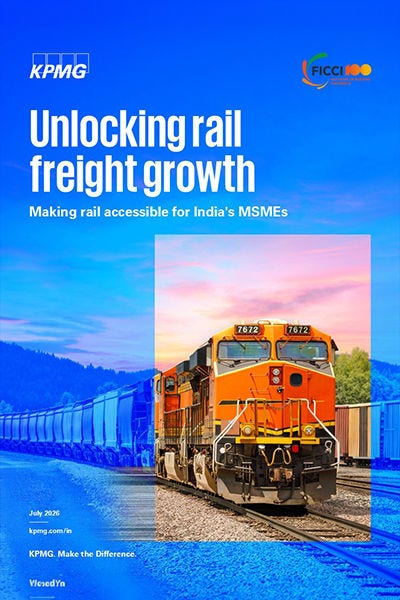
      Unlocking rail freight growth: Making rail accessible for India's MSMEs

      Unlock a significant new freight opportunity for Indian Railways while reducing logistics costs for India's MSME sector

      Key Contact

      Sameer Bhatnagar

      Partner

      KPMG in India

      How can KPMG in India help

      Powered by multimodal infrastructure, AI and sustainability imperatives

      For a more productive and sustainable business future

      Transformation agendas are evolving from digital adoption to enterprise-wide value creation, resilience and long-term impact

      Access our latest insights on Apple or Android devices