
      Strengthening expectations for credit institutions: the significance of MNB’s new sustainability recommendation and the amendment to the Hpt.


      In recent years, sustainability and particularly climate-related risks have gained an increasingly prominent role in the regulation of the financial system. The banking sector is at once a key player in financing the green economic transition and an institutional system exposed to substantial risks stemming from climate change and shifts in the economic structure. Accordingly, European supervisory authorities have placed growing emphasis on integrating ESG risks – that is, risks related to environmental, social, and governance factors – into banking operations.

      In Hungary, one of the most important tools of this supervisory approach is the MNB’s green banking recommendation. In 2022, the central bank issued its comprehensive recommendation[1] for credit institutions on the management of climate-related and environmental risks, which for the first time set out system-level expectations for integrating environmental risks into banking operations. However, the rapid development of the regulatory landscape made it necessary to revise this framework, primarily prompted by the European Banking Authority’s (EBA) January 2025 Guidelines on environmental, social, and governance (ESG) risk management. As a result, in March 2026, the MNB issued a new recommendation[2], which significantly clarifies and tightens prior expectations. We provided a detailed overview of the EBA ESG Guidelines in the August 2025 issue of the KPMG Financial Risk & Regulation newsletter.

      The new recommendation is more than a simple update: it reflects a clear shift in supervisory mindset. While the prior recommendation mainly served as guidance to help banks recognise climate and environmental risks and begin their management, the new recommendation already formulates much more specific, operational requirements for the full integration of ESG risks into banking operations.

      In addition to the new recommendation, the legislative environment surrounding ESG risk management also tightened at the end of 2025. On 16 December, an amendment to Act CCXXXVII of 2013 on Credit Institutions and Financial Enterprises (Hpt.) introduced the obligation to appropriately integrate ESG into credit institutions’ operations. The definition of ESG risk has been added to the interpretative provisions and must be incorporated into institutions’ internal capital adequacy assessment process (ICAAP), their governance and risk management systems, and will be examined as part of the Supervisory Review and Evaluation Process (SREP).

      The role of the 2022 recommendation: foundations for the integration of sustainability risks in banking

      The 2022 green recommendation was a significant milestone in domestic financial regulation. The aim of the document was to help credit institutions recognise the financial relevance of climate and environmental risks and begin integrating them across different areas of banking operations.

      At that time, the MNB primarily aimed to ensure that banks establish the organisational and methodological foundations necessary for managing sustainability risks. The recommendation emphasised that climate and environmental risks cannot be considered as independent risk categories in the traditional sense but may appear in various financial risks – such as credit, market, or operational risk.

      Accordingly, the document set out expectations in several areas. In corporate governance, it highlighted the responsibility of governing bodies; in risk management, it required the incorporation of climate risks into the risk appetite framework; and in data management, it required the initiation of ESG data collection and processing.

      However, it is important to emphasise that the 2022 recommendation left considerable flexibility for institutions regarding implementation. The central bank’s main objective was to support a shift in mindset and recognised that banks still had limited experience in this field.

      Conceptual change in the new recommendation: from climate risks to ESG risks

      One of the most important novelties of the 2026 recommendation is the broadening of its focus. While the previous document primarily concentrated on risks related to climate change and environmental factors, the new recommendation covers the full spectrum of ESG risks.

      This shift is consistent with broader European regulatory trends. In recent years, both the European Banking Authority and the European Central Bank have increasingly emphasised that sustainability factors cannot be interpreted solely in an environmental dimension. Social and governance factors – such as labour rights, supply chain sustainability, or the quality of corporate governance – can also have significant impacts on the risk profile of financial institutions.

      The new recommendation therefore represents an integrated approach in which ESG risks become an organic part of the banking risk management framework. This means that the management of sustainability risks can no longer be treated as a separate area; instead, it must appear across all relevant banking processes.

      Expansion of expectations: the new sustainability recommendation in numbers

      The new recommendation contains 241 expectations – counting subpoints individually – of which 14 are described as good practices. Forty-four expectations apply exclusively to large institutions, while simplified expectations appear in several areas for small and non-complex institutions.

      Comparing the new and the previous recommendations, it is evident that expectations have not only been refined and detailed but have also broadened significantly in terms of scope. The figure below illustrates the overlap between the expectations set out in the sustainability recommendation and those included in the 2022 recommendation:
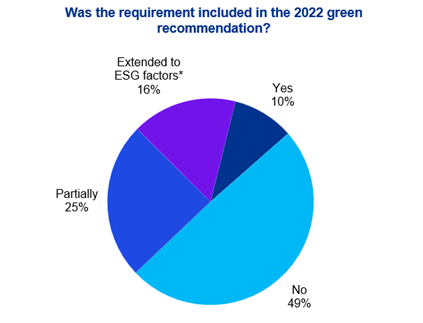
       

      pie-chart-frr

      * Requirements that previously applied only to environmental aspects but have now been supplemented with social and governance factors.

      Source: Own editing

      The review of the requirements shows that the new recommendation largely contains requirements that were not included in the previous recommendation at all, or that replace the general expectations set out therein with precise and detailed requirements. Most of the new requirements relate to the transition plan and the materiality assessment, while the expectations concerning corporate governance have in most cases been expanded with social and governance factors.

      Tightened corporate governance expectations

      One of the key messages of the renewed recommendation is the strengthened role of corporate governance structures. The MNB makes it clear that ESG risk management cannot be limited to sustainability or strategy functions, it must also be incorporated at the highest decision-making levels.

      Accordingly, governing bodies must play an active role in overseeing ESG risks and ensure that appropriate resources are allocated for their management. The central bank expects banks to clearly define, within their organisational structure, the functions responsible for managing ESG risks, and to establish regular reporting mechanisms for the governing bodies.

      This reflects the supervisory approach that ESG issues are no longer merely strategic or reputational considerations but form an integral part of prudent governance.

      Deeper transformation of the risk management framework

      In risk management, the new recommendation sets even clearer expectations for the integration of sustainability risks. Banks must not only identify ESG risks but also have to be able to measure, monitor and integrate them into their risk management processes.

      This is particularly important in credit risk management, given that a large part of banking portfolios is linked to economic sectors that may be vulnerable to climate policies or physical climate risks. The MNB expects credit institutions to assess their clients’ ESG exposure and incorporate this into lending decisions where necessary.

      Furthermore, ESG risks must appear in the institutions’ risk appetite frameworks and internal capital adequacy assessment process (ICAAP). This means that sustainability factors may directly influence capital and risk management strategies in the future.

      The role of data management

      One of the biggest practical challenges in managing sustainability risks is the availability of adequate data. The new recommendation therefore places strong emphasis on improving data management and reporting systems.

      Banks must assess what ESG data are needed to properly evaluate risks and must develop systems for collecting and processing these data. This often requires substantial IT developments, particularly where clients do not yet have structured sustainability data.

      In addition, the new recommendation emphasises the role of management information systems: information related to ESG risks must be available in a form that enables strategic decision-making by governing bodies.

      New supervisory expectations for transition plans

      A key novelty of the recommendation is the introduction of supervisory expectations for transition plans. The central bank no longer expects institutions merely to identify and measure ESG risks, it also requires them to prepare strategically for the decarbonisation of the economy and the shift to a sustainable economic structure. As part of this, institutions must prepare transition plans detailing how they intend to align their business models, financing activities, and portfolio structures with long-term climate and sustainability targets.

      Transition plans must not function only as strategic documents: the central bank expects them to be aligned with the bank’s risk appetite, business strategy, and capital and liquidity planning processes. This approach indicates that, going forward, the Supervisory Authority will increasingly expect financial institutions to consciously and proactively manage the risks and opportunities arising from the green transition over the long term. We provided a detailed overview of the prudential transition plans required under the EBA ESG Guidelines in the August 2025 issue of the KPMG Financial Risk & Regulation newsletter.

      Tightening of the legal environment

      The Hpt. amendment incorporated the concept of ESG risks directly into the legislation governing credit institutions. These risks must now be considered when institutions design capital adequacy strategies, operate governance and risk management systems, and develop remuneration policies.

      According to the Hpt. amendment, institutions must have appropriate strategies, policies, procedures, and systems for identifying, measuring, managing, and monitoring ESG risks, proportionate to the scale and complexity of these risks. The resilience of companies to ESG risks must be assessed through the analysis of potential long‑term impacts arising in their business environment. This must be carried out through a vulnerability assessment that considers a baseline scenario and additional adverse scenarios, starting with the assessment of climate‑related factors.

      Governing bodies must define measurable targets and related procedural plans for managing short-, medium-, and long-term financial risks arising from ESG factors. The governing bodies of credit institutions must possess appropriate knowledge, skills and experience to adequately oversee and understand the risks to which the credit institution is exposed, as well as the impacts it generates. Accordingly, governing bodies must receive adequate training on ESG risks and impacts.

      Change in supervisory approach

      The MNB’s new recommendation fits into the broader European trend in which sustainability risk management is becoming an integral part of prudential supervision. The integration of ESG risks is no longer merely a recommended practice but is increasingly becoming part of supervisory assessments and risk management expectations.

      According to the amendment to the Hpt., the Supervisory Review and Evaluation Process (SREP) includes the assessment of credit institutions’ governance and risk‑management processes for managing ESG risks, as well as their exposures to ESG risks, taking into account the business model of the banks.

      As part of the SREP, the Supervisory Authority examines and assesses:

      • The credit institutions’ exposures to ESG risks, based on the quantitative targets and procedural plans developed for these risks
      • The results achieved in managing ESG risks arising from the process of achieving climate neutrality and adaptation
      • The practices of credit institutions relating to ESG strategies and the associated risk management, including quantitative targets and procedural plans
      • The credit institutions’ sustainability‑related product offering, transition financing policies and related lending policies, as well as the assessment of ESG targets and limits

      In the event of a breach of the requirements or the identification of deficiencies, the Supervisory Authority may require credit institutions to reduce the risks arising from ESG factors in the short, medium and long term, as well as the risks resulting from the objectives, measures and actions stemming from the adjustment of the business plan, strategy and risk‑management framework prepared for the management of ESG.

      Conclusions

      The MNB’s 2026 sustainability recommendation clearly indicates that sustainability risk management has become a defining element of the operations of the banking sector. The document tightens and specifies previous expectations in several areas, particularly in the fields of corporate governance, risk management and data management.

      While the 2022 recommendation primarily served to prepare banks and support a shift in mindset, the new recommendation reflects a more mature regulatory phase. The management of sustainability risks can no longer be regarded as an optional or additional task: it has become an integral part of prudential risk management.

      With the amendment of the Hpt., ESG risks have been incorporated into the legal framework as well, enabling the Supervisory Authority even to impose stricter sanctions when assessing compliance with the requirements set out in the recommendation.

      This sends a clear message to the banking sector. In the coming years, those institutions will be able to adapt effectively to the changing regulatory environment that genuinely integrate sustainability considerations into their operations, rather than viewing them merely as a compliance exercise.

      Contributors to the preparation of this newsletter: Marcell Szabó, Levente Marek, Balázs Egerszegi


      Contact us

      Gergő Wieder

      Director

      KPMG in Hungary

      Péter Vajda

      Manager

      KPMG in Hungary