
      For many consumers, chatting to an AI before making a purchase is already part of everyday life. In agentic commerce, AI agents can take over the entire shopping process. For retailers and manufacturers, this means they must also ensure that the AI is convinced by their offerings.

      Artificial intelligence has long supported numerous data-driven decisions in the retail and consumer goods sectors – from sales forecasts and pricing to personalised recommendations. Now, it is increasingly changing direct interaction with consumers and taking on a new role in the purchasing process: that of a shopping adviser. AI agents search for products, compare alternatives and make recommendations based on individual goals and needs. It is foreseeable that agents will eventually complete the purchase themselves. The first areas of application are likely to be recurring purchases with little emotional attachment, such as washing powder, toothpaste or coffee. The greater the trust consumers place in these agents, the more likely AI is to evolve from an adviser into an independently acting player in the purchasing process.
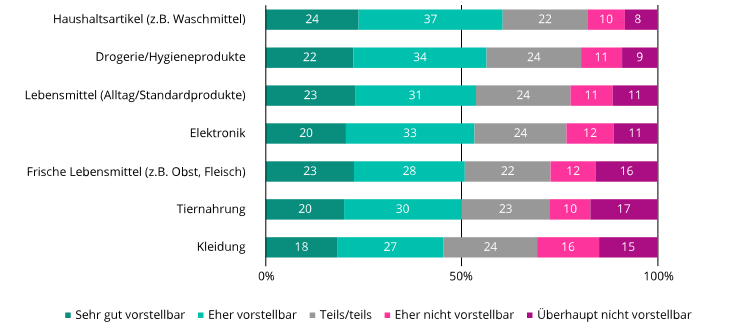
      Buy yourself or instruct an AI agent? Willingness by product category

      For routine purchases, there is the greatest willingness to leave the purchasing decision to AI agents.

      abbildung 1

      Source: KPMG AG, Appinio survey, June 2026, n=1,000, figures in per cent


      Discover how KPMG can support your business.

      AI agents are becoming the gatekeepers of consumption

      AI agents are creating a new intermediary between consumers and the product offering. Until now, search engines, online shops and marketplaces have been at the centre of product searches. Now, AI agents are increasingly making a preliminary selection, thereby influencing which products even make it onto consumers’ shortlists. For brands, manufacturers and retailers, this once again raises the question of how they can ensure they are taken into account in this selection process.

      So what information determines whether an AI agent recommends a product? Structured, up-to-date and machine-readable product information forms an important basis for this. The better agents can capture products and their characteristics, the more accurately they can match them to specific customer needs. However, product data alone does not determine a recommendation. Factors such as availability, reviews, trust or digital visibility can also influence the selection. Companies should therefore identify which criteria are actually decisive in the decision-making process and how their importance varies depending on the enquiry and the AI agent.

      What does Agentic Commerce mean for retail and industry?

      New rules apply to product search and customer access: retailers and manufacturers must ensure that their brands and products remain visible and relevant in response to needs-driven enquiries from AI agents. Objectivity is becoming a key factor in building trust. Consumers expect transparent recommendations that are not determined solely by advertising budgets or profit margins. This is particularly relevant for retailers’ and manufacturers’ own AI offerings, which compete with general AI services for consumers’ trust.

      Retailers and manufacturers must now adapt to Agentic Commerce. In addition to digital visibility and trustworthy, as objective as possible recommendations, they should also be able to understand the logic by which AI agents select products and brands, and how these are included in the Agent Relevant Set. Those who understand these mechanisms early on can tailor their product data, digital presence and customer engagement specifically to them.


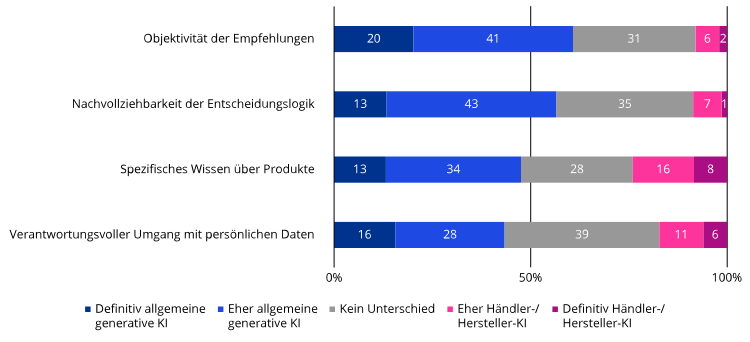
      Retailer or manufacturer AI, or general AI? Preferences regarding key purchasing criteria

      General AI has a significant lead in terms of objectivity. Retailer or manufacturer AI is catching up in terms of product knowledge and data handling.

      abbildung 2

      Source: KPMG AG, Consumer Snapshot Issue 03/2026: Agentic Commerce put to the test, Appinio survey October 2026, n=500, figures in per cent 

      More on AI and agentic commerce

      Your contacts