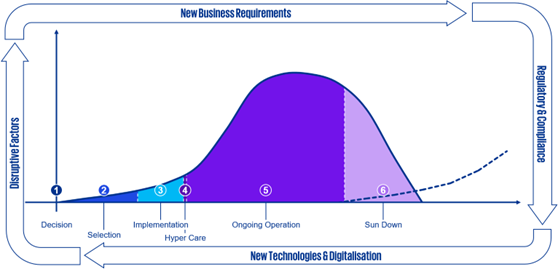
Once you have decided on the right TMS, the next step is to implement it. A successful system implementation requires careful planning, a clear project organisation and the involvement of all relevant stakeholders. A well-structured project organisation creates the basis for effective collaboration and communication. At the same time, it is important to identify the needs and expectations of stakeholders and ensure that they are taken into account throughout the project.
Another key aspect is the choice of project management approach based on the specific project requirements. This forms the basis and at the same time sets the framework for the entire course of the project. While agility enables flexibility and quick adjustments, the waterfall approach offers clear phases and structure. A decisive factor in the decision is the company's own approach, which can also consist of a hybrid solution.
As soon as the framework parameters have been defined, the creation of specialised concepts can begin on the basis of the requirements, in which the target processes are described clearly and in detail. Here, diagrams help to illustrate and create an in-depth understanding. It is essential to consider how the processes are to be mapped. This offers a great opportunity to streamline workflows and switch to best practice approaches. Often, not every step has to be adopted 1:1.
The system integrator then describes in a technical concept how the requirements are covered by customising the software. The specialist department and system integrator should work closely together due to the interdependence between requirements and implementation, as some systems are supplied with standard processes more or less out of the box. This makes it possible to reduce both implementation and subsequent maintenance costs.
When defining both the functional and technical concepts, it is very important to delineate the requirements that are not part of the implementation in order to define a realistic and feasible catalogue of tasks based on the scheduled project timeframe. As with the previous system selection, the MSCW method is an efficient method for prioritising and categorising all requirements on the basis of importance and impact. By involving the stakeholders involved and categorising them collaboratively, a common and transparent set of expectations for the project is created. Requirements that are subsequently classified as relevant to the project during the implementation period should be subject to the same prioritisation and may result in additional effort - both in terms of resources and costs.
The successful prioritisation of project activities is followed by the actual implementation and introduction of the system. Experience shows that companies ask themselves at this point what the right test procedure is. The need for dedicated test management and the associated documentation is undisputed. Project delays often have a negative impact on the test phase. Inadequate testing can lead to serious problems such as incorrect bookings, incorrect valuations, inability to pay or breaches of compliance guidelines. These examples show how important thorough testing is in order to avoid major consequences. Modern test management is seen as a way of anticipating the known challenges of a system implementation by addressing the requirements already defined during the RfP at an early stage and combining them with relevant KPIs to maximise transparency.1 This approach enables a detailed and precise estimate of the effort required for the test run. A test management tool also enables clear progress tracking, target group-orientated reporting and also serves as a basis for control. It is advisable to plan the procedure as early as possible in order to be able to demonstrate a comprehensive and audit-compliant procedure in the subsequent annual audit, as TMS systems provide important data for ERP systems and therefore influence the accounting. This relevance should always be taken into account during implementation planning and audit compliance. A project-accompanying audit (in accordance with the ISAE3000 standard) can help you to recognise problems at an early stage, prevent them and ensure the success of the project.
A classic cost driver in implementation projects are the interfaces to other systems - both internal (e.g. accounting) and external (e.g. payment transactions). For this reason, it is important to take the existing IT architecture into account and involve affected departments in the project as early as possible. It is also important to clarify responsibilities, particularly with the IT department, for the subsequent transfer to regular operations, as a clear division of responsibilities and competences is necessary to ensure efficient operations and avoid misunderstandings.
In addition to technical and organisational planning, change management is also a key success factor. "Clear role allocations and communication channels ensure effective implementation. In addition to expertise, soft Competencies such as communication and problem-solving skills are crucial for team members. "2 It makes sense to integrate existing employees, skills, role concepts and responsibilities and to build up knowledge, especially with regard to the new system and potentially associated process changes. Another key aspect is the early involvement of all future users. Users are familiarised with the new system through targeted testing and training. Comprehensive communication is crucial in order to promote acceptance and address potential resistance. This methodical approach ensures not only the technical implementation, but also the sustainable integration of the system into existing work processes.
After successful testing and approval by the relevant stakeholders, it is advisable to carry out this process as part of a "dress rehearsal" in a test environment in preparation for the go-live of the new TMS, so that the schedule can be checked and potential inconsistencies in the process or in the performance of manual activities can be identified and rectified. Furthermore, all issues that cannot be finalised by this point and are not relevant to Go Live must be documented. A structured handover of the open points enables smooth operation or prioritised processing of these remaining open points afterwards. You should make sure to set an implementation date to ensure complete and timely realisation.