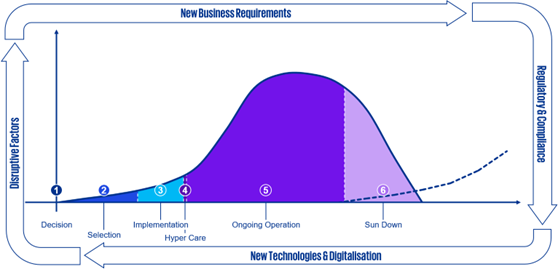
Once the decision has been made to evaluate various alternative courses of action in relation to the TMS, the next step is to structure the selection process and determine who should be involved in these decisions.
Firstly, the requirements for the system or the system provider itself must be formulated in order to select a fit-for-purpose system. Both functional (e.g. cash management activities) and non-functional aspects (e.g. commercial or IT-specific requirements) need to be considered. It is essential to formulate these requirements as completely and precisely as possible. Requirements that are formulated too briefly harbour the risk of misunderstandings, e.g. the "recording and processing of loans" is very generic and is offered by most providers in a more or less sophisticated form. If there is a need to map complex fee structures, conditional cancellation options or market value compensation in the event of early repayment, this should be reflected in the requirements. Ideally, and as far as can be anticipated, future requirements should also be taken into account, for example if new instruments are to be used in risk management or the company develops an ESG strategy according to which future business partners must have an ESG rating at a certain level.
In addition to the treasury department, the following departments should be able to address their requirements to a system or provider: the accounting department (e.g. for posting the business transactions associated with treasury activities), the HR department (e.g. for processing HR payments), the IT department (e.g. for taking strategic partnerships into account), the finance department (e.g. for processing HR payments), the finance department (e.g. for processing HR payments), the finance department (e.g. for processing HR payments) and the finance department (e.g. for processing HR payments).(e.g. for the consideration of strategic partnerships or for interfaces for embedding in the overall corporate IT landscape), the controlling department (e.g. for the transfer of planning data) or the compliance department (e.g. for the creation of AWV reports). Once the requirements of all potential stakeholder groups have been taken into account, they must be prioritised or weighted to ensure that essential requirements are not underestimated and less value-creating requirements are not overestimated. One approach here is the MSCW method, in which the requirements are categorised into four groups: Must (requirements that should be fulfilled in any case), Should (requirements that are also important but do not have top priority), Could (so-called nice-to-have criteria whose lack of fulfilment does not mean a decisive disadvantage) and Won't (criteria that are not likely to be fulfilled, but which do not affect the benefit or acceptance).
Based on the defined criteria, the next step is an initial analysis of the provider and solution market. In addition to validating the knowledge available in the company, the exchange with other treasurers, relevant market analyses (e.g. from Gartner or Forrester), research on the Internet and in specialist publications (e.g. Der Treasurer) as well as external expert knowledge should be used as sources. The result is a "market list". At this point, initial, overarching filter criteria can already be used, e.g. the basic range of functions, the degree of complexity or the size of the manufacturer, in order to organise the further selection process as efficiently as possible. After this rough filtering, a "longlist" is obtained.
This longlist is then reduced to a "shortlist" by applying individual requirement criteria. Ideally, this should contain two to five systems. If the criteria are sufficiently detailed and the information to fulfil them is freely available, the shortlist can be drawn up directly after the market analysis. Alternatively, objective expert knowledge can be used.
In a Request for Proposal, which is based on the requirements formulated at the beginning, corresponding documents must be prepared which, in addition to the specification, also contain information about the company itself, the further process, a timetable for answering the questions and other details. At this point, the purchasing department and the legal department should be involved - if they have not already been - in order to organise the process, lay the foundations for subsequent targeted negotiations and ensure that legal framework conditions are taken into account. The tender documents are sent to the bidders and there is often an opportunity to ask questions, the answers to which can be shared with all participants. It is advisable to design the tender documents in such a way that the responses can be analysed efficiently. It should also be borne in mind that suppliers are often very optimistic about the fulfilment of requirements. Hands-on expert knowledge offers great added value here. The degree of fulfilment of the requirements weighted at the beginning must be evaluated on the basis of the responses.
Often two to three systems remain on the shortlist, which are then invited to a so-called "beauty contest", for the preparation of which various essential end-to-end use cases are defined, e.g. from the receipt of a bank statement to reconciliation with forecasts, possibly with manual post-processing, to posting and the creation of a daily financial status. The impression of the presentation can also be included in the assessment. If necessary, further contract negotiations take place in parallel or subsequently in order to optimise the commercial offer.
Taking all parameters into account, the objectively best system should be selected and, if necessary, a system integrator if the service cannot be provided in full by the treasury and IT departments and the system provider. In this context, the corresponding contracts must be signed.Once the decision has been made to evaluate various alternative courses of action in relation to the TMS, the next step is to structure the selection process and determine who should be involved in these decisions.
Firstly, the requirements for the system or the system provider itself must be formulated in order to select a fit-for-purpose system. Both functional (e.g. cash management activities) and non-functional aspects (e.g. commercial or IT-specific requirements) need to be considered. It is essential to formulate these requirements as completely and precisely as possible. Requirements that are formulated too briefly harbour the risk of misunderstandings, e.g. the "recording and processing of loans" is very generic and is offered by most providers in a more or less sophisticated form. If there is a need to map complex fee structures, conditional cancellation options or market value compensation in the event of early repayment, this should be reflected in the requirements. Ideally, and as far as can be anticipated, future requirements should also be taken into account, for example if new instruments are to be used in risk management or the company develops an ESG strategy according to which future business partners must have an ESG rating at a certain level.
In addition to the treasury department, the following departments should be able to address their requirements to a system or provider: the accounting department (e.g. for posting the business transactions associated with treasury activities), the HR department (e.g. for processing HR payments), the IT department (e.g. for taking strategic partnerships into account), the finance department (e.g. for processing HR payments), the finance department (e.g. for processing HR payments), the finance department (e.g. for processing HR payments) and the finance department (e.g. for processing HR payments).(e.g. for the consideration of strategic partnerships or for interfaces for embedding in the overall corporate IT landscape), the controlling department (e.g. for the transfer of planning data) or the compliance department (e.g. for the creation of AWV reports). Once the requirements of all potential stakeholder groups have been taken into account, they must be prioritised or weighted to ensure that essential requirements are not underestimated and less value-creating requirements are not overestimated. One approach here is the MSCW method, in which the requirements are categorised into four groups: Must (requirements that should be fulfilled in any case), Should (requirements that are also important but do not have top priority), Could (so-called nice-to-have criteria whose lack of fulfilment does not mean a decisive disadvantage) and Won't (criteria that are not likely to be fulfilled, but which do not affect the benefit or acceptance).
Based on the defined criteria, the next step is an initial analysis of the provider and solution market. In addition to validating the knowledge available in the company, the exchange with other treasurers, relevant market analyses (e.g. from Gartner or Forrester), research on the Internet and in specialist publications (e.g. Der Treasurer) as well as external expert knowledge should be used as sources. The result is a "market list". At this point, initial, overarching filter criteria can already be used, e.g. the basic range of functions, the degree of complexity or the size of the manufacturer, in order to organise the further selection process as efficiently as possible. After this rough filtering, a "longlist" is obtained.
This longlist is then reduced to a "shortlist" by applying individual requirement criteria. Ideally, this should contain two to five systems. If the criteria are sufficiently detailed and the information to fulfil them is freely available, the shortlist can be drawn up directly after the market analysis. Alternatively, objective expert knowledge can be used.
In a Request for Proposal, which is based on the requirements formulated at the beginning, corresponding documents must be prepared which, in addition to the specification, also contain information about the company itself, the further process, a timetable for answering the questions and other details. At this point, the purchasing department and the legal department should be involved - if they have not already been - in order to organise the process, lay the foundations for subsequent targeted negotiations and ensure that legal framework conditions are taken into account. The tender documents are sent to the bidders and there is often an opportunity to ask questions, the answers to which can be shared with all participants. It is advisable to design the tender documents in such a way that the responses can be analysed efficiently. It should also be borne in mind that suppliers are often very optimistic about the fulfilment of requirements. Hands-on expert knowledge offers great added value here. The degree of fulfilment of the requirements weighted at the beginning must be evaluated on the basis of the responses.
Often two to three systems remain on the shortlist, which are then invited to a so-called "beauty contest", for the preparation of which various essential end-to-end use cases are defined, e.g. from the receipt of a bank statement to reconciliation with forecasts, possibly with manual post-processing, to posting and the creation of a daily financial status. The impression of the presentation can also be included in the assessment. If necessary, further contract negotiations take place in parallel or subsequently in order to optimise the commercial offer.
Taking all parameters into account, the objectively best system should be selected and, if necessary, a system integrator if the service cannot be provided in full by the treasury and IT departments and the system provider. In this context, the corresponding contracts must be signed.