

For many years, expectations of customer communication have been characterised by sectors with an increasingly high level of digital maturity. Customers do not differentiate between sectors when it comes to interaction. A study shows that over 80% of all consumers expect to be able to switch smoothly between channels when communicating with an insurance company. It is therefore possible to transfer corresponding expectations in communication to the insurance industry.
Hybrid customer behaviour along the entire customer journey
Communication content should not be provided in the same way via every touchpoint/access channel. A suitability test and customisation depending on the communication content, its complexity, customer preference and interaction intention as well as the costs of channel use are relevant. Experience has shown that digital channels are particularly suitable for simple communication content. However, with increasing complexity, customers have a greater desire for personalised support and proximity, which must be taken into account when communicating.

It is important to understand customers' expectations and design the customer journey accordingly. Successful customer centricity requires customisation to the customer's needs and seamless integration of all touchpoints along the customer journey. At the same time, consistent communication offers insurance companies opportunities to optimise their top and bottom lines. Personalised, needs-based approaches can improve conversion and cancellation rates. At the same time, costs can be saved by reducing or eliminating cost-intensive analogue communication processes.
Based on the diversity of customers and insurers, it is clear that there is no "one-size-fits-all" solution to achieve successful customer centricity.
Connected Enterprise approach
At insurance companies, we often see that there are numerous individual digital initiatives for customer centricity. However, these do not follow a company-wide, consistent strategy for customer centricity. As a result, touchpoints are often disjointed and suffer from media discontinuity. This leads to an incoherent customer experience and a high level of complexity in the associated processes. Customer data is often only available in incomplete form and is sometimes of low quality.
To counteract these challenges, we at KPMG have developed the customer-centred, company-wide approach of the Connected Enterprise. This approach is aimed at an overarching focus on fulfilling customer expectations, creating corporate value and promoting sustainable growth in a digital world.
The Connected Enterprise approach includes eight capabilities that form the basis of a successful customer-centred transformation and the foundation for future success. They impact the entire value chain and relate to key capabilities such as products, services, processes and personnel.
This allows you to keep an eye on all requirement dimensions:
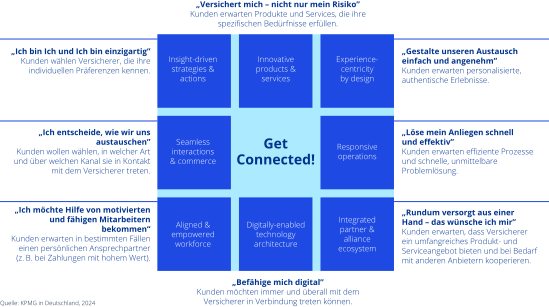
In order to continue to fulfil customer expectations in the future, it is important to constantly find new answers to existing expectations and to implement them with the necessary sensitivity. To ensure future success, insurance companies must always have the right answers to fulfil (digital) expectations. With our connected enterprise approach, you act holistically and can therefore successfully respond to the needs of your customers.


