
With a gross domestic product of 4,470 billion euros in 2025, Germany remains the world’s third-largest economy—behind the United States and China and just ahead of Japan—and is thus also Europe’s largest economy. In particular, exports of motor vehicles and vehicle parts, as well as chemical products, make Germany the world’s third-largest exporting nation. At 70%, the service sector accounts for the largest share of the country’s gross domestic product (GDP). With a share of around 26%, industry in Germany makes a comparatively high contribution to economic output. In other European countries such as France or the United Kingdom, and also in the U.S., the figure is about 17%, while in China it is around 38%.
Data retrieved: 9 June 2026

Current insights in June 2026
- Economic growth
- Export
- Inflation
- Unemployment
- Monetary Social Benefits Provided by the State
Economic Experts Significantly Lower Economic Forecast
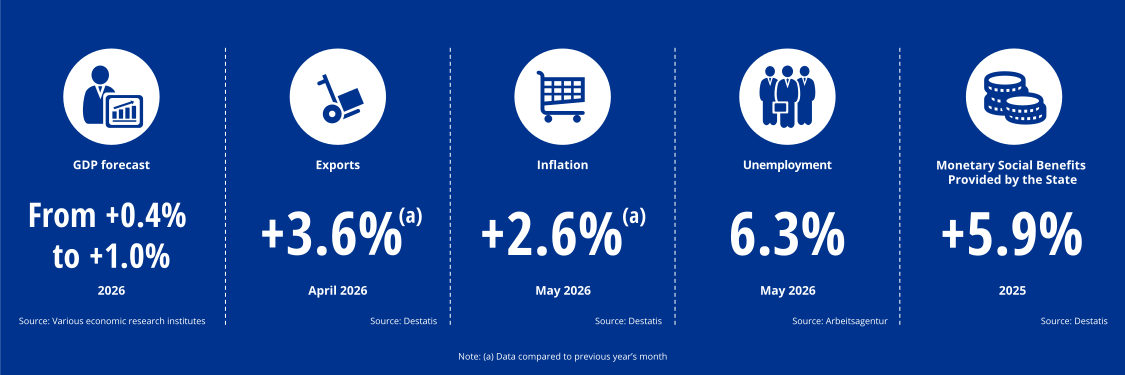
The so-called Economic Experts have significantly lowered their forecast for the German economy in June 2026. Due to the consequences of the war in Iran, the experts now expect gross domestic product (GDP) to grow by only +0.5% for the current year. For 2027, they forecast growth of +0.8%.
In November 2025, the German Council of Economic Experts had still anticipated GDP growth of +0.9% for this year. However, the already weak economic performance is now being hampered once again by rising oil and gas prices.
High energy costs are weighing on businesses, further reducing already declining industrial production and hampering private investment. Rising social security contributions are also increasingly becoming a drag on the overall economy, as they raise companies’ labor costs and reduce households’ net income. Public spending from the fiscal package for defense and infrastructure, on the other hand, is likely to provide some support for economic growth.
Following the slump in March and April 2026, business sentiment in Germany recovered slightly in May 2026. The ifo Business Climate Index rose to 84.9 points, up from 84.5 in April 2026. Businesses appeared somewhat more satisfied with current business conditions, and their outlook for the coming months was also less pessimistic.
The government spending ratio, which indicates the government’s influence on an economy, is calculated as total government spending as a percentage of GDP. According to the European Commission, this stood at 50.2% in Germany in 2025, marking a further increase of +0.7 percentage points compared to 2024. This put the public expenditure ratio slightly above the EU average of 49.6%, but significantly above that of other major economies, such as the United Kingdom (46.9%), Japan (41.3%), and the United States (39.6%).
According to the OECD, income tax plus employee and employer social security contributions for a single worker amounted to 49.3% in Germany in 2025. This means that, among all 38 OECD member states, Germany has the second-highest tax and contribution rate after Belgium and is well above the OECD average of 35.1%, which significantly undermines Germany’s attractiveness as an investment location. The rate is also significantly lower in countries outside the EU, such as the United Kingdom (32.4%) or the United States (30.0%).
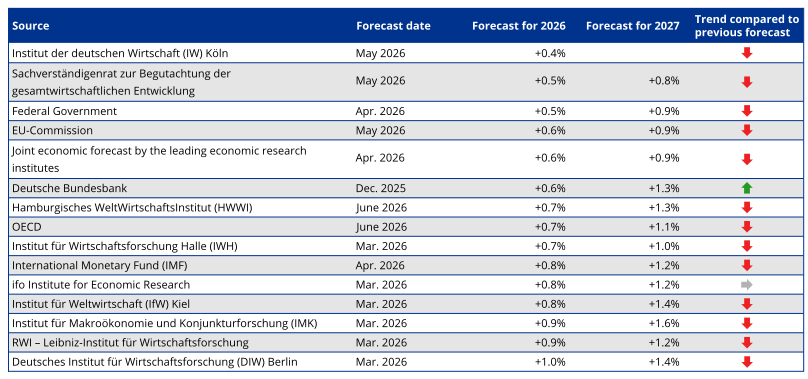
Current forecasts by German economic research institutes and government organizations regarding GDP growth in Germany range from +0.4% to +1.0% for the calendar year 2026 and from +0.8% to +1.6% for 2027:
Data retrieved: 9 June 2026

German exports rise for the third consecutive month in April 2026
Germany’s exports rose for the third consecutive month in April 2026, despite the headwinds caused by the war in Iran. Exports increased by +0.9% from the previous month to 136.6 billion euros. Imports rose by +1.2% to 122.1 billion euros. Compared to the same month last year (April 2025), exports increased by +3.6% and imports by +6.2%.
The increase was driven primarily by demand from the EU and the U.S. Exports to European Union member states rose by +1.0% compared to the previous month, reaching 79.1 billion euros. Exports to the United States rose by +1.8% to 11.4 billion euros. In contrast, exports to China fell by -3.5%, and to the United Kingdom by as much as -9.5%.
However, the Ministry of Economics is looking ahead to the second quarter of 2026 with concern. Against the backdrop of the ongoing conflict in the Middle East and rising energy prices, the industrial economy is showing a rather subdued performance. Both weaker order growth and increasingly strained supply chains dampened exports in the second quarter. It therefore remains to be seen whether the upward trend will continue from May 2026 onward: The ifo Barometer for export expectations had already fallen in May 2026 to its lowest level since April 2025.
Real (price-adjusted) order intake in the manufacturing sector fell by -3.8% in April 2026 compared to March 2026, after seasonal and calendar adjustment. Excluding large orders, order intake was also 3.8% lower than in the previous month. Even in the less volatile three-month comparison, order intake from February to April 2026 was 3.1% lower than in the three months prior.
Real (price-adjusted) production in the manufacturing sector rose by +0.4% in April 2026 compared to March 2026, seasonally and calendar-adjusted. In the less volatile three-month comparison, production from February to April 2026 was 0.5% lower than in the previous three months.

Inflation drops to 2.6% in May 2026
The inflation rate in Germany fell in May 2026—following the introduction of the fuel rebate. However, goods and services were still 2.6% more expensive compared to the same month last year—down from 2.9% in April 2026.
Since the start of the war with Iran in late February 2026, the inflation rate in Germany had risen significantly in March and April. While it was still below two percent in February—before the U.S. and Israeli attack on Iran—it had already reached nearly the three-percent mark two months later.
According to the Bundesbank, the fuel subsidy reduced the inflation rate by about -0.25 percentage points. However, the Federal Cartel Office also emphasized that crude oil prices had fallen in May 2026 amid hopes for a de-escalation in the Middle East.
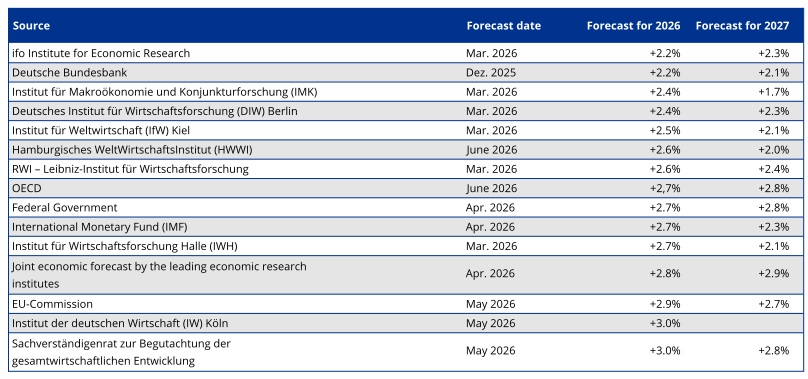
For 2026, economic research institutes currently forecast an average inflation rate of +2.2% to +3.0%, and for 2027, inflation of +1.7% to +2.9%:
Data retrieved: 9 June 2026

Unemployment Falls Below Three Million
For the first time since December 2025, the number of unemployed people in Germany has fallen below the three-million mark. According to the data, approximately 2.95 million people were unemployed nationwide in May 2026—a decrease of 58,000 from the previous month. Compared to May 2025, however, the number of unemployed is 31,000 higher.
The unemployment rate stood at 6.3% in May 2026, which is 0.1 percentage points lower than in April 2026. It was 0.1 percentage points higher than the unemployment rate in the previous year. Despite the decline in unemployment, the spring upturn has not really gained momentum this year. According to the Federal Employment Agency, the decline in unemployment may be attributable more to a weak April than to a strong May. A turnaround toward a positive trend in the labor market remains out of sight.

Monetary social benefits provided by the state rose by 5.9% in 2025
In 2025, the government spent more on cash benefits to cover social risks than in the previous year. Government monetary social benefits rose by +5.9% or +41.7 billion euros in 2025 compared to 2024, reaching 751.2 billion euros. This meant that the increase remained above average compared to the long-term average since 1991 (+3.4%). However, it was lower than in the two previous years (2024: +7.4%; 2023: +6.9%).
Monetary social benefits are cash payments made by the government to provide protection against social risks. In 2025, individual monetary social benefits developed differently: For instance, cash benefits from the German Pension Insurance (+5.9% or +23.2 billion euros to 417.9 billion euros) and public pensions (+5.1% or +4.6 billion euros to 95.0 billion euros) rose significantly. The rise in unemployment led to significant increases in Unemployment Benefit I (+19.1% or +4.5 billion euros to 28.2 billion euros) and in government subsidies for vocational training (+19.4% or +1.2 billion euros to 7.2 billion euros). Spending on housing benefits also increased significantly compared to the previous year (+26.7% or +1.1 billion euros to 5.0 billion euros). Sickness benefits rose by +5.0% (+1.1 billion euros to 22.3 billion euros), long-term care benefits increased by +13.1% (+3.7 billion euros to 31.9 billion euros), and social assistance rose by +7.8% (+3.2 billion euros to 44.4 billion euros). In contrast, the citizen’s income (from July 2026: basic security allowance) declined slightly (-1.5% or -0.4 billion euros to 29.4 billion euros).

A survey of 400 CFOs at international companies in Germany reveals a continuing downward trend in key location factors, but also points to new business opportunities. In our study “Business Destination Germany 2026,” we analyze the data and identify the most important areas for action.
Our most important study results, analyses, and classifications for strategic adjustments to the key areas of geopolitics, artificial intelligence, and sustainability can be found in our white paper From Fragmentation to Trusted Growth: What Matters for Leaders in 2026.
The KPMG Global Navigator provides insights into global growth prospects, opportunities, and challenges.
Our CEO Outlook 2025, for which 1,350 CEOs of large companies around the world were surveyed, including 125 CEOs in Germany, also provides assessments of the economic situation, generative AI, ESG, and other current topics.
Our Future Readiness Monitor 2025, for which 570 top decision-makers in the German economy were surveyed, also provides an assessment of German companies' own future viability in light of new opportunities and complex tasks, their investment plans, and their assessment of trends in the coming years.


Your contacts


- Item 1
- Item 2