

We need to change our thinking: from simply increasing defence spending to building a truly functional, resilient, and strategically managed defence ecosystem across society as a whole.
Hundreds of billions in Czech defence spending
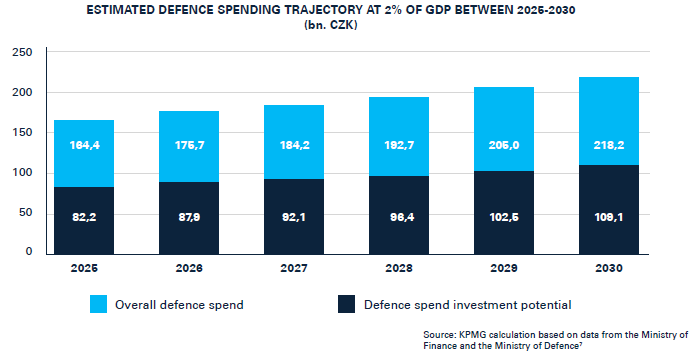
Even if defence spending remains at just 2% of GDP, between 2025 and 2030 there will be a cumulative total of 570 billion CZK available. It is therefore crucial to correctly determine and manage investment priorities.

David Slánský
Partner, Advisory
Every investment in defense is an investment in our country’s future.
Our Czech Defence Vision 2030
By 2030, the Czech Republic will be a resilient, fully integrated, and strategically important country for NATO forces that actively contributes to the stability of the Euro-Atlantic region. This vision is based on five pillars:
I. Strategic management and acquisition excellence
Defense and security are among the state’s top priorities. The state openly communicates its defence acquisition needs over the long term, shares relevant data, and works alongside industry to plan, finance, and maintain capabilities over their entire life cycle. Business shares capacity data.
Why we need change: Fragmented management, weak coordination, and limited transparency
Audits show that current processes are not prepared to absorb the increased volume of funds effectively and transparently, as evidenced by up to 1.4 billion CZK in inefficiencies
Experience from the French SCORPION programme shows that similar problems can be prevented by creating a central authority with clear responsibility for managing large acquisition projects and supporting clustering or consortia and the support of clusters or consorcium and clearly defined procedures.
Good practice: FRENCH SCORPION
The SCORPION programme (worth over 6.8 billion
USD) is transforming the French land forces by
replacing 1970s technology with modern platforms
connected in real time (the ‘collaborative combat’
doctrine). Since its launch in 2014, over 1,100 vehicles
(GRIFFON, SERVAL, JAGUAR) have been delivered
by 2025, and production capacity has tripled to 300
vehicles per year, creating over 1,700 direct jobs.
Good practice:
FRENCH SCORPION
Success factors

II. Coordinated supply chains and strong exports
The state supports the defense and security industry and they work together as strategic partners. Including key raw materials, production capacity, technology skills, and risk dependency management. It is able to plan, prevent outages, and respond adeptly to crisis scenarios. The Czech industry is fully prepared and open to developing both domestic and international partnerships.
Why we need change: A defence industry without a strategic framework
In 2024, defence equipment exports reached a historic high of 94 billion CZK (3.74 billion EUR). Achieving an even better result would be supported by faster and fully digitalized export licensing. Where appropriate, Czech companies actively participate in stable industry clusters and associations.

Petr Brychta
Associate Director, Advisory
Our goal by 2028 should be to involve at least 20 Czech entities in EDF and PESCO projects and to secure access to at least €20 million annually.
Good practice: ESTONIAN CLUSTER AND SUCCESS IN EDF
Estonia shows how a well-organised cluster can
multiply the chances of small companies to obtain
European funding. The Estonian Defence and
Aerospace Industry Association (Defence Estonia
Cluster) brings together more than 100 companies
and research institutions and acts as their single
“main supplier” to the state and the EU.
As part of the EDF’s predecessor, the European
Defence Industrial Development Programme
(EDIDP), it coordinated the participation of
Estonian companies in projects with total support
of over 10 million EUR, including the flagship
iMUGS project for the development of unmanned
ground systems with a budget of 32.6 million
EUR (of which 30.6 million EUR came from the
EU). It followed up on this success in the EDF
programme, where Estonia, thanks to the cluster
and the active role of the Ministry of Defence,
obtained funding for 16 international projects,
which is the best result in its history and a
significantly above-average performance given
the size of its economy.
Good practice:
ESTONIAN CLUSTER AND SUCCESS IN EDF
III. Innovation, research, and technological sovereignty
Czech research bridges the gap between development and practice. There is a functional framework for technology support, knowledge sharing, and testing, bringing together research institutions, business, and the military to introduce prototypes and translate research into commercial products.
Why we need change: We have high-quality research, but no way to use it
The security threats of the 21st century are primarily technological. Modern defense technologies do not have only a security dimension; they can also become another pillar of innovation-driven and, consequently, economic growth. Many projects end up with prototypes placed in a figurative drawer. We must support the development of dual-use technologies, regular rotation of experts between academia, industry, and the armed forces, and the creation of venture capital funds (with state participation) focused on defense and dual-use start-ups. Legislative changes are also needed to make it easier for companies to use military testing facilities.
The experience from Ukraine shows that it is not only the technological level itself that is decisive, but also the ability to connect research, the military, and industry into a rapid feedback cycle – from identifying needs, experimentation, and prototyping to industrial production and tactical integration into doctrine.
Good practice: LESSONS FROM UKRAINE
After Ukraine effectively lost its navy in
conventional terms, it faced the challenge of
how to counter the dominance of the Russian
Black Sea Fleet. The answer was not to purchase
expensive frigates, but to develop inexpensive,
unmanned surface vessels (USVs) that could be
deployed in groups.
The development of Magura-class drones
(‘Maritime Autonomous Guard Unmanned Robotic
Apparatus’) under the leadership of the Ukrainian
intelligence service HUR shows what an extremely
fast innovation cycle looks like in practice:
The Magura example shows that even a more
complex system can be developed in a matter of
months, rather than decades, if there is a direct
link between the operator and the developer. The
key is not perfecting first prototype, but the ability
to quickly deploy a minimum viable product
(MVP) and modify it immediately.
Good practice:
LESSONS FROM UKRAINE – WAR AS AN
ACCELERATOR OF DEFENCE INNOVATION
Magura V5: Agile development as a strategic
weapon
IV. Logistical and infrastructure readiness
The state systematically develops critical infrastructure (roads, hospitals, housing, supplies, healthcare, etc.) with a dual use – civilian operations and crisis situations. This hereby strengthens logistical preparedness and the ability to fulfil the obligations of a host country.
Why we need change: Infrastructure cannot succeed without coordination
Infrastructure is one of the most fundamental prerequisites for a state's defense capability. The experiences of Poland and other NATO countries show how the systematic modernization of infrastructure can strengthen both national security and the construction sector, as well as regional employment.
The Czech state should maintain a digitally managed inventory of military assets, including information on potential sharing across public authorities and with the civilian sector.
Good practice: EAST SHIELD PROJECT
The East Shield programme (Polish: ‘Tarcza
Wschód’) an investment of 10 billion PLN by 2028,
is the building of a multi-layered defence line along
the 700 km border with Belarus and Russia. The
project combines classic fortifications (anti-tank
ditches, concrete barriers, bunkers, barbed wire) with a technological aspect (airspace surveillance,
anti-drone measures, drones, aerostats, and
elements of the ‘Barbara’ reconnaissance system)
, along with robust logistical support for the rapid
deployment of forces. The programme not only
serves as a deterrent but also strengthens the
mobility of Polish forces and their ability to deploy
quickly.
The backbone of the project is a network of
advanced material depots (concrete, HESCO,
engineering material) deployed in three layers from
the border itself to rear centre inland. A total of
108 contracts worth approximately 300 million PLN
have been awarded, with some of the warehouses
already in operation.
An important element of East Shield is the
interconnection of defence and civilian
infrastructure. Some of the investments in roads
and bridges have a dual purpose, primarily to
increase the army’s mobility, but in peacetime
serving regional development and civilian
transport. This dual-use strategy reduces overall
costs, increases the social value of the project,
and creates synergies between security and
economic goals. According to expert analysis, the
interconnection of civil and defence functions is
also important for crisis management, as it allows
the same transport, energy, and communication
elements to be used in times of peace and in
times of threat.
Economically, the programme strengthens
domestic industry (construction companies,
technology companies, and defence equipment
suppliers), while creating jobs in border regions.
Poland is actively seeking to utilise European
financial resources, focusing on funds from the
European Investment Bank (EIB) as part of its
initiative for security and dual-use projects, while
also promoting the possibility of direct co-financing
of the defence line from the EU budget. According
to preliminary agreements, Poland was to negotiate
with the EIB for approximately 1 billion EUR
earmarked directly for the East Shield project.
The main risks include the high long-term
maintenance costs of an extensive warehouse
network, the logistical vulnerability of border
depots, and the political sensitivity of certain
measures, such as the creation of minefields.
Nevertheless, the combination of strong political
support, a modular logistics network, technological
innovations, and the interconnection of civil and
defence infrastructure makes the East Shield
programme one of the most ambitious projects
aiming to strengthen NATO’s eastern flank.
Good practice:
EAST SHIELD PROJECT
V. Human capital, education, and cross-societal resilience
Czechs are ready for crisis situations. The state systematically supports the preparedness of its citizens and strengthens resilience against crisis situations, whilst ensuring that the basic cornerstones of the economy keep running. Developing human capital for national security takes place across state administration, the armed forces, academia, local government, industry, and voluntary organisations.
Why we need change: Society can be a source of resilience, the state must create a framework
A truly resilient society can only emerge when a wide range of actors are involved in its protection, including government institutions, the army, businesses, schools, the non-profit sector, and citizens themselves. An approach that connects the armed forces and society is known as a ‘wholeof-society’ approach. This is not about the militarization of society, but about its comprehensive strengthening and consolidation in order to increase psychological resilience, social cohesion, and trust in authorities. Countries whose populations are able to respond to crises and maintain basic operations during them manage shocks more quickly and at lower cost.
The state now has a unique window of opportunity lasting approximately five to seven years, when a more numerically larger generation of young people will enter the labour market and tertiary education. If the army, security forces, and defence industry fail to target this specific wave with attractive offers and meaningful careers right now, this opportunity will disappear.
Good practice: SWEDISH TOTAL DEFENCE
Sweden is a European leader in preparing its
population for crisis situations. For many years,
it has been applying the concept of Total Defence
(Swedish: ‘Totalförsvar’), a comprehensive defence
system that combines military defence and civil
defence into a unified and coordinated framework.
A similar approach is also applied by neighbouring
Finland. One of the most striking features of this
model is the systematic involvement of the whole
of society in crisis preparedness: state institutions,
local authorities, companies, and individuals.
In 2018, the Swedish Civil Contingencies Agency
resumed distribution of the brochure
„If crisis or war comes“ (Swedish “Om krisen eller kriget
kommer”) to all households in Sweden, and
in November 2024, an updated and expanded
version responding to the deteriorating security
situation, „In case of crisis or war“, was published
and distributed. This campaign is an example of
effective communication within the Total Defence
approach.
Similar material, the 72 Hours brochure, has
also been published by the Czech Ministry of the
Interior (MV). Although it focuses primarily on
natural disasters, most of the recommendations
are also applicable in the event of military or hybrid
threats.119
However, it is important to emphasise that a
simple information brochure is only the first
step. In Sweden, the entire system is much more
robust: crisis preparedness is firmly integrated
into educational programmes at all levels and is
continuously developed in cooperation with the
private sector.
Good practice:
SWEDISH TOTAL DEFENCE
What the Czech Republic must do:
Four phases of transformation
The Czech defense ecosystem can be transformed through four interrelated but parallel phases. The proposed steps are not isolated; they form an interconnected plan that responds to the need for more effective management of strategic acquisitions, strengthening the domestic industrial base, and ensuring the state’s preparedness for crisis scenarios.
Phase 1: Set the direction
Step 1: Unify the strategic defence framework
The government, in cooperation with its ministries, will unify fragmented strategic documents into a single coherent framework and set a uniform methodology for planning and ongoing updates, thus creating a comprehensive and realistic Central Defence Plan.
Result: A consistent environment for long-term planning.
Timeframe: 2026
Step 2: Translate ambitions into long-term plans
The Czech Armed Forces will update military requirements based on the Czech Republic’s Security and Defence Strategy. The Ministry of Defence will create a long-term acquisition and defence infrastructure investment plan, determine risk dependencies on foreign countries, and propose their replacement with domestic, European, or other reliable sources.
Result: A clear, predictable, financially realistic technology investment plan coordinated with industry.
Timeframe: 2027 (full implementation of planning cycles), supplier analysis by 2028)
Phase 2: Solid foundations for performance
Step 3: Communicate needs to industry transparently
The Ministry of Defence will regularly publish medium-term acquisition priorities. Suppliers will share capacity and price information. The Ministry of Industry and Trade will monitor data, support exports, and work with the MoD to map industrial capacity and technological readiness.
Result: Industry has the time and confidence to invest. The state makes transparent purchases at fair prices with guaranteed participation for domestic manufacturers.
Timeframe: 2027
Step 4: Introduce unified data architecture and reporting
The Ministry of Defence will conduct a digital process audit and create a “single source of truth” for managing and independently auditing investments in equipment and infrastructure.
Result: Data-driven decision-making, reduced corruption risks, and significantly accelerated and more flexible management processes. The state gains an immediate and accurate overview of what the army has, what it needs, and who can supply it.
Timeframe: 2027 (architecture and Atlas), 2028 (audits and risk plans), 2029 (asset records)
Step 5: Optimise, digitise, and automate key processes
The legislative environment will be analysed to identify barriers. Legislative changes will enable faster, more efficient, and more transparent decision-making regarding resilience, acquisitions, business and research support, infrastructure, and crisis management.
Result: Digitised and accelerated processes with reduced transaction costs.
Timeline: 2027 (audits and process setup), 2028 (full digitisation)
Phase 3: Strengthen resilience
Step 6: Strengthen the resilience of supply chains and
critical infrastructure
The Ministry of Industry and Trade, together with the Ministry of Defence and the State Material Reserves Administration, will identify critical defence players and support them methodologically and financially or with minimum purchase guarantees. This will help build supplies, strengthen self-sufficiency, and modernise the defence environment and the ability to support allies.
Result: Strategic reserves and diversified resources guarantee continuity of supply in crisis situations. Critical infrastructure is fully prepared for military and civilian use.
Timeframe: 2027 (concept and programmes), 2028 (full identification of needs and system configuration)
Step 7: Strengthen mobilisation readiness
The Ministry of Defence will update plans to guarantee the functioning of key capacities in crises. It will focus on regular procedural exercises, coordination across public administration and industry, and developing production capacity that can be rapidly expanded.
Result: Better coordination between public administration, industry, and society for a fast and effective response to exceptional situations.
Timeframe: 2027
Step 8: Develop human capital and societal resilience
The government will create a National Strategy for Human Capital Development in Defence. Responsibilities will be divided between ministries and regions for defence education, crisis preparedness, digital literacy, labour market stability, and local resilience.
Result: Stable labour and technological capacities, improved population readiness, and reduced systemic impact of shocks.
Timeframe: 2027
Phase 4: Unlocking potential
Step 9: Build an innovation and testing ecosystem
The state will modernise its system for supporting innovation and bridge the gap between research and practice. A coordinating body for defence and security R&D will be created with a mandate for strategic planning and 2.5% of the defence budget. It will work with ministries, academia, industry, and the financial sector and manage specialised testing centres.
Result: Fewer barriers between research and industry and increased innovation capacity.
Timeframe: 2027
Step 10: Strengthen international cooperation and exports
The Ministry of Industry and Trade will create a new Defence Industry Export Strategy and digitise export licensing processes. Together with the Ministries of Foreign Affairs and Defence, it will establish a “one-stop shop” for exporters, integrating services from CzechTrade, embassies, and relevant ministries.
Result: Stronger export performance and improved geopolitical position for the Czech Republic.
Timeframe: 2027
Main authors of the study
David Slánský, Partner, Advisory – Head of Defence

David Slánský has nearly 30 years of experience in strategic transformation and data-driven consulting. He specializes in manufacturing, energy, financial services, public administration, defense, and municipalities, helping organizations develop new business models, including creative forms of cooperation between different stakeholders, improve engagement with clients and employees, and drive the digitalization and overall efficiency of processes. He has successfully delivered hundreds of projects across five continents. He is an active member of several global KPMG teams, including Defence and Data & Analytics. He also teaches at the Prague University of Economics and Business and other universities, and is the author of several books and numerous professional articles.
Petr Brychta, Associate Director, Advisory – Subject Matter Expert
Petr Brychta is an expert in the defense industry and technological innovation with more than 20 years of experience. As a member of the Board of Directors at AERO Vodochody AEROSPACE, he led the company’s transformation and established key international partnerships. He also oversaw the security of strategic projects, including deliveries of L-159 aircraft to Iraq, with personal involvement on the ground. As CEO of LPP Holding, he supervised the development of advanced technologies ranging from fully autonomous drones to AI systems and neural networks. He also served as Security Director at Penta Investments.
Radek Chaloupka, Senior Manager, Advisory – Strategy & Performance

Radek Chaloupka leads a team of specialists focused on development concepts, impact studies, and other strategic documents for the public sector. He has overseen impact studies for some of the largest investment projects in the Czech Republic, including Toyota, Onsemi, and Dukovany. Before joining KPMG, he worked at the Ministry of Regional Development, where in both expert and leadership roles he focused on regional development, cooperation with municipalities, and the design of strategic and financial instruments to support territorial development.
Kristina Boudová, Consultant, Advisory – Strategy & Performance

Kristina Boudová specializes in strategic and analytical projects for public administration in the areas of defense, regional development and public policy evaluation. In KPMG, she participated in the preparation of socio-economic analyses and impact studies for major investment units and regional development strategies. She has experience with program evaluations at the national and international levels, including projects for institutions of European Union. In her work, she combines strategic thinking about public investments with an emphasis on long-term impacts, institutional capacities and data-based decision-making.