

Organizations are rapidly adopting AI. It’s exposing them to new risks. It is also creating countless opportunities to improve operations and efficiencies, unlock value and grow competitive advantage.
Cyber Human Risk Management (HRM) is essential to cybersecurity culture, as the way people manage technology is the window through which threat actors can infiltrate organizations.
In all organizations, but particularly ones with diverse ways of working across geographies, building a comprehensive and sustained cybersecurity culture can be challenging. Cybersecurity culture complexities can include how to overcome change resistance, how to adopt emerging technologies securely without slowing down innovation, how to manage interconnected systems securely, how to make the most of metrics and measurement, and more.
KPMG, along with Cybersecurity at Massachusetts Institute of Technology (MIT) Sloan (CAMS), part of Sloan Management School Cybersecurity Research Division, set out to gain a better understanding of cybersecurity culture, its challenges, and how AI could make an impact.
Read the full survey findings to learn how AI can impact cybersecurity culture.
How can AI help boost cyber culture?
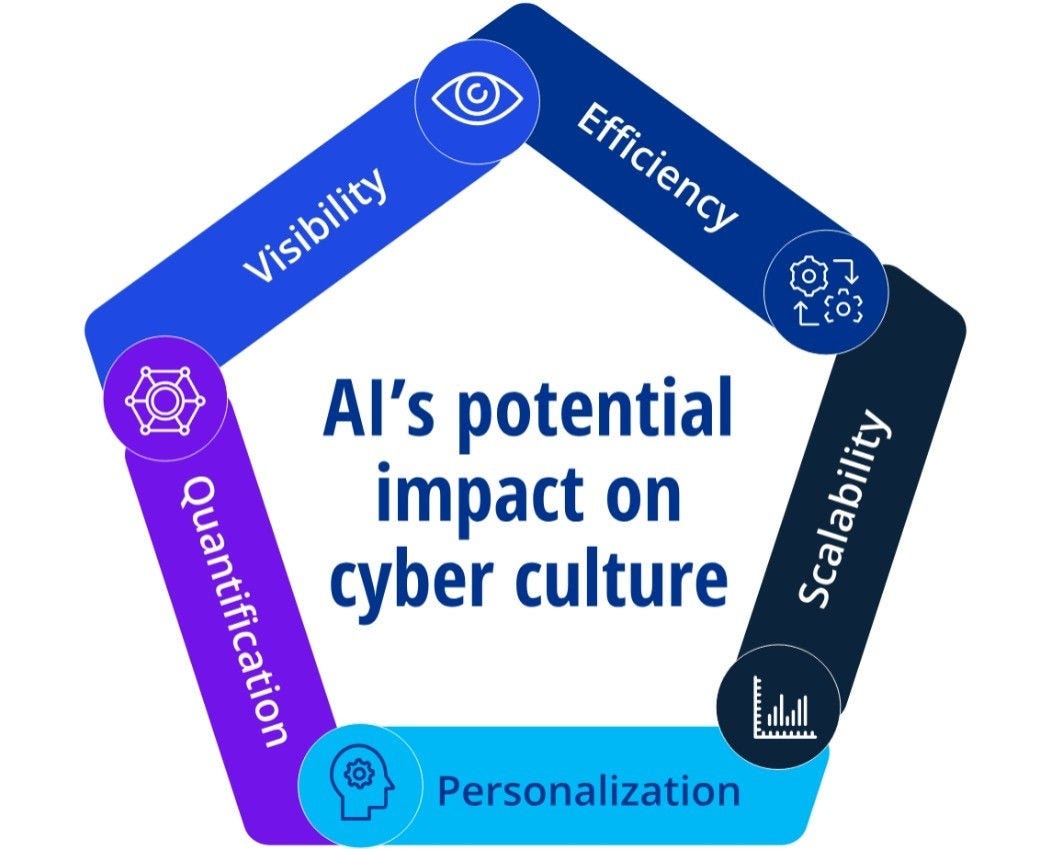
Fostering a strong cybersecurity culture across enterprises and broader ecosystems clearly has its challenges. And, it’s only getting more challenging. AI supports can help an organization building a strong cybersecurity culture through five key themes – visibility, efficiency, quantification, personalization and scalability.

Seven considerations to transform your cyber culture
Build a stronger cybersecurity culture with the support of AI by considering the following:
1. Outline your aspirations: Understand your current cybersecurity culture and set goals and aspirations for where you want to be in the future.
2. Secure support and investment: Seek support from parts of the organization that already have capabilities to develop and embed AI across functions.
3. Explore and experiment: Identify the gaps in your current capabilities and explore options for using AI through the definition of use cases.
4. Prioritize and implement: Focus on implementing the AI use cases that can have the most impact to driving a stronger cybersecurity culture and reducing risk.
5. Collect and measure what matters: An upfront focus on data and its quality can help you get the best out of your AI use cases, and avoid accuracy impacts of your AI models.
6. Be mindful of new risks: Consider what the AI tools and technologies can and can’t do, and the risks that come with them.
7. Prioritize the employee change journey: Prioritize employee wellbeing throughout change with the right communications, training and recognition.
A new age of cybersecurity culture
Drawing on the findings of this new research of cybersecurity leaders, subject matter experts and cross-industry executives, we explore how to harness AI to promote secure workplace behaviors.
Let's connect

Gerasimos Ntouskas
Board Member | Head of Technology Consulting | Chief Digital Officer
KPMG in Cyprus