

In July 2026, the Single Resolution Board (SRB) published its final Operational Guidance on Business Reorganisation Plan Analysis Reports (BRP ARs), a feedback statement on the preceding consultation and the related quantitative template. The documents clarify how banks should demonstrate their operational ability to prepare and implement a Business Reorganisation Plan in a timely manner and show reasonable prospects of long-term viability following an Open Bank Bail-in (OBBI).
Where a bank is placed into resolution and the OBBI tool is applied, its management body must generally submit a Business Reorganisation Plan (BRP) within one month; in exceptional circumstances, the deadline may be extended to up to two months. The BRP AR is distinct: it is a preparatory, capability-oriented resolution-planning deliverable. It should demonstrate that the governance, processes, data and analyses are in place to prepare, implement and monitor a BRP in a crisis and to credibly demonstrate long-term viability after OBBI. A BRP Analysis Report is expected to cover, in particular, the following topics:
- Governance
- Core Bank Identification
- Scenario Identification
- Business Reorganisation Measures
- Maximum Reorganisation Capacity (MRC)
The SRB has a clear view of how the BRP Analysis Report should be prepared as an iterative process:
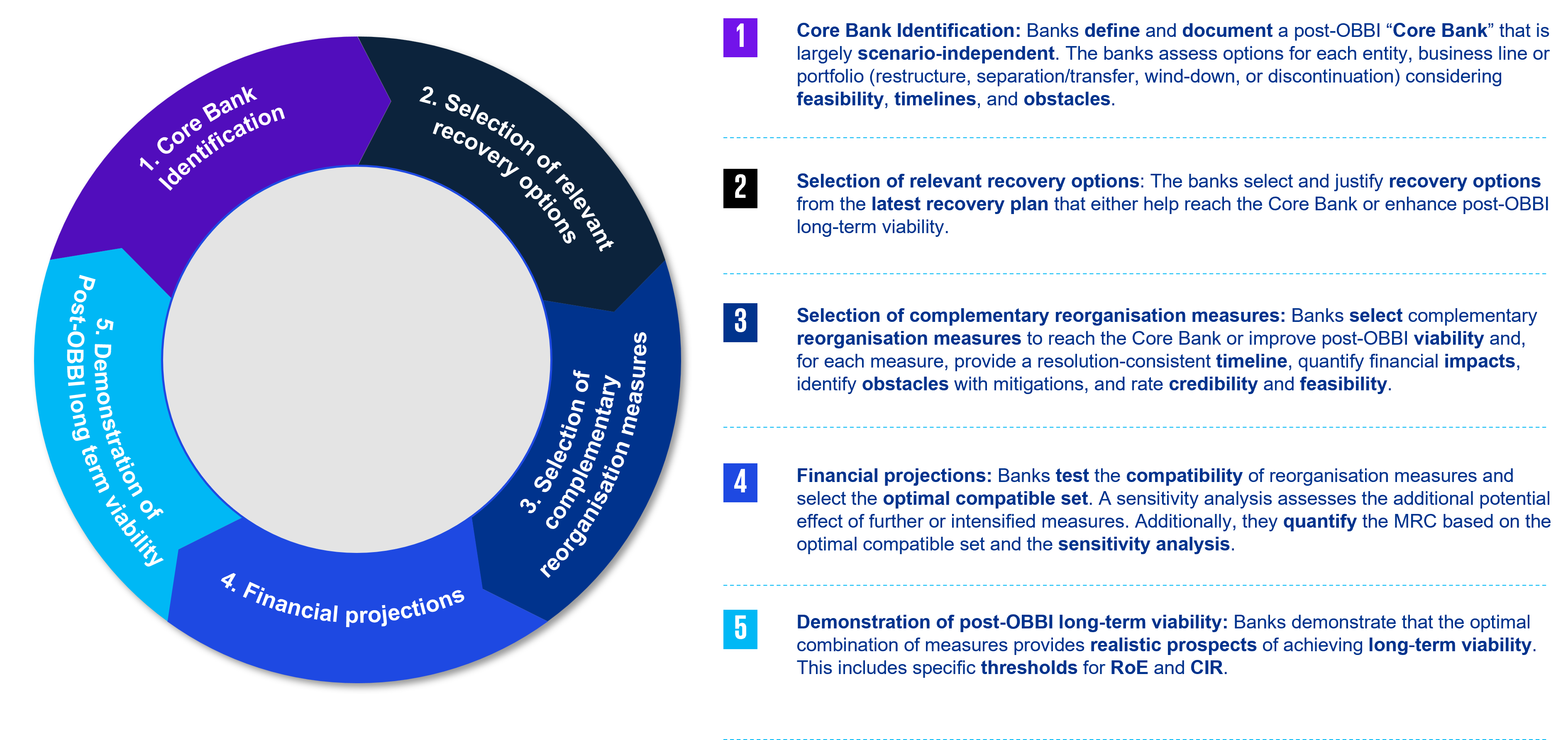
The Guidance consolidates expectations communicated since 2021, addresses gaps identified in earlier deliverables and incorporates best practices. The accompanying feedback statement explains how consultation feedback was considered. Key clarifications concern the distinction between the BRP and the BRP AR, the optional but recommended quantitative template, the timing of application, updates following material changes and the interaction between the Core Bank, the optimal combination of measures, sensitivity analysis and Maximum Reorganisation Capacity.
Capabilities and information
The final Guidance pursues two interconnected objectives. Banks should demonstrate that they have the capabilities to
- prepare and implement a BRP,
- provide reasonable prospects for long-term post-OBBI viability.
The requirements are to be integrated into the normal resolution-planning cycle. Until the competent Internal Resolution Team (IRT) considers the objectives of the BRP AR to have been met, banks must continue to develop their analyses and processes, address IRT feedback and close existing gaps. This requires recurring engagement with the IRT and, where necessary, substantial additions relating to governance structures, the Core Bank, reorganisation measures, financial projections and MRC. Once the IRT confirms that the objectives have been met, updates are generally required only in the event of material changes or upon an explicit request from the IRT.
Core Bank
The Core Bank is the minimum set of viable activities and business lines that the resolved bank is expected to perform at the end of the five-year projection period. It is largely scenario-independent and serves as a conceptual tool for identifying reorganisation measures. Under the Guidance, it results from the measures that collectively achieve the Maximum Reorganisation Capacity; however, not all identified measures necessarily need to be implemented in a crisis. The description should include at least the following categories:
- Critical Economic Functions (CEFs or CFs)
- Core and non-core Business Lines (CBLs)
- Legal entities, including:
- Material Legal Entities (MLEs)
- Relevant Legal Entities (RLEs)
- Key Liquidity Entities (KLEs)
- Service delivery model, including
- Management Information Systems (MIS)
- Financial Market Infrastructure (FMIs)
- Geographical presence and legal jurisdiction
- Branches
- Number of full-time equivalents (FTEs)
Recovery options / reorganisation measures
The Guidance requires a catalogue of credible and feasible reorganisation measures. Suitable options from the current recovery plan form the starting point; where they are insufficient, complementary reorganisation measures must be identified. Options that are not credible, not feasible or not relevant to long-term viability or the Core Bank should be excluded. The process includes:
- Identification of obstacles/constraints
- Quantification/estimation of annual financial effects
- Creating a matrix and choosing an optimal combination of reorganisation measures
Governance
The SRB expects a minimum set of information and elements to document the governance. This also includes the processes following the first draft of the BRP.
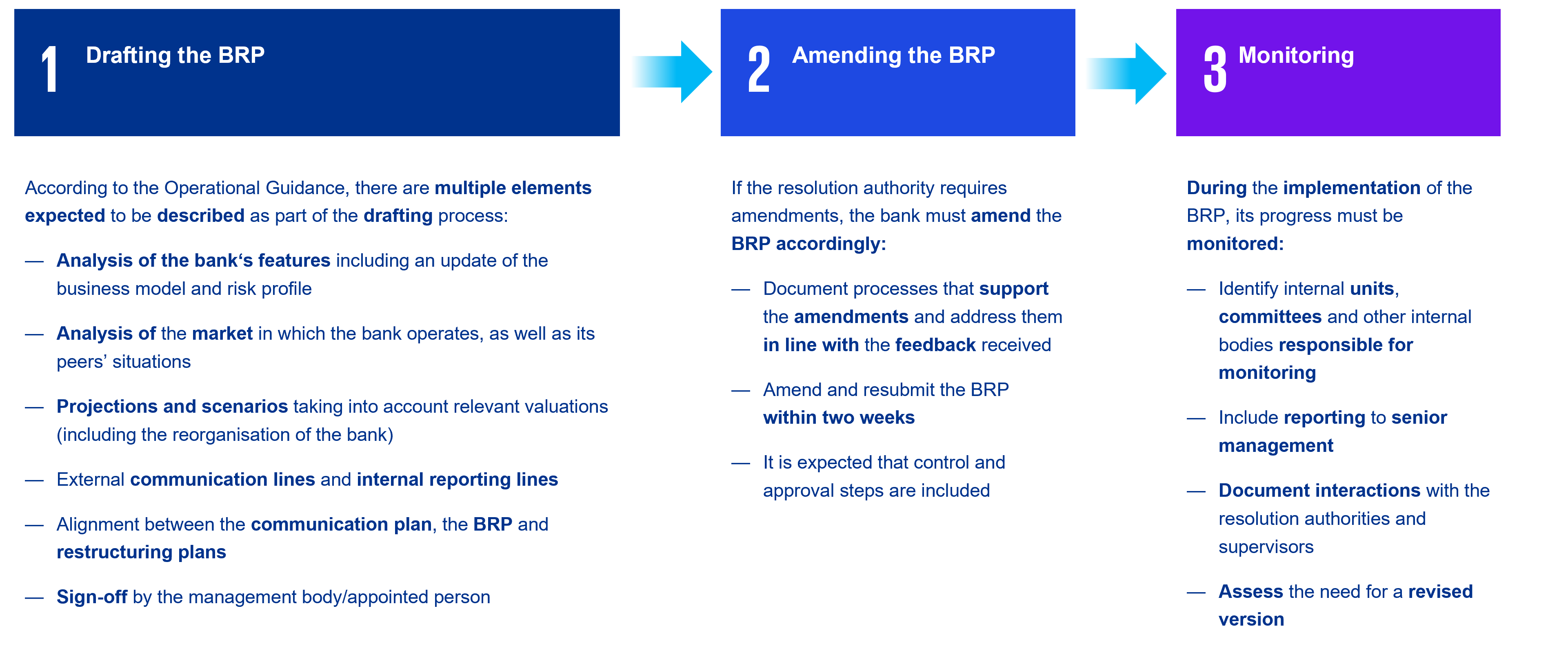
Furthermore, the new guidance specifies the information to be documented for each element:
- List of Stakeholders
- Interconnections/interactions between stakeholders
- Tasks/Operational steps
- Process to create a progress report
Maximum Reorganisation Capacity (MRC):
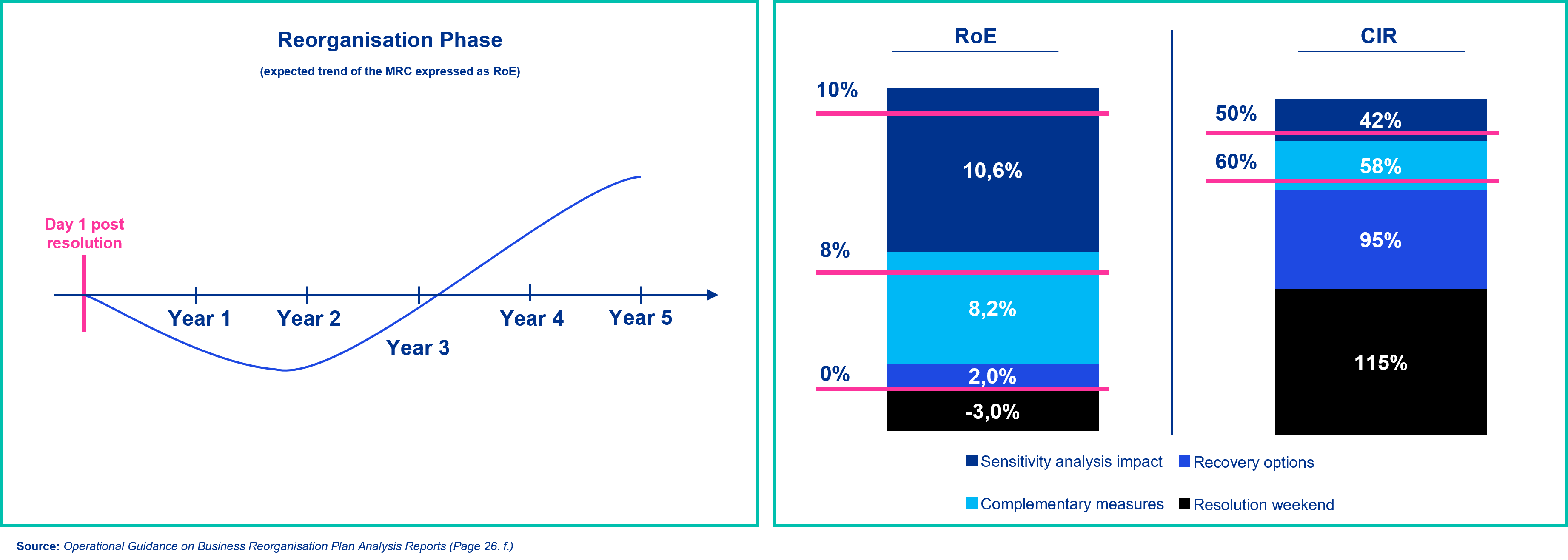
As the Guidance devotes an entire chapter to MRC, the SRB has clearly identified it as a key focus area. Expectations include explanations of the underlying rationale and thresholds, such as:
- A sensitivity analysis for reorganisation measures / to calculate the MRC.
- Focus of the MRC on Return on Equity (ROE) and Cost Income Ratio (CIR).
- Specific RoE and CIR thresholds that define viability (between 8–10% RoE and 50–60% CIR).
Quantitative Template
To present the quantitative elements in a structured manner, the SRB published an Excel template. Its use is not mandatory, but it is expressly recommended to ensure completeness and consistency. Banks may use another format or integrate the information directly into the BRP AR but must then provide an equivalent quantitative analysis. The template comprises eight worksheets and supports three pillars:
- Quantitative description of the Core Bank
- Provision of reasonable prospects for achieving post-OBBI (long-term) viability
- Quantification of the MRC
In addition to the information and overview sheets, five worksheets are central:
- The first is the Entity View, in which the different elements of the Core Bank (critical functions, core business lines, geographical presence, branches and full-time employees) are documented.
- The next tab allows banks to describe the reorganisation measures and document their effects on quantitative metrics including P&L, RoE, CIR, CET1, TCR, RWA and LCR.
- The Compatibility tab provides a compatibility matrix for the reorganisation measures identified by the bank. The bank must populate three categories: incompatible, partially compatible and fully compatible.
- The Balance Sheet tab shows the impact of the reorganisation over a five-year period.
- The Financial Projection tab documents the impact on the P&L, the optimal combination and implementation roadmap, and the sensitivity analysis.
Main Implications for banks
- Review the existing BRP AR against the newly published Operational Guidance and close substantive and procedural gaps within the normal resolution-planning cycle.
- Establish crisis-ready BRP governance with defined responsibilities, timelines, MIS, escalation routes and semi-annual progress reporting to the resolution authorities.
- Identify the optimal combination of reorganisation measures with timelines and impacts on key metrics including RoE, CIR, CET1, TCR, RWAs and LCR.
- Make a deliberate decision on whether to use the quantitative template. If an alternative format is chosen, ensure that the quantitative analysis is complete, consistent with the BRP AR and covers the full five-year projection period. The analysis should transparently document the underlying assumptions, the annual effects of the reorganisation measures and the resulting impact on long-term viability and MRC.
Implementing the Operational Guidance requires a comprehensive review and further development of existing BRP ARs within the current resolution-planning cycle. Banks must close substantive and procedural gaps and address IRT feedback until the IRT considers the requirements to have been met.
In July 2026, the SRB published the final Operational Guidance, the consultation feedback statement and the quantitative template for BRP ARs: Operational Guidance on Business Reorganisation Plan Analysis Reports and Quantitative template
Discorver more
Our experts have already closely engaged with the SRB consultation and its practical implications for banks. They are looking forward d to supporting you from the initial analysis through to the final BRP AR. Benefit from our experience and KPMG tools, templates and blueprints.


