

The Single Resolution Board (SRB) is currently consulting on its updated Operational Guidance on Liquidity and Funding in Resolution. Banks must be able to estimate funding needs and the liquidity position in resolution, measure and report their liquidity situation at short notice, and identify and mobilise available collateral in a timely manner.
With the consultation, the SRB brings together principles 3.1, 3.2 and 3.3 of the Expectations for Banks (EfB) in one consolidated document which builds on the existing expectations but further refines them in a targeted manner. This reflects, among other things, experience from past banking crises, outcomes of SRB resolvability assessments and recent regulatory developments. In particular, it has become apparent that liquidity outflows in stress and crisis situations can occur faster than previously assumed.
The SRB clarifies existing expectations and provides templates that banks can use to demonstrate their capacities and capabilities in a more structured way. For banks, the resulting need for action lies in comparing existing methodologies, governance structures, Management Information Systems (MIS), data and reporting processes, and capabilities to mobilise collateral against the new clarifications and templates.
What the planned Operational Guidance builds on
The previous Operational Guidance on Liquidity and Funding from 2021 had one main objective: banks should be able to understand and transparently describe how their liquidity situation would develop in resolution (focus on principle 3.1). The main objective was therefore identifying which entities within a banking group are particularly relevant for liquidity, where material liquidity flows arise and which factors could significantly influence the liquidity position in a crisis.
At its core, the previous guidance already aimed to systematically capture key liquidity sources, potential pressures and possible constraints in a stress or resolution situation.
The planned updated guidance therefore does not start from scratch but connects existing expectations within a consistent framework.
What is clarified
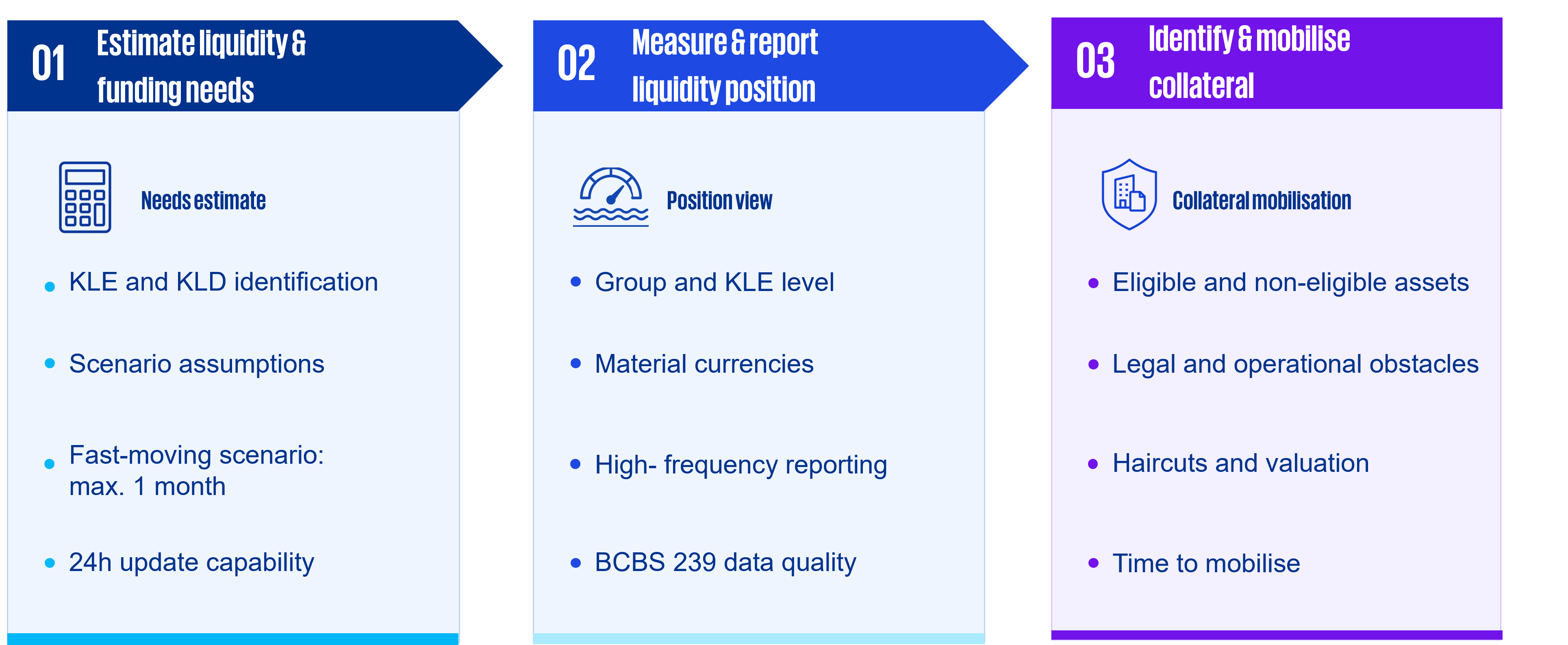
The new guidance broadens the focus from the estimation of the liquidity position to an end-to-end capability. It combines the estimation of funding needs and the liquidity position, the measurement and reporting of the liquidity situation, and the identification and mobilisation of collateral within a single framework.
Estimating funding needs and the liquidity position
Banks are expected to develop or expand robust methodologies to estimate funding needs and the liquidity position in resolution ex ante. In particular, it is clarified that these methodologies should also consider the Variant Resolution Strategy (VRS) and be adaptable to changing market conditions at short notice. The SRB refers to an update capability within a 24-hour timeframe.
Particularly relevant is the adjustment of scenario assumptions: the fast-moving scenario is shortened from up to three months to no more than one month before resolution. The SRB’s guidance thereby reflects practical experience that liquidity crises can accelerate significantly due to rapid market reactions, digital payment technologies and resulting information dynamics.
Measurement and reporting of the liquidity situation
Another focus is the ability to measure the liquidity situation in resolution at short notice and with high frequency, and to report it to resolution authorities. Banks should be able to provide standardised data at resolution group or resolution entity level, as well as at the level of individual Key Liquidity Entities (KLEs) and in material currencies. The consultation emphasises data quality, completeness, accuracy, integrity and timeliness in line with BCBS 239.
The focus is on clear responsibilities for data, plausibility checks, approvals and escalation, as well as the ability to provide information quickly and consistently in a resolution case. Data gaps, manual process steps and operational dependencies should be made transparent and addressed in a targeted manner.
Identification and mobilisation of collateral
The consultation also clarifies expectations for the Collateral Management in resolution. Banks should be able to identify usable collateral at a granular level, assess its legal and operational availability, apply valuation and haircut methodologies, and document the expected time to mobilise collateral by asset class.
Less liquid or non-central-bank eligible assets are particularly relevant. Banks should analyse which assets could be actually mobilised in resolution, what legal or operational obstacles may exist and how quickly collateral could be made available.
Templates for Key Liquidity Entities, Key Liquidity Drivers and collateral
The SRB provides two Excel templates. The Key Liquidity Entities (KLE) and Key Liquidity Drivers (KLD) template supports banks in the structured identification of material entities and material liquidity drivers. It covers, among other things, funding structure, collateral, risk positions, roles as liquidity provider or liquidity receiver, as well as the development over time of outflows, inflows and drivers across different resolution phases.
The collateral template focuses on the expected time to mobilise different asset classes. It distinguishes, between central-bank eligible and non-central-bank eligible assets, marketable and non-marketable assets, and different time buckets for mobilising 50 percent or the maximum mobilisable amount of an asset class.
Implications for banks
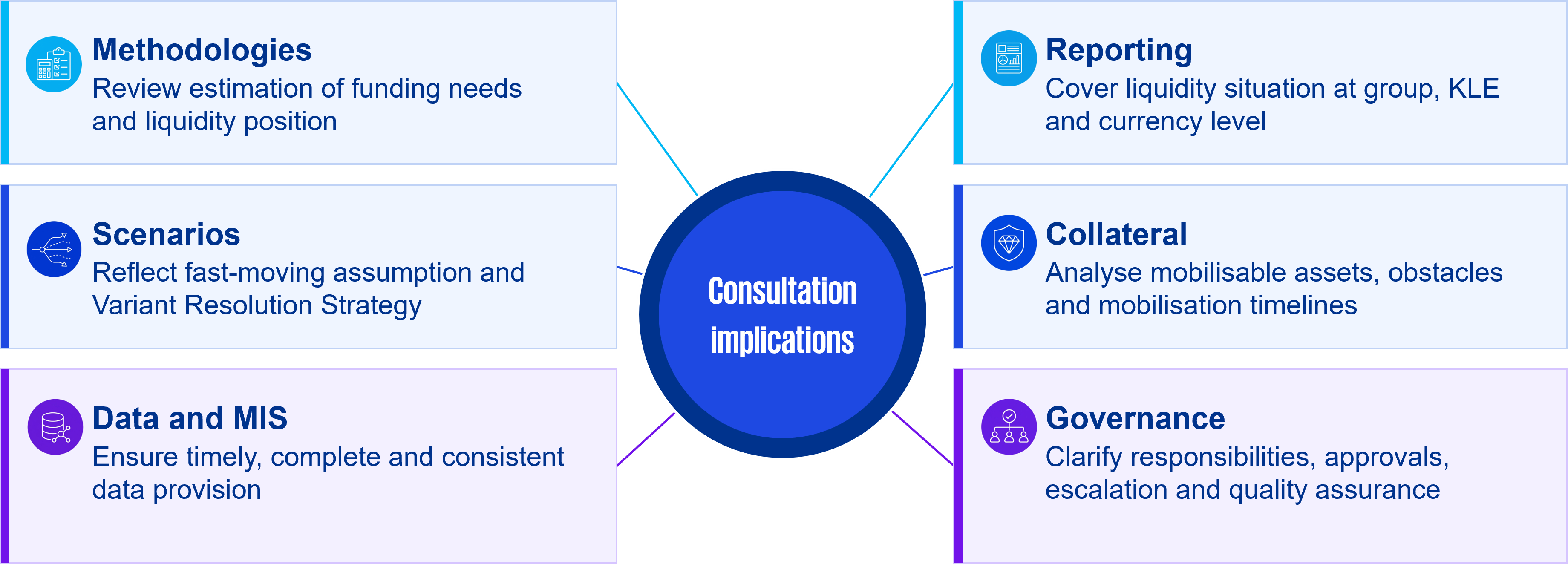
For banks, the key need for action lies in further developing existing capacities and capabilities. Banks should assess whether their methodologies sufficiently cover the new fast-moving assumption, the Variant Resolution Strategy, material currencies, KLE-specific analyses and the mobilisation of collateral.
In addition, banks should review their governance and MIS structures from a resolvability perspective. What matters is whether data can be produced, validated and reported at short notice, completely and consistently, including at the level of individual KLEs, in material currencies and, where relevant, intraday.
The consultation period until 6 July 2026 should be used to identify potential ambiguities and prepare targeted feedback to the SRB.
Discover more about Liquidity and Funding in Resolution
Our experts have already closely engaged with the SRB consultation and its practical implications for banks.
We are here to support you, among other things, with:
- gap analyses against the updated expectations
- review of methodologies for estimating funding needs and the liquidity position in resolution
- preparation and quality assurance of KLE and KLD analysis
- further development of MIS and reporting capabilities
- operationalisation of frameworks for the mobilisation of collateral


