

The Single Resolution Board (SRB) has updated its Operational Guidance on Separability and Transferability for Transfer Tools, as part of its SRM Vision 2028. The updated separability package aims to strengthen banks’ ability to demonstrate that parts of their business can be effectively separated and transferred in resolution, thereby supporting the operational feasibility of transfer tools.
The updated framework aligns with recent developments in the European resolution framework, including the latest European Banking Authority (EBA) guidelines, the revised framework for resolvability self-assessment and the resolution testing and crisis readiness, which are described in the new SRB Operational Guidance on Resolvability Self-Assessment, and the SRB Operational Guidance on Resolvability Testing for Banks.
The separability package focuses on three key areas:
- Operational Guidance on Separability and Transferability for Transfer Tools
- Operational Guidance on Transfer Playbooks
- Annex on Testing Separability and Transfer Strategies
Together, these documents clarify expectations for how banks should identify, structure, and operationalise transfer strategies, while also ensuring that these strategies are regularly tested and executable under stress scenarios.
1. Operational Guidance on Separability and Transferability
The updated Operational Guidance on Separability and Transferability for Transfer Tools provides a structured framework for banks to demonstrate that parts of their business can be separated and transferred in resolution using tools such as:
- Sale of Business
- Bridge Institution
- Asset Separation Tool
The guidance focuses on the identification of a credible transfer perimeter, the analysis of operational dependencies and the assessment of marketability.
Identifying the Transfer Perimeter
A central concept in the guidance is the transfer perimeter, defined as the set of assets, rights and liabilities that could be transferred to another entity during resolution.
To identify this perimeter, the SRB proposes a three-layer methodology:

First, institutions determine the initial perimeter based on critical functions and core business lines, representing the activities that may need to be preserved in resolution. Second, the perimeter is expanded to include assets, rights and liabilities linked through hard interconnections or separability conflicts, where dependencies cannot be removed without significant time or operational effort. Finally, the perimeter may be adjusted to improve marketability and feasibility, for example by modifying its structure, liquidity profile or risk characteristics.
This layered approach allows institutions to progressively refine the transfer perimeter while ensuring that the selected activities can realistically be transferred under crisis conditions.
Assessing Separability and Operational Interconnections
Once the transfer perimeter has been identified, institutions must assess whether it can actuallybe separated from the rest of the bank. This requires analysing a range of interconnections that may link the transfer perimeter to other parts of the institution. The analysis should cover the following dimensions:
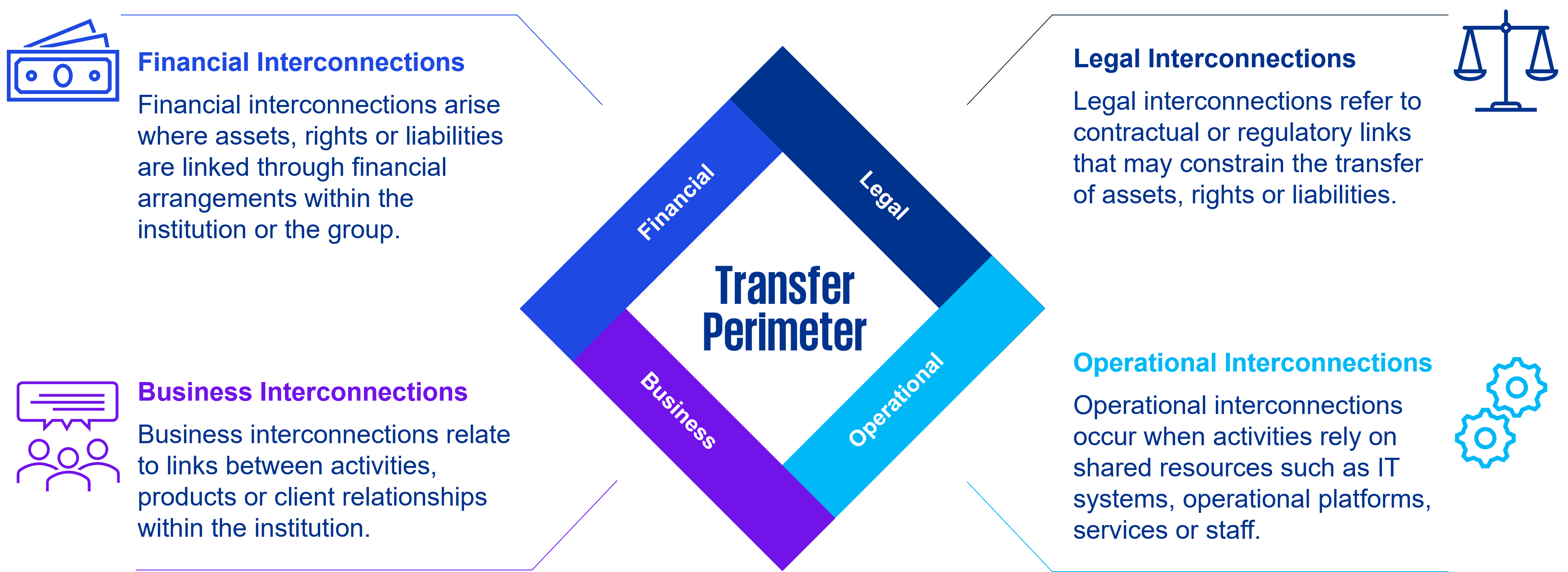
Where obstacles are identified, banks are expected to propose mitigating actions, such as restructuring arrangements, contractual solutions or service agreements that enable the transfer to take place without disrupting critical functions.
Marketability of the Transfer Perimeter
Beyond technical separability, the guidance emphasises that the transfer perimeter must also be marketable, meaning that it should be attractive and feasible for potential buyers.
Banks are therefore expected to assess whether the identified perimeter could realistically be acquired by a buyer during a resolution process. This includes analysing:
- Potential purchaser capacity
- Capital and liquidity requirements
- Regulatory constraints
- Strategic fit and market interest.
To enhance marketability, institutions may adjust the size, structure or financial characteristics of the transfer perimeter. The objective is to ensure that potential transfers remain credible and executable within the tight timelines typically associated with bank resolution.
Management Information Systems (MIS)
Management Information Systems (MIS) play a central role in the feasibility of transfer strategies. In a resolution scenario, the transfer perimeter may include IT systems, data repositories and system licences required to ensure operational continuity of the transferred activities.
Banks are therefore expected to demonstrate that their MIS architecture can support the separation and migration of the transfer perimeter. This includes the ability to identify system dependencies and to ensure that transferred business lines can operate independently from the residual institution.
Robust MIS capabilities are essential to ensure that resolution authorities and potential buyers have access to timely, accurate and comprehensive information, enabling the effective execution of transfer tools during a crisis.
Separability and Transferability: Key Changes After Consultation
Following the public consultation, the SRB introduced several important adjustments to the guidance.
Key updates include:
- The final guidance strengthens the principle of proportionality, allowing expectations to be calibrated depending on each institution’s resolution strategy, size and complexity.
- Cost assessments were simplified, with banks expected to identify key cost drivers and risks rather than provide precise quantitative estimates.
- The SRB clarified that institutions do not need to prepare equally for share and asset deals, as expectations depend on the resolution strategy agreed with the Internal Resolution Team (IRT).
- Interconnection analysis was simplified, allowing assessments at activity or portfolio level instead of detailed asset-by-asset reviews.
- Marketability expectations were reduced, allowing banks to rely primarily on existing market knowledge and available information.
- Several technical annexes were removed to reduce operational burden and are now used only as illustrative references in supervisory discussions.
- The SRB clarified that banks are not expected to prepare fully negotiated Service Level Agreements (SLAs) or Transitional Service Agreements (TSAs) in advance. Instead, institutions should identify operational interconnections and mitigation measures, leveraging existing Operational Continuity in Resolution (OCIR) deliverables where possible.
- The guidance confirms a scenario-neutral approach to separability analysis, avoiding the need for multiple crisis simulations.
- Additional clarifications were introduced on residual institutions, No-Creditor-Worse-Off (NCWO) considerations, asset management vehicles and back-transfer mechanisms.
- The guidance clarifies that transfer tools may be used as primary or complementary tools, including in combination with bail-in or as part of the Asset Separation Tool
2. Transfer Playbooks: Operationalise Transfer Strategies
The updated Operational Guidance on Transfer Playbooks complements the separability framework by defining how banks should operationalise transfer strategies in practice.
The Transfer Playbook functions as crisis manuals, describing the internal governance, processes and documentation needed to support the execution of a transfer in resolution. The guidance identifies five key areas that institutions should address within their Transfer Playbook:

In addition, the SRB Guidance structures the transfer process into three phases. As shown below, the Transfer Playbook should therefore outline the operational steps required to execute a transfer during resolution:
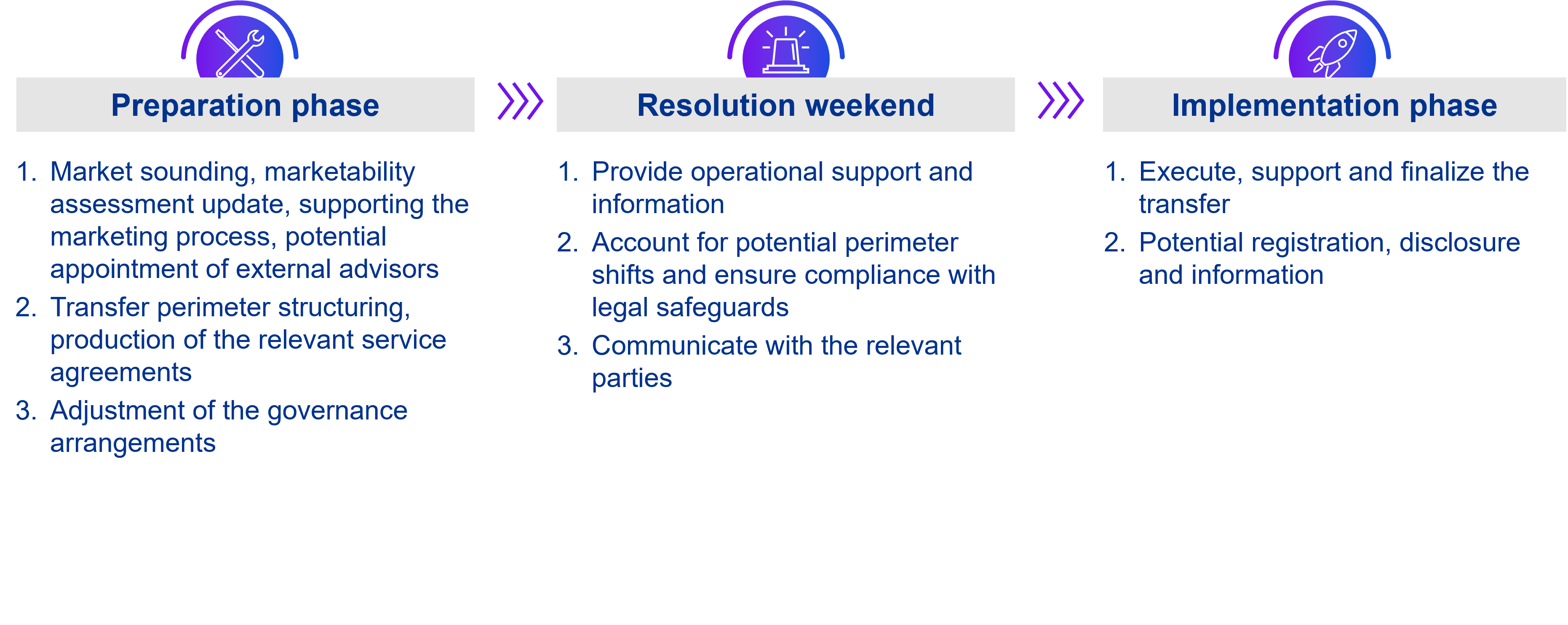
To support these phases, institutions are expected to establish governance arrangements that enable them to support resolution authorities throughout the transfer process. These arrangements should define the internal decision-making structures, responsibilities and escalation procedures that would apply during a resolution scenario.
In particular, banks should be able to support resolution authorities in activities such as:
- identifying and updating the transfer perimeter,
- supporting market soundings and marketing processes,
- coordinating with external advisers, where required, and
- providing the information needed for the resolution scheme and implementing acts.
The Transfer Playbook also includes a realistic and prudent timeline outlining key execution steps and potential overlaps between activities. Given the tight timelines typically associated with resolution, it highlights potential execution risks, including risks to operational or business continuity, and describes corresponding mitigation or contingency measures. It further outlines the operational arrangements required to implement the transfer, such as preparing service arrangements, coordinating with relevant stakeholders and ensuring the capability to transfer assets, contracts, systems and staff where needed.
Together, these elements help ensure that the transfer can be executed effectively during the Resolution Weekend and finalised during the Implementation Phase, while maintaining the continuity of the transferred activities.
Information Sharing and Communication
The Transfer Playbook also sets out the communication arrangements to be applied throughout the transfer process, including how relevant information is shared internally and communicated to external stakeholders such as resolution authorities and potential buyers. It further addresses the handling of confidential and potentially inside information, ensuring compliance with applicable regulatory requirements such as the Market Abuse Regulation (MAR).
Transfer Playbooks: Key Changes After Consultation
The consultation process also resulted in several refinements to the updated Transfer Playbook
Guidance.
Key updates include:
- Stronger emphasis on proportionality, clarifying that expectations should be calibrated depending on each institution’s size, complexity and resolution strategy.
- The SRB clarified that the Transfer Playbook apply to both preferred and variant resolution strategies, with the depth of analysis determined in dialogue with the relevant IRT.
- Clarification of scope, confirming that hosted banks may be included where operational dependencies affect the feasibility of a transfer.
- Clearer distinction between expectations and “focus points”, which are now described as good practices rather than mandatory requirements.
- Improved linkage between the Transfer Playbook and the Separability Analysis Report, clarifying that the playbook should build on Separability Analysis Report assumptions.
3. Testing Separability and Transfer Strategies
The annex on Testing Separability and Transfer Strategies complements the Operational Guidance on Separability and Transfer Playbooks by introducing expectations for resolvability testing. The objective is to ensure that the capabilities described in the Separability Analysis Report and the Transfer Playbook are not only documented but can also be demonstrated in practice.
Testing exercises allow institutions and resolution authorities to verify whether banks are operationally prepared to support the implementation of transfer strategies in a crisis scenario. This annex complements the broader SRB framework for resolvability testing, as outlined in the Operational Guidance on Resolvability Testing for Banks. The principles applied in this context are also aligned with the Resolvability Self-Assessment Template Guidance.
Key Testing Areas
The guidance identifies several areas that institutions should test to demonstrate their readiness to support a transfer strategy.
Testing should cover:
- governance arrangements, ensuring that internal decision-making processes function as described in the Transfer Playbook
- the identification and update of the transfer perimeter, including the ability to define and adjust the scope of a potential transfer
- marketability assessments, including procedures for identifying potential buyers and assessing market interest
- operational continuity, particularly the ability to support services, staff and IT systems linked to the transfer perimeter
- the execution of the transfer process, including preparatory actions and mitigation of potential obstacles
- back-transfers and adjustments, where assets or liabilities may be returned to the institution following resolution actions
These testing areas aim to ensure that institutions can effectively operationalise transfer strategies under stressed conditions.
Testing: Key Changes After Consultation
The SRB also revised the Testing Guidance following industry feedback.
Key updates include:
- The final framework introduces a gradual and proportionate testing approach, aligned with the maturity of institutions’ Separability Analysis Report and Transfer Playbook.
- Testing is expected to begin with walkthroughs or desktop simulations, with more advanced exercises introduced once the underlying capabilities are sufficiently developed.
- The SRB clarified that resolution authorities will not directly participate in bank-led testing, which should instead focus on assessing institutions’ internal governance, decision-making processes and operational readiness.
- Testing should aim to identify operational obstacles and mitigation measures, rather than replicate live transactions
- Back-transfer testing should focus on governance and procedural readiness, and any adjustments to the transfer perimeter during testing should be agreed with the relevant IRT.
- The final guidance also confirms that management sign-off and technical elements such as MIS migration testing should follow a proportionate approach, with simulations used where dedicated testing environments are not available.
The SRB’s updated separability package makes it clear that transfer strategies must be operationally feasible, not only conceptually documented. Banks are expected to demonstrate that they can identify a credible transfer perimeter, support the execution of a transfer and maintain operational continuity during resolution.
For the full practices report, please refer to the SRB publications.
Discover more about separability analysis and transfer playbooks
Our transfer strategy experts have you covered, from initial analysis to the final playbook, and look foward to share our standardised, tried and tested approach with you to efficiently meet the SRB‘s expecations.


