
      Accurate and timely valuations are essential for the effective resolution of banks, as they underpin authorities’ key resolution decisions. Reliable valuations depend on banks’ management information systems (MIS) and their ability to provide comprehensive data quickly.

      To ensure this, the Single Resolution Board (SRB) has finalised its Expectations on Valuation Capabilities (EoVC), following a public consultation between 2 April and 2 July 2025. The final guidance builds upon the SRB's Valuation Data Set (VDS) published in 2020 and represents a key deliverable under the SRB’s SRM Vision 2028, aimed at enhancing banks' crisis readiness.
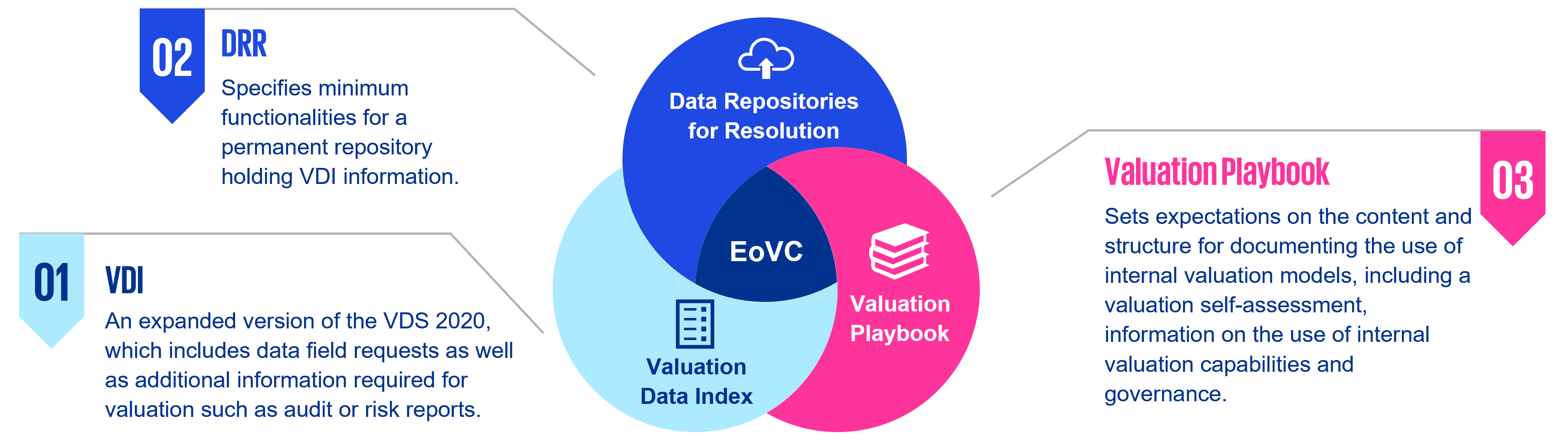
      Main components of the EoVCs

      The EoVC enhances and expands the 2020 framework by

      • introducing a Valuation Data Index (VDI) covering both structured and unstructured information,
      • establishing clear expectations for a Data Repository for Resolution (DRR), and
      • formalising requirements for Valuation Playbooks, including self-assessment model use and governance.

      Main components of the EoVCs

       1. Valuation Data Index (VDI)

      The SRB’s EoVC aim to ensure that independent valuers have timely access to comprehensive, high-quality information to carry out fair and realistic valuations in resolution. To achieve this, the VDI establishes a minimum, structured index of information required to support resolution valuations, combining

      • an enhanced structured Valuation Data Set (VDS) covering asset- and liability-level data as well as portfolio-level information, together with the Minimum Bail-in Data Template (MBDT), both prepared and stored in the DRR, and
      • a defined set of unstructured documents, such as audit reports, risk reports, business plans and documentation on internal valuation models.

      The SRB explicitly aims to leverage existing bank data and documentation "as far as possible", avoiding duplication of information already available through supervisory or public channels. By frontloading data collection in business-as-usual conditions, the SRB seeks to improve data quality, reduce reliance on ad hoc requests during crises, and ensure consistency across valuation processes. In support of these objectives, the EoVC also introduce technical submission and extensive validation rules, supporting automated valuation processes and effective quality assurance.

      EoVC consultation vs. final expectations

      In response to industry feedback, the SRB has introduced the following key refinements amongst others:

      • Removed 95 mandatory annual fields (~25%) and streamlined the real estate collateral dataset by roughly 40%; additions are mostly identifiers to link with other frameworks to limit the net burden.
      • Trimmed the VDI document list by removing duplicative items (e.g., Business strategy, Stress tests, Shareholders, etc.), reducing operational complexity beyond just data attributes.
      • Introduced more flexible submission frequencies: certain VDI elements are now submitted annually with a year-end cut-off (due 30 April), instead of earlier semi-annual expectations.
      • Reaffirmed that subsidiary level data remains essential for accurate group valuation, because losses/risks at subsidiaries affect the group’s net asset value.
      • Specified that only Resolution Entities (REs) and Relevant Legal Entities (RLEs) are required to submit the VDI/VDS. However, EU subsidiaries of third country parents or EU/ Banking Union parents that are not designated as REs are still expected to provide a full scope VDI due to potential SPE bail-in/write down needs.
      • Added Annex 6, providing a comparison between the new VDS and the 2020 VDS framework.
      • Simplified reconciliation: only against FINREP or the accounting ledger; COREP and tax reconciliation fields were removed.
      • Removed duplicative processes by replacing two separate MBDT tracks - one for bail in and one for liability valuation - with a single MBDT framework, supplemented by additional datasets for liability valuation purposes.

      2. Data Repository for Resolution (DRR)

      To support the VDI, banks are required to establish a Data Repository for Resolution (DRR) to store, manage and share VDI information.

      The DRR ensures

      • timely availability of data in crisis situations, and
      • efficient and structured data collection during business-as-usual periods.
      EoVC consultation vs. final expectations

      In response to consultation feedback, the SRB refined its expectations:

      • Permanent, continuous SRB access is no longer required. Access will be granted on request, in the context of crisis preparation or structured testing, within 24 hours.
      • The scope of DRR use is limited to crisis preparedness and testing, reducing signalling and cyber-risk concerns.
      • Mandatory two-factor authentication has been removed, while an audit trail requirement has been added to track user activity.

      While respondents to the consultation raised concerns about cost, cyber risk, and operational burden, the SRB concluded that a permanent DRR is essential for timely data availability in resolution. Notably, around 90% of banks already have some form of data repository in place. Banks therefore retain flexibility to rely on either in-house or third-party solutions, provided the functional requirements are met.


      3. Valuation Playbook

      In addition, the EoVC introduces a formal requirement for Valuation Playbooks, documenting banks' valuation capabilities in a structured and transparent manner.

      The playbook must cover:

      • A valuation self-assessment, focusing on methodologies and valuation challenges
      • The use and flexibility of internal valuation models
      • Governance arrangements, including data lifecycle management, approval processes, quality assurance and management responsibilities

      These playbooks are intended to enable independent valuers to quickly understand banks' valuation approaches and, where appropriate, rely on existing internal models.

      EoVC consultation vs. final expectations


      Feedback on the valuation playbooks focused on concerns that banks would be required to develop new valuation models or duplicate existing documentation. In response, the SRB clarified amongst others that:

      • No new models or infrastructure are required; banks are expected to document and explain existing internal valuation models used for IFRS 13 and IFRS 7 purposes.
      • Banks do not need to link individual models to each VDS line; instead, they should map instruments in the VDS to valuation clusters and then describe the models at the cluster level in the playbook with cross-references to VDI materials.
      • The playbook should summarise methodologies, with detailed documentation referenced from existing internal materials.

      The SRB will not validate models directly but may simulate or run walkthroughs to check processes and the bank's ability to provide required information.

      The SRB also clarified the role of the single point of contact (SPOC), noting that while the SPOC's primary role is during resolution, they should have sufficient understanding of crisis responsibilities and the bank's valuation capabilities in business-as-usual (BAU).


      Implementation and Next Steps

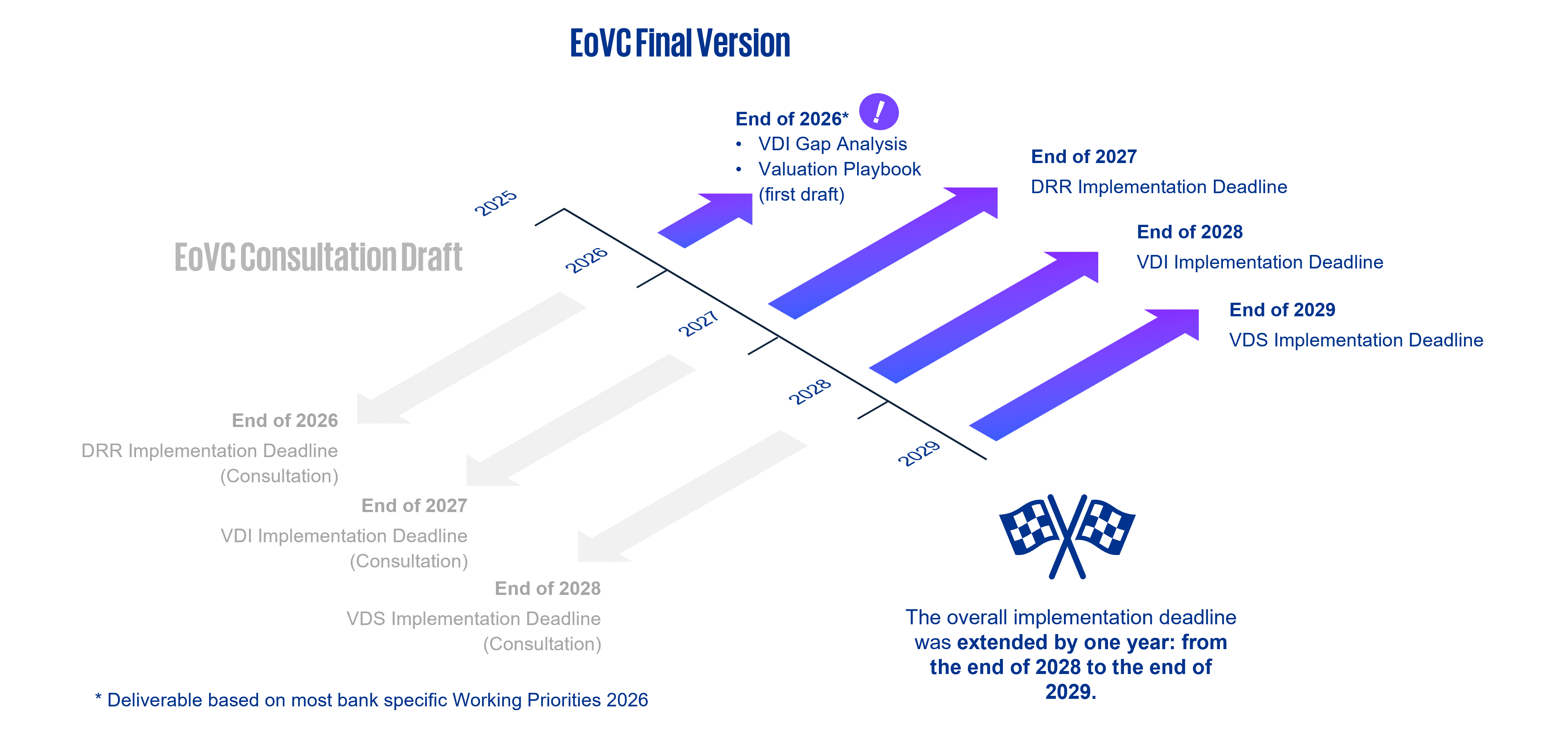
      The SRB has extended the EoVC implementation timeline by one year, with full adoption now expected by the end of 2029. Key milestones are staggered to support a phased rollout.


      Consultation (grey) vs. Final (blue) Implementation Timeline

      For VDI items with a year-end cut-off date, the first submissions are due by 30 April 2029, except for the VDS (VDI item 1.1) and other structured VDI items (1.2-1.4), which are due by 30 April 2030.  VDI documents with cut-off dates indicated as ‘Latest version available’ should be submitted for the first time starting from 1 January 2029. Intermediate milestones for the Valuation Playbook will be communicated via annual priorities letters.

      Banks will phase in these new expectations gradually, ensuring that ad hoc VDS 2020 capabilities remain available until the full implementation of the EoVCs. The SRB has also indicated that the EoVCs may be further refined over time to reflect regulatory developments, market feedback, and lessons learned from practical experience.

      In summary, we can conclude that, based on industry feedback, the SRB has further revised its guidance and incorporated several simplifications. However, the fundamental requirements remain in place and will continue to pose challenges for banks in the coming years.

      For further details, please refer to https://www.srb.europa.eu/en/content/expectations-valuation-capabilities


      Discover more about EoVC


      In a personal connect our experts look foward to share our standardised, tried and tested approach with you to efficiently meet the SRB‘s expecations. 

      Alexander Schiller

      Director, Advisory, Vienna

      KPMG Austria

      Stephan Egger

      Director, Advisory / Financial Services, Wien

      KPMG Austria

      Jessica Aigner

      Senior Managerin, Advisory / Financial Services, Wien

      KPMG Austria


      Alexander Schiller

      Director, Advisory, Vienna

      KPMG Austria

      Stephan Egger

      Director, Advisory / Financial Services, Wien

      KPMG Austria

      Jessica Aigner

      Senior Manager, Advisory, Vienna

      KPMG Austria

      Advisory

      We focus on identifying, assessing, and managing risks in order to strengthen a company's financial resilience. In doing so, our experts always keep an eye on legal regulations and regulatory requirements in the financial sector.

      roof of moden buildings

      Gemeinsam steuern wir mit Ihnen in eine erfolgreiche Zukunft und finden die passenden Lösungen für Ihre Herausforderungen.

      Wir stehen Ihnen als Partner zur Seite und lösen gemeinsam die komplexen Anforderungen Ihrer Branche.


      Treten Sie mit uns in Kontakt

      Unsere Expert:innen freuen sich, von Ihnen zu hören.                              

      Weltkugel und Frau