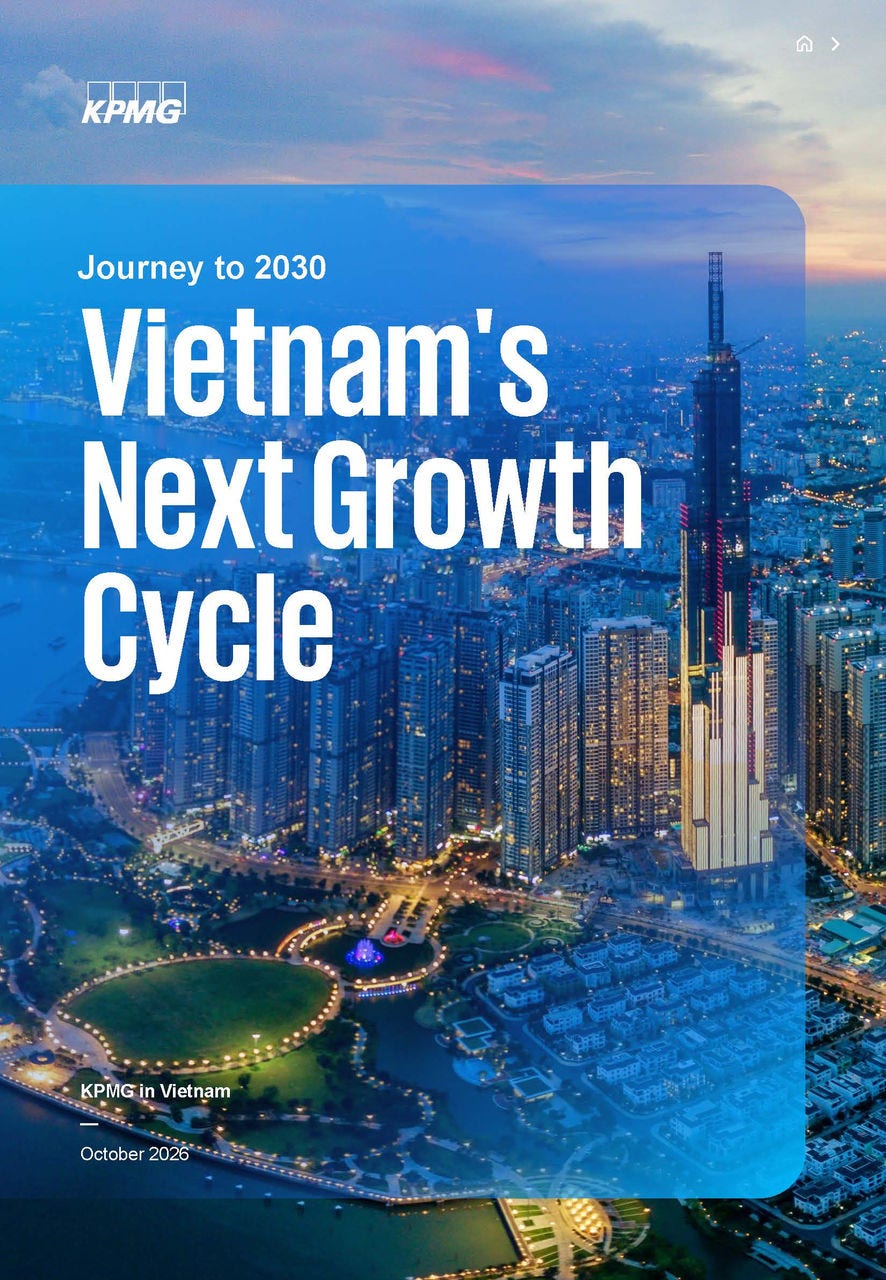
Vietnam is entering its most ambitious growth cycle yet, targeting double-digit growth and an upper-middle-income economy by 2030. 

      This comprehensive report by KPMG in Vietnam examines the momentum behind this ambition, from record FDI and trade to the FTSE Russell's upgrade and the launch of the International Financial Center. It also covers the risks investors must manage: FDI concentration, funding, power supply, consumer caution, external pressure and tougher enforcement. 

      This is KPMG's practical guide to investing with precision in Vietnam's next chapter.

      Why Invest in Vietnam

      Vietnam grew 8.2% in the first half of 2026, its fastest start in fifteen years. Registered FDI jumped 61% to US$34.65 billion. Trade is heading past US$1 trillion. In September 2026, FTSE Russell's upgrade opened the door to a new tier of global capital. Long Thanh opens in December 2026, and the IFC is open for business.

      This anticipated surge can be attributed to several factors, including Vietnam's:

      Vietnam's GDP grew 8.2% in H1 2026, the fastest first-half growth in 15 years and the strongest in ASEAN. All three economic sectors grew, and Vietnam is now officially an upper-middle-income economy.

      The government targets about 10% growth a year to 2030, GDP per capita of US$8,500 and a place among the world's 30 largest economies. A record US$41 billion public investment plan for 2026 and a middle class expected to reach 26% of the population support these targets.

      Total trade reached a record US$549.7 billion in H1 2026, up 27.1% year-on-year. That puts annual trade on track to pass US$1 trillion for the first time. The FDI sector accounts for 76% of trade, and electronics, machinery and components lead both exports and imports.

      With 18 FTAs in force, including the Vietnam-EFTA deal signed in October 2026, and over 80 double tax agreements, Vietnam gives investors preferential access to most major global consumer markets.

      Registered FDI rose 61% to US$34.65 billion in H1 2026, and disbursed FDI reached US$13.03 billion, a five-year high for the first half. Intel, Samsung, BYD and Foxconn all expanded their investments, and M&A activity is shifting toward high-quality assets.

      Resolution No. 10 marks a strategic reset, prioritizing high-tech, green and innovation-driven FDI, technology transfer and local supplier linkages, with a target of US$200–300 billion in registered capital for 2026–2030.

      Of 102.5 million people, 69.1 million are of working age, and the median age is 33.4, younger than China or Thailand. Workers keep moving from agriculture into industry and services. New IFC rules allow visas and work permits of up to 10 years, making it easier to bring in global talent.

      Vietnam is reorganizing its economy around growth corridors and regional hubs. The North drew over 81% of newly registered capital in H1 2026, while Ho Chi Minh City and Da Nang anchor the new International Financial Centers.

      Unveiling Sectoral Potential

      Explore Vietnam’s most promising sectors - where policy momentum, rising demand and investment opportunity now meet.

      factory

      Industrial Manufacturing

      shopping_cart

      Consumer Markets

      health_and_safety

      Healthcare

      cloud_done

      Technology

      real_estate_agent

      Real Estate

      flyover

      Infrastructure

      bolt

      Energy & Utilities

      finance

      Financial Services

      Regulatory spotlight for foreign investors

      • Tax & Transfer Pricing: managing change and controversy

        New CIT framework, 2% capital assignment tax, Decree No. 255 on transfer pricing, Global Minimum Tax.

      • Workforce: strategy and incentives

        IFC work permits valid for up to 10 years, personal income tax reform, stronger social insurance enforcement.

      • Legal: the investment and compliance imperative

        Investment Law 2025, Enterprise Law amendments, the data protection law and Decree No. 330.

      • Customs: trade facilitation in a tariff-driven world

        Scrutiny of origin, FTA utilization, post-clearance audits.

      For investors, the question has changed. It is no longer where to build a factory, but where to place technology, R&D and capital. That is where KPMG works every day, alongside government and business leaders, turning policy into practice. This report is our honest read of Vietnam's next growth cycle, and our invitation to be part of it.

      Warrick Cleine MBE

      Chairman and CEO

      KPMG in Vietnam and Cambodia

      Other editions

      download

      Vietnamese version

      Additional language versions

      Coming soon

      A Defining Moment for Growth

      The Investor's Guide to Growth

      Investing in Vietnam - Redrawing the horizon

      Connect with us

      KPMG in Vietnam combines multi-disciplinary approach with deep, practical industry knowledge to help clients meet challenges and respond to opportunities. Connect with our team to start the conversation.