
Over the past few years, particularly following IFRS 17 implementation, there has been increasing discussion around finance and actuarial process transformation, target operating models, automation, and re-engineering. Many organizations have moved beyond implementation and are now focused on making reporting processes sustainable, scalable, and decision-useful.
In practice, these discussions often begin with process questions: how to shorten reporting timelines, reduce manual work, improve controls, or redesign existing workflows. Underneath these conversations, however, is often a simpler question: What information are we actually trying to produce, and why?
In finance and actuarial transformation work, a consistent sequence tends to emerge: understand the information requirement, diagnose current capability, remove execution friction, then redesign architecture when needed.
This piece focuses on the first part of that sequence: understanding what needs to be produced and diagnosing why current processes struggle to deliver it.
Why information comes first
While transformation initiatives are often triggered by a range of pressures such as cost, customer experience, regulatory change, information gaps are what typically determine where effort needs to be directed.
Transformation projects therefore tend to begin with a gap: decision-makers need information the current process can’t reliably deliver.
These gaps can take several forms. Sometimes, it’s timing. The CFO requires variance analysis within days of close, but meaningful insight is only available two to three weeks later. It could also be granularity, where leadership needs margin by product line and distribution channel, but reporting only shows aggregated results. Or flexibility, as reporting supports predefined questions but breaks down when management asks something beyond what was anticipated.
Transformation begins with a clear definition of what “good” looks like:
- What questions need to be answered?
- At what level of detail?
- How quickly?
- With what degree of reliability?
This clarity provides a destination. Not an abstract goal like a "faster close", but concrete information that would help specific people make specific decisions.
A useful move: Ask what people would want if constraints didn't exist.
Not to create a wish list, but to surface what they have stopped asking for. The Appointed Actuary may no longer ask for experience variance by cohort because “we’ve never been able to produce that within the reporting window.” Temporarily removing constraints helps distinguish between what is needed and what people have learned to settle for.
Why process mapping comes second: a diagnostic exercise
The second step is process mapping. The aim is not to document every step in the actuarial valuation or financial close process. Instead, it is to understand why the required information is difficult to produce in the first place.
At this stage, attention tends to focus on questions like:
- Which information takes too long to stabilize, and what causes the delay?
- Where does uncertainty enter? For example, where do reserve estimates change materially after initial production?
- Where do exceptions explode into dozens of manual adjustments?
- Which steps exist mainly because we have little confidence in upstream data?
The key shift is to map backwards from the information pain point, rather than forwards from “step one”. This reframes process mapping as diagnostic work. You're not capturing "how the valuation runs", you're understanding "why we can't produce reserve movement analysis within the required timeline."
The three types of gaps
Once the information requirement is clear and current capability has been diagnosed, the situation typically falls into one of three categories:
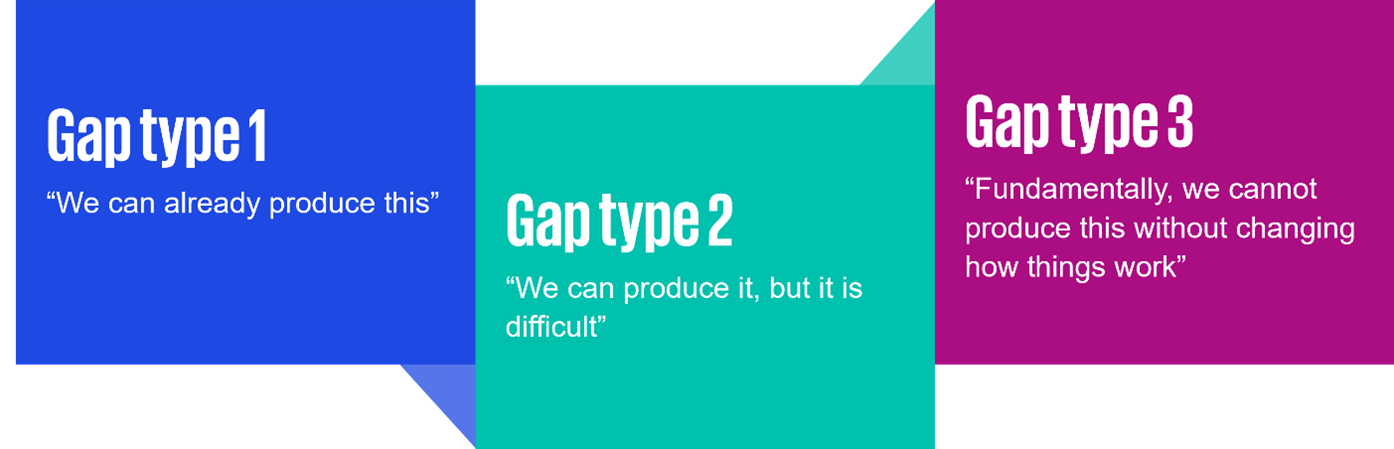
- Gap type 1
- Gap type 2
- Gap type 3
Gap type 1: "We can already produce this"
The capability exists, but it is not standardized or consistently applied. The actuary may produce expected versus actual analysis one way in one period and differently in another. In some cases, it may not be produced at all unless specifically requested.
This is a governance and adoption issue.
Gap type 2: "We can produce it, but it is challenging "
The process can deliver the information but only through extensive manual effort. Extracting policy data and reformatting it for the valuation model, running reconciliations manually through disconnected systems, or checking calculations in detail, cell-by-cell.
In some cases, the challenge is less about the effort and more about confidence. Ownership is unclear, controls are insufficient, or outputs are not able to provide confidence.
This is an execution efficiency and reliability problem.
Gap type 3: "Fundamentally, we cannot produce this without changing how things work"
The current process lacks the data, architecture, or logic needed.
For example, profit attribution may require product-level granularity that does not exist in the system. Experience variance may require cash flow details not stored in current models. Reporting timelines may be structurally constrained because certain inputs are only available after a specific point in time.
This is an architecture problem.
The distinction matters because each gap requires a different intervention.
· Type 1 - standardization and governance
· Type 2 - automation to remove execution friction
· Type 3 - re-engineering to redesign architecture
Misdiagnosing leads to applying the wrong solution. You cannot automate your way out of an architecture problem. Re-engineering is unnecessary if you just need better discipline. Governance doesn't help if the constraint is 40 hours of manual data preparation.
Keeping the work grounded
In practice, a few things help keep this grounded:
- Concrete information requirements, not abstract "better reporting", but specific, decision-relevant outputs
- Honest diagnosis of constraints, whether you're facing a governance, execution, or architecture problem
- Clarity on what you're solving for, and the trade-offs involved
Looking ahead
Transformation is not about faster processes. It’s about delivering the right information, at the right time, with sufficient reliability to support decisions.
Once the information requirement is clear and the nature of the gap is understood, the next question becomes: what intervention works and in what sequence?
In the next piece, we will explore how automation and re-engineering fit into this picture and why applying the wrong solution can be as limiting as not transforming at all.

