error
Subscriptions are not available for this site while you are logged into your current account.
close
Skip to main content

      Interest Limitation rules

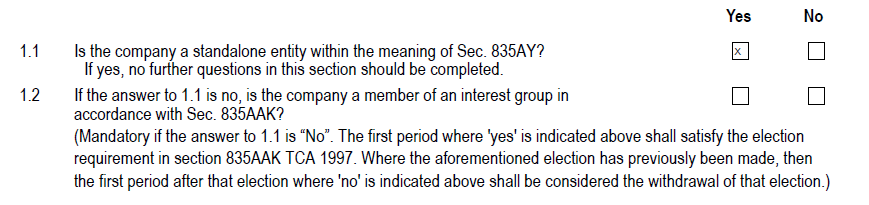
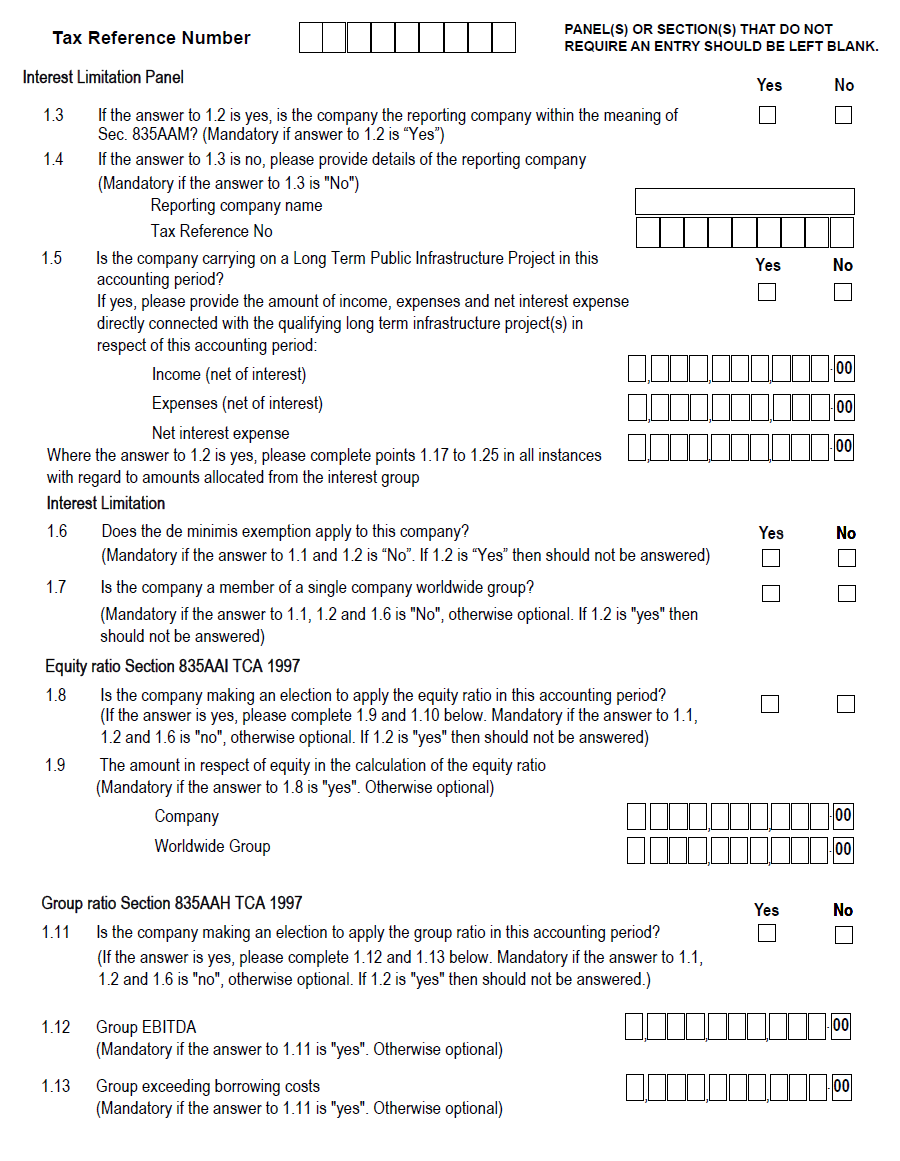
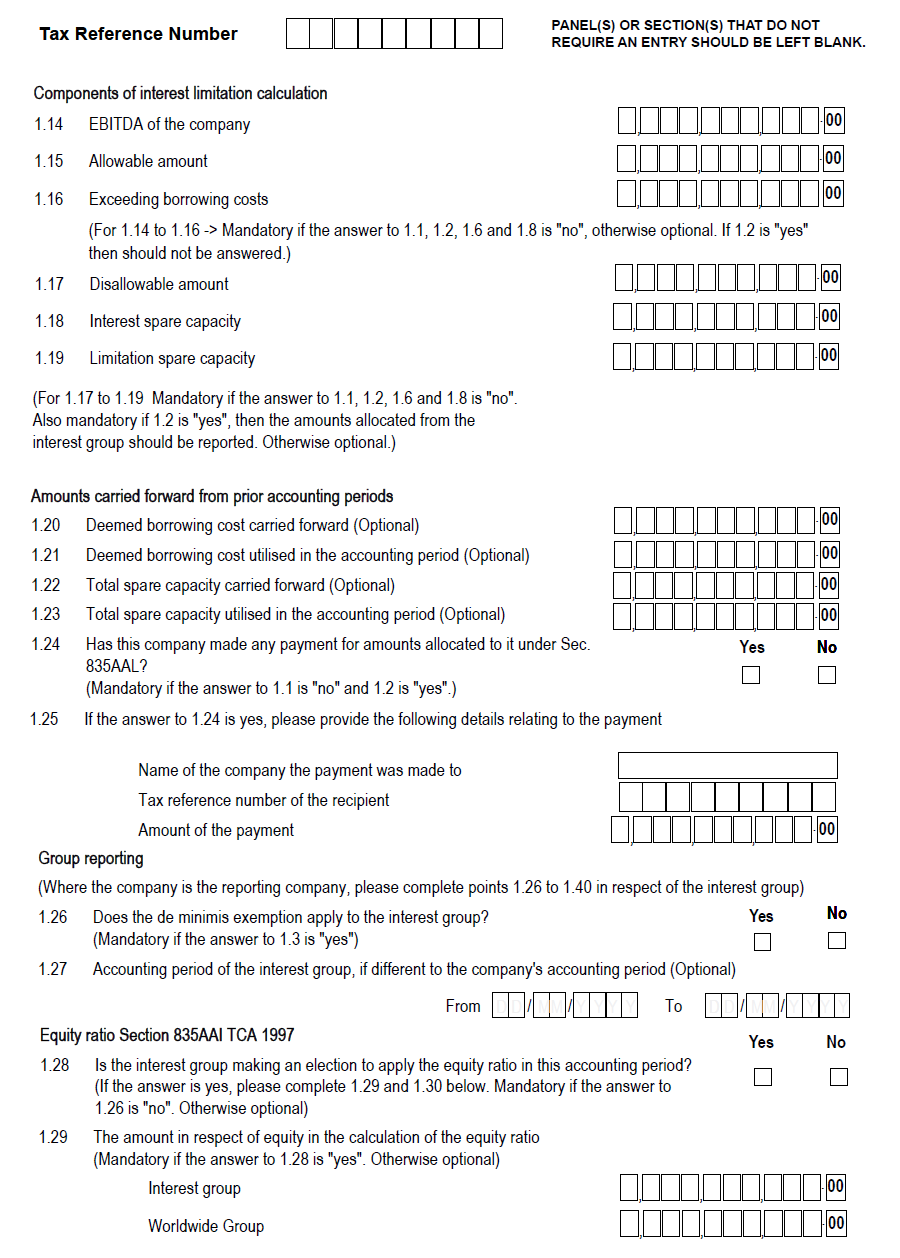
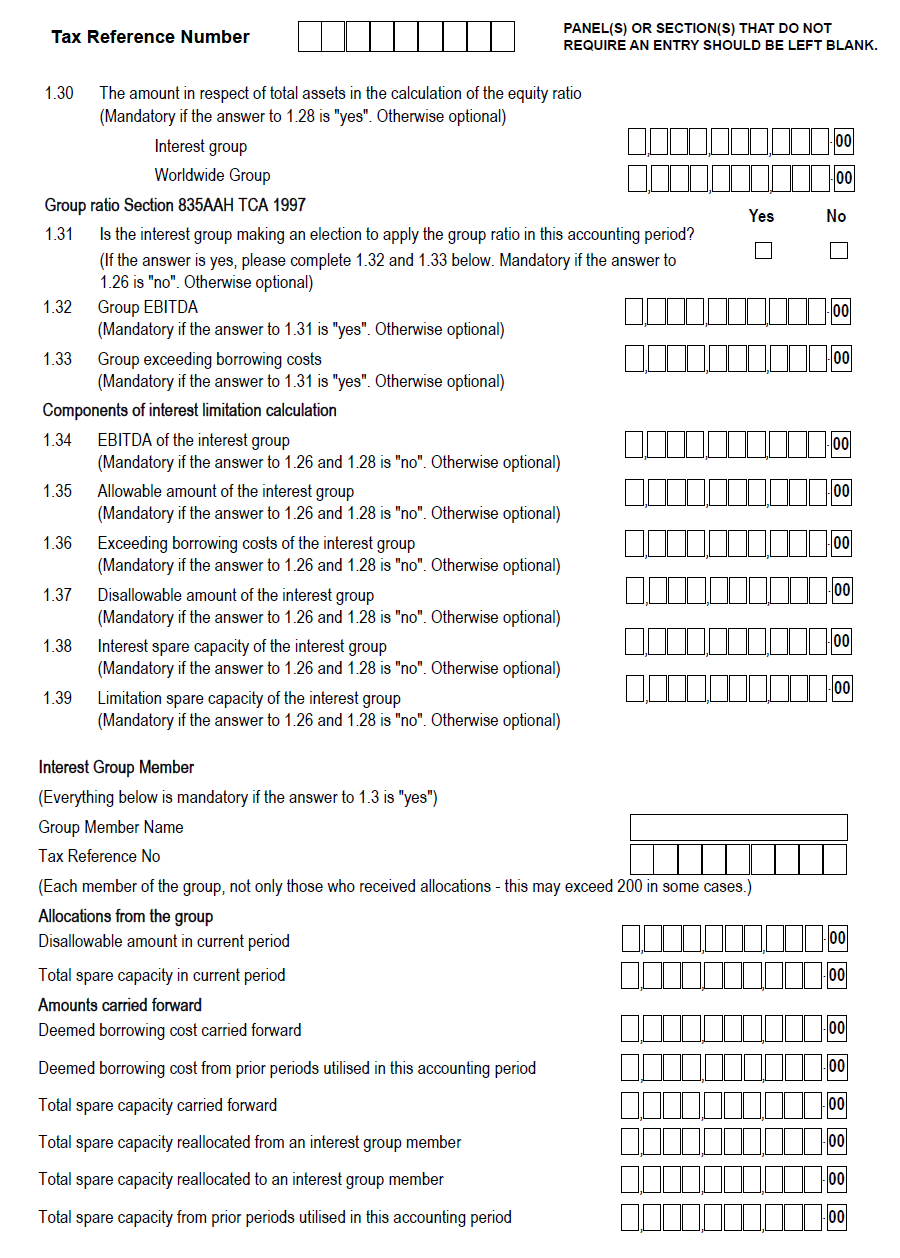
      Interest Limitation rules (“ILR”) applies to Irish resident companies and those subject to corporation tax with tax deductible borrowing costs. In summary, the ILR will cap the corporation tax deduction that a company can take for “exceeding borrowing costs” at 30% of a corporate taxpayer’s earnings before interest, tax, depreciation, and amortisation (or its Tax EBITDA), as measured under tax principles.

      There are various exemptions and reliefs which may mitigate the ILR impact on a company (particularly for smaller companies / groups) but the availability of such will need to be assessed by each company. The quantification of “exceeding borrowing costs” will also need to be assessed by each company. There is a detailed disclosure panel in the corporation tax return (Form CT1) to capture certain information related to the interest limitation rules. 

      Form CT1 screenshot
      Form CT1 screenshot
      Form CT1 screenshot
      Form CT1 screenshot


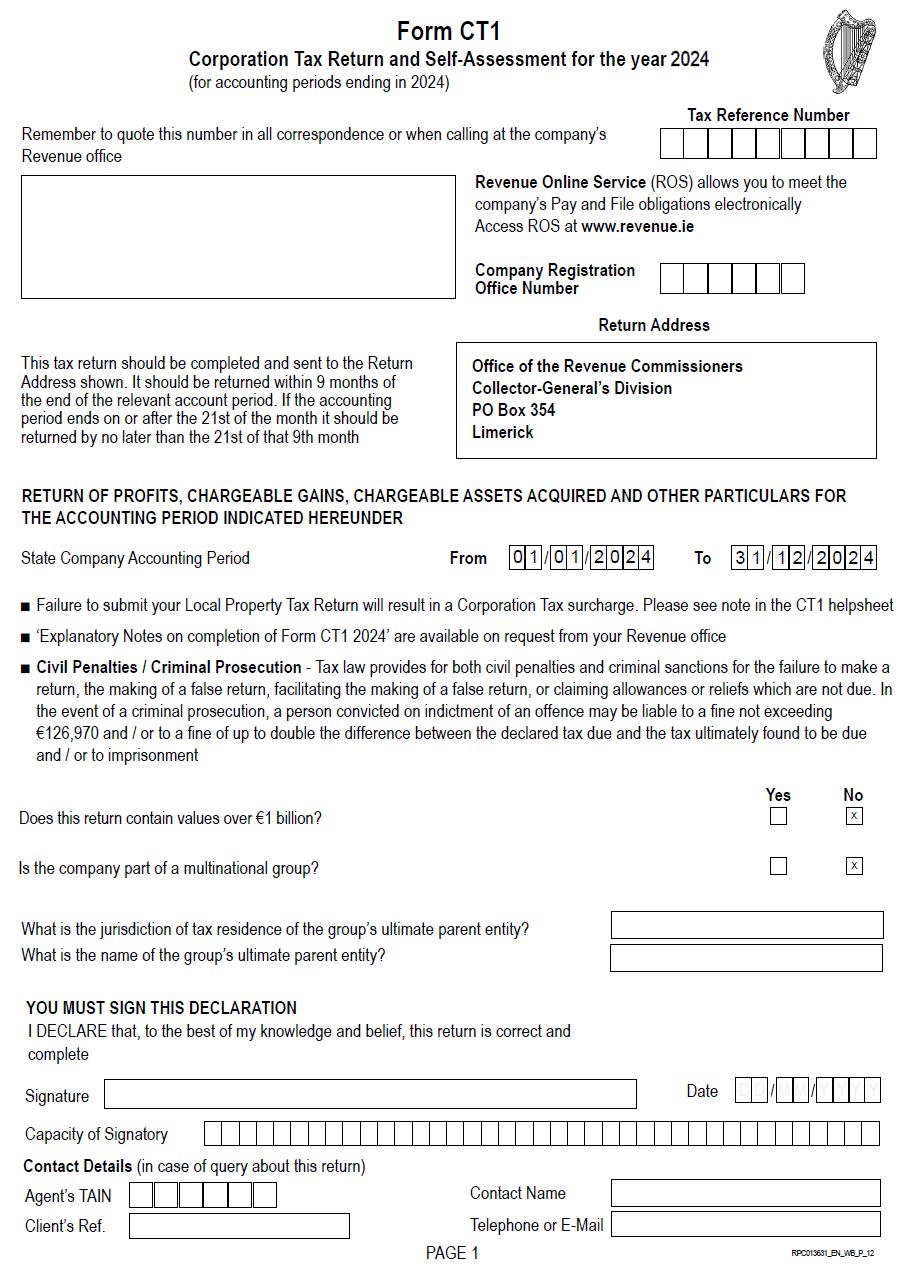
      Multinational Group

      The Irish Revenue Commissioners have not issued any guidance in relation to how the Multinational Group panel on the Form CT1 should be completed; for example, whether “multinational group” should be interpreted based on its ordinary meaning (i.e. a consolidated group with entities in more than one jurisdiction) or alternatively whether it should be construed by reference to the legislative definition of the term in the context of specific provisions.

      In the absence of any guidance, this panel has been completed based on the ordinary meaning of the term in the context of the consolidated accounting position i.e. by considering a company as being part of a multinational group whereby it is part of an accounting consolidation with entities that are tax resident in a jurisdiction other than Ireland.

      It is also unclear whether the ultimate parent entity disclosure needs to be completed where the company is not part of a multinational group. For prudence, this panel has been completed irrespective of the multinational group disclosure i.e. based on the parent per the accounting consolidation position, with the parent disclosure included regardless of whether the company is part of a multinational group. 

      Form CT1 screenshot


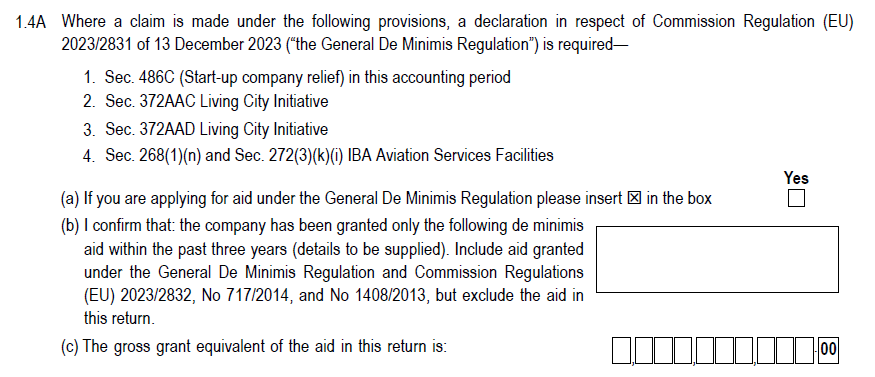
      De Minimis Aid

      The EU De Minimis rule imposes a maximum amount of State aid of €300,000 that a company or group of companies can avail of, from all sources subject to the De Minimis Regulation, in any rolling three-year period.    

      The sources of aid currently subject to the De Minimis rules are;

      1. S486C - Start-up company relief,
      2. S372AAC Living City Initiative,
      3. S372AAD Living City Initiative,
      4. S268(1)(n) an S272(3)(k)(i) IBA Aviation Services Facilities.            

      A company is required to keep, and on request to produce, records to enable the amount of State aid received to be verified by the Revenue Commissioners and by the EU. A company is also required to complete the declaration included on the tax return in respect of the De Minimis Regulation.

      Form CT1 screenshot


      Transactions with non-cooperative jurisdictions

      A jurisdiction is considered non-cooperative where it is included on the Revenue list at the date of filing the tax return (or the due date, where the return is filed late). The most up to date list of non-cooperative jurisdictions for tax purposes is included at the link below.

      https://www.revenue.ie/en/companies-and-charities international-tax/eu-list-of-non-cooperative-jurisdictions index.aspx  

      Revenue have indicated that “currently” means the date the Form CT1 for the period during which the transaction occurred is filed, where the Form CT1 is filed on or before the due date for filing it. Therefore, if a jurisdiction is on the list of non-cooperative jurisdictions for tax purposes when the Form CT1 is filed then, regardless of whether the jurisdiction was on the list at the date of the transaction, the transaction must be noted by ticking the relevant box. 

      Form CT1 screenshot


      Outbound payments defensive measures

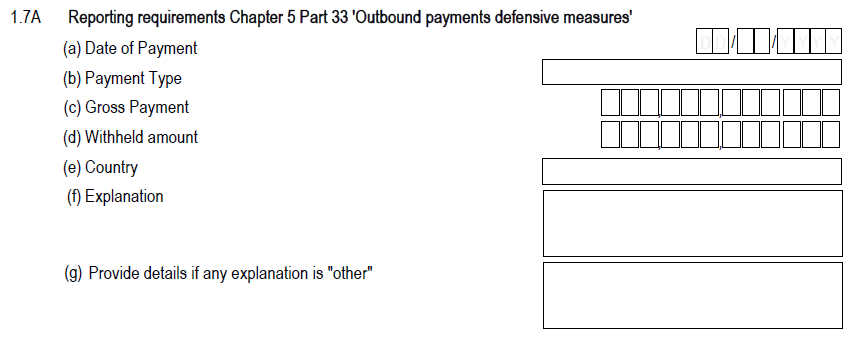
      Outbound payments defensive measures apply withholding tax to certain outbound payments made by Irish tax resident entities. This legislation operates by disapplying existing domestic withholding tax exemptions to certain payments made to non-resident entities. The legislation applies to payments of interest, dividends and royalties made by Irish tax resident companies, all of which are in principle subject to withholding tax but may qualify for a range of domestic exemptions where conditions are satisfied.

      To be in scope of these outbound payment rules, the payment made by the Irish company must be made to an “associated entity” that is resident in a “specified territory”.  These terms are defined in section 817U TCA 1997:

      Where a company makes a payment is subject to withholding tax because off these outbound payments defensive measures they are required to disclose the following details in 1.7A of the company's tax return:

      (a) Date of payment
      (b) Payment type
      (c) Gross payment
      (d) Withheld amount
      (e) Country
      (f) Explanation

      Form CT1 screenshot


      Transfer pricing SME

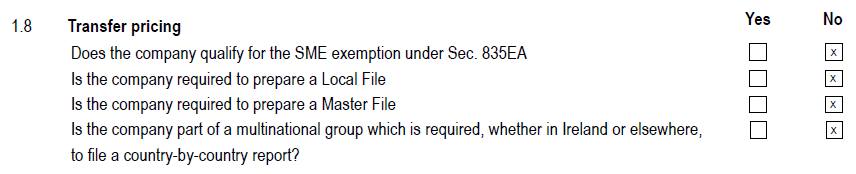
      Small and Medium Enterprises (“SME”) are currently not within the scope of the Irish Transfer Pricing legislation. An enterprise may be regarded as an SME if, in respect of the chargeable period, it has:

      • a total staff headcount of less than 250 and either;
        • an annual turnover of less than or equal to €50m or;
        • an annual balance sheet total (i.e. gross assets without deduction of liabilities) of less than or equal to €43m.

      These thresholds are determined by reference to the global consolidated results of any group of which an enterprise is a member. 

      Form CT1 screenshot


      Transfer pricing

      Transfer pricing documentation

      As outlined above, Finance Act 2019 brought enhanced Transfer Pricing documentation requirements into Irish law. In addition to requiring a taxpayer to have available such records as may reasonably be required to demonstrate compliance with Transfer Pricing legislation, it also requires larger taxpayers to prepare a master file and/or local file in accordance with OECD guidelines.

      Any master/local files should be in place no later than the due date for the submission of the tax return for an accounting period and must be provided within 30 days of a written request made by Revenue.

      Transfer Pricing documentation must be kept up to date and reviewed regularly to determine the pricing remains arm’s length. Information showing how the Transfer Pricing Policy was actually applied in each period should be updated annually.

      Local file

      A company is required to prepare a local file where it forms part of a multinational group (‘’MNE Group’’) and the total consolidated global revenue of the group is at, or likely to be at, or above €50 million.

      The local file provides detailed entity-level information, which is specific to the Irish operations, identifying related party transactions, amounts involved in relation to such transactions and the transfer pricing determinations that have been made with regard to those transactions.

      As an alternative to preparing an individual file for each Irish group company, it is possible to prepare a “country file” for all Irish entities of an MNE group.

      You should ensure that the local file is finalised and in place before the tax return due date which is outlined in our obligations page.

      Master file

      A company is required to prepare a master file where it forms part of an MNE Group and the total consolidated global revenue of the group is at, or likely to be at, or above €250 million.

      The master file provides details of the business operations and transfer pricing policies at an MNE group level. This includes details of the business operations, supply chain, the principal contributions to value creation by individual entities, details of intangibles and intercompany financing activities, and the transfer pricing policies and practices.

      Penalties

      A fixed penalty of €25,000 applies where the taxpayer fails to meet the transfer pricing documentation requirements and provide the relevant records to Irish Revenue within 30 days of a request in writing. This penalty increases by €100 for each day on which the failure continues.

      Form CT1 screenshot


      Irish Controlled Foreign Company ("CFC")

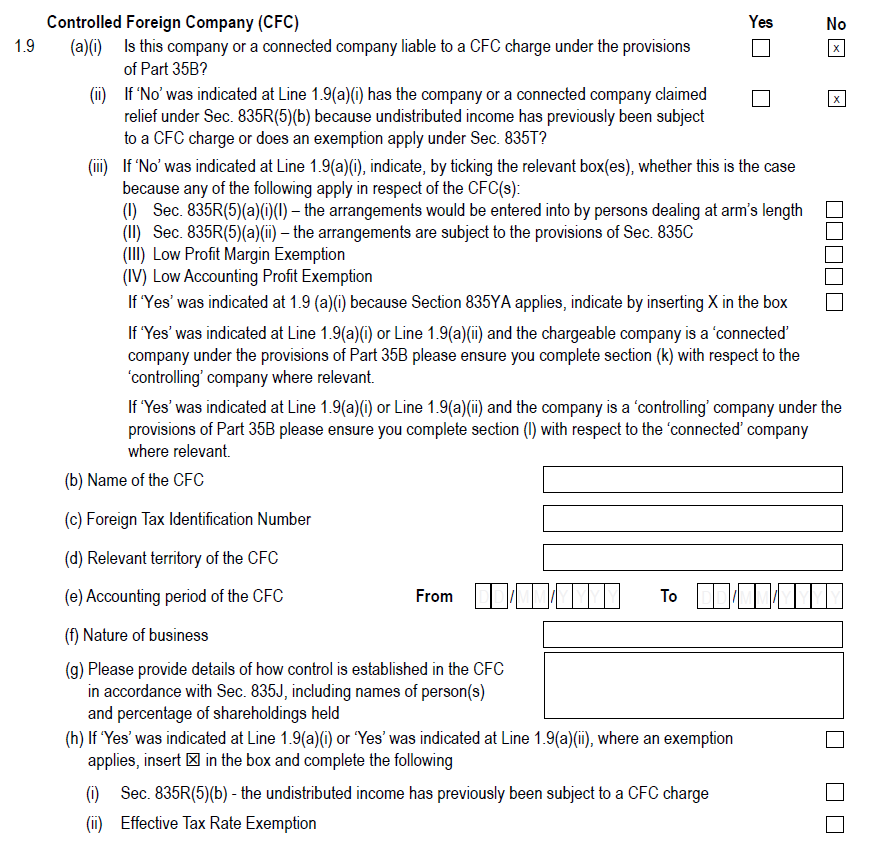
      Irish Controlled Foreign Company (“CFC”) rules are an anti-abuse measure, designed to prevent the artificial diversion of profits from controlling companies to offshore entities in low or no-tax jurisdictions.

      The general thrust of the regime is to assess an Irish company with a CFC charge based on an arm’s length measure of the undistributed profits of the CFC that are attributable to either, the activities of significant people functions (“SPFs”) or key entrepreneurial risk-taking functions carried on in Ireland. The CFC charge does not apply where the essential purpose of the arrangements is not to secure a tax advantage.

      Where a company or a connected company is not subject to a CFC charge on the basis that the undistributed income has previously been subject to a CFC charge or the effective tax rate exemption applies, this must be disclosed on panel 1.9(a)(ii) of the Form CT1.

      Panel 1.9(iii) lists a number of exemptions from the application of Irish CFC rules as follows. Where any of these exemptions are relied upon, this must be disclosed on the Form CT1.

      (I) the arrangements would be entered into arm’s length
      (II) the arrangements are subject to the provisions of Irish Transfer Pricing legislation
      (III) the low profit margin exemption
      (IV) low accounting profit exemption 

      Form CT1 screenshot


      Non-resident Landlord Withholding Tax

      Tenants/Collection Agents

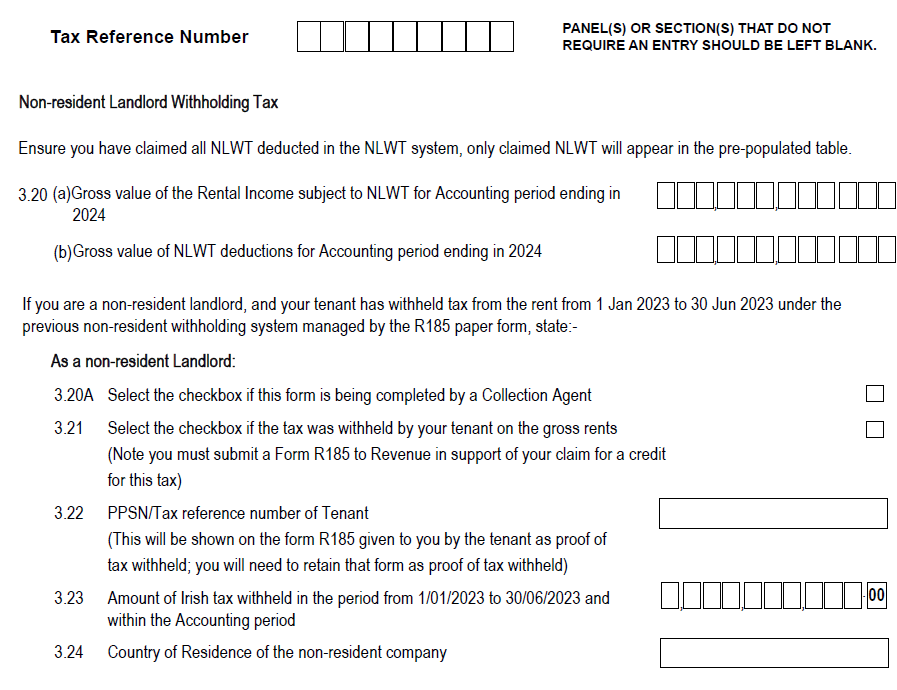
      • Tenants who pay rent directly to a non-resident landlord are required to withhold 20% of the gross rental due to the landlord and remit this amount to Revenue via the NLWT system.
      • Collection agents (e.g. letting agents or property managers) acting on behalf of non-resident landlords are also required to withhold 20% of the gross rental due to the non-resident landlord and remit this amount to the Revenue via the NLWT system unless the collection agent has agreed to be assessable for the Irish tax due by the non-resident landlord in respect of the Irish rental income.
      • Where NLWT is withheld, a rental notification (RN) must be submitted by the tenant or collection agent through the NLWT system each time rent is paid to the non-resident landlord, and the NLWT must be remitted to the Revenue by the tenant / collection agent. There is no longer a requirement for a Form R185 to be issued to the landlord when tax is withheld from rents.
      • Where a collection agent does not operate the new NLWT system, it remains chargeable and assessable for the Irish tax due by the non-resident landlord in respect of the Irish rental income which the agent is acting in respect of (as was the case where collection agents were appointed by non-resident landlords prior to the changes to the regime introduced in Finance Act 2022). In such cases, the collection agent must obtain a specific tax registration number for the non-resident landlord on whose behalf they are acting and on behalf of whom they will file a tax return. While the tax assessment will be in the name of the Irish collection agent, the tax to be charged is the amount which would be charged if the non-resident landlord in question was assessed in its own right.

      Non-resident landlord

      • Where a tenant or collection agent operates the NLWT (i.e. has withheld 20% of the gross rental due to the non-resident landlord), the non-resident landlord must register for Irish tax and file an annual tax return in respect of its Irish rental income (and any other income within the charge to Irish tax).
      • NLWT withheld from rent due to the non-resident landlord should be available as a credit to the non-resident landlord when filing its annual tax return.

      For further details, please refer to Revenue’s official guidance here.

      Form CT1 screenshot


      Anti-hybrid Mismatches

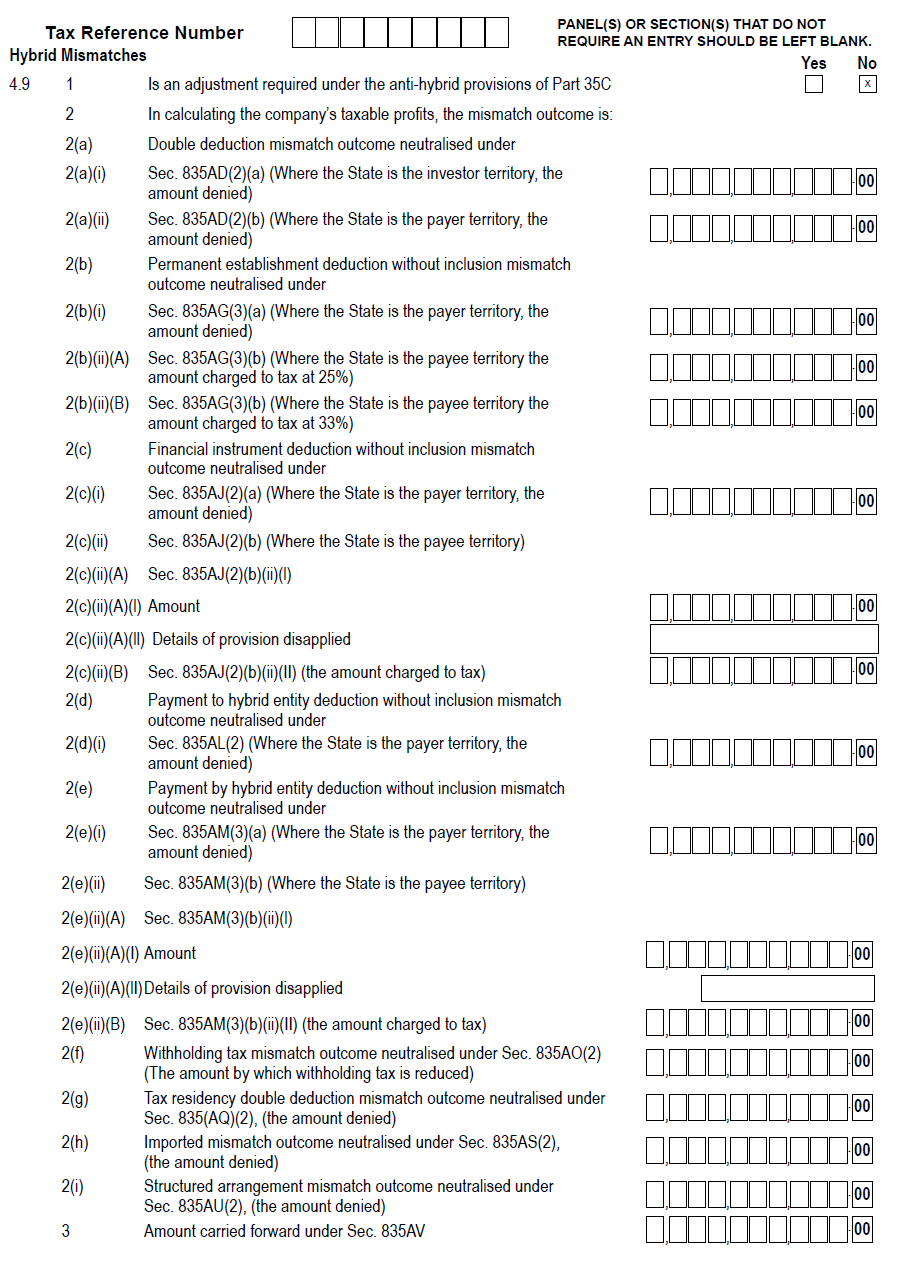
      The Form CT1 includes details of any adjustment which is required in the tax return of the company due to anti-hybrid rules.

      These anti-avoidance rules are quite complex and are designed to counteract the impact of arrangements that exploit the differences in the tax treatment of an instrument / entity arising from the way in which that instrument / entity is characterised under the tax laws of two or more territories so as to generate a tax advantage or a mismatch outcome.

      There are a number of hybrid mismatches included in the new legislation which can broadly be put into two categories:

      • Mismatch outcomes which result in a deduction for a payment in the payer territory where the income is not picked up or “included” by the recipient of the payment in its territory (a “deduction / non-inclusion outcome”); and
      • Mismatch outcomes which result in a deduction being taken in two territories for the same payment (a “double deduction mismatch outcome”), where the payment is not set-off against an amount that is considered to be “included” in both territories (known as dual-inclusion income).

      Where a mismatch outcome arises, the rules can act to restrict the deductibility of the payment for Irish Corporation Tax purposes. 

      Form CT1 screenshot


      Foreign Bank Accounts

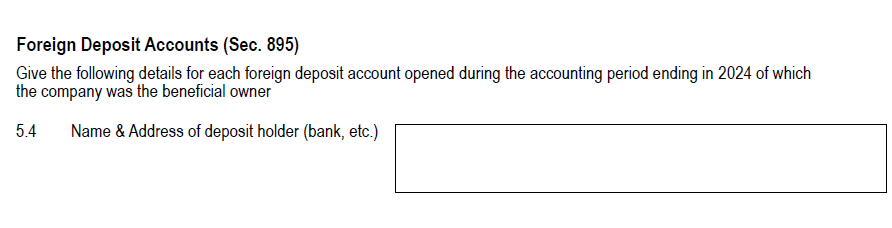
      The Form CT1 requires each Irish tax resident company to disclose details of any foreign bank accounts which were opened during the period, either (i) by the company, or (ii) where the company caused another person to open a bank account in relation to which the company is the beneficial owner of a deposit held in that account.

      A foreign bank account is an account in which a deposit is held at a location outside of Ireland.  A deposit is a sum of money paid to a person on terms under which it will be repaid with or without interest and either on demand or at a time or in circumstances agreed by or on behalf of the person making the payment and the person to whom it is made.

      This legislation also applies to intermediaries in certain circumstances.  However, current Revenue practice is not to apply this to financial services companies in the following circumstances:

      • The foreign account is opened in the course of a financial services trade carried on by the company;
      • The overnight/shorter account is opened for placement (short-term meaning up to 3 months);
      • The deposit on the account is held as a trading asset of the company;
      • Income on the account forms part of the trading income of the company.

      This practice is subject to a written undertaking being supplied by the financial service company involved to the Revenue Branch dealing with their affairs confirming that the income arising on such foreign accounts will be included in the company’s annual return of income

      Form CT1 screenshot