error
Subscriptions are not available for this site while you are logged into your current account.
close
Skip to main content

      The arrival of Europe’s first credible alternative to cards reinforces payments sovereignty amid geopolitical uncertainty.

      Europe’s payments landscape has reached a structural inflection point. For the first time, account‑to‑account (A2A) payments represent a credible alternative to cards for everyday retail and e‑commerce use. This shift is driven by the convergence of mandatory instant payments, strengthened open banking and interoperable A2A wallet models.

      Payments sovereignty has moved decisively from a theoretical concern to a strategic priority. Europe is reassessing its reliance on non‑European card schemes, technology providers and infrastructure in the context of heightened geopolitical and operational risk.

      In response, regulatory reform, public‑sector positioning and market initiatives are converging around European‑controlled payment rails designed to reduce dependency, strengthen resilience and support long‑term autonomy.

      A2A payments 


      A2A payments sit at the centre of this transition. Mandatory SEPA Instant Payments have established a pan‑European, always‑on settlement layer, while PSD3 and the new Payment Services Regulation materially strengthen open banking and pay‑by‑account models.

      Together, these reforms elevate A2A from a niche transfer mechanism to a viable foundation for everyday payments at scale.

      Market adoption is accelerating. High‑profile merchant launches, including pay‑by‑bank at checkout, demonstrate that A2A is no longer experimental.

      Overlay services such as wallets and identifier‑based payments are abstracting complexity from underlying bank rails, delivering consumer‑grade experiences that increasingly rival cards. Ireland’s launch of Zippay illustrates how bank‑led models can reassert relevance by embedding frictionless A2A payments directly into existing digital channels.


      Interoperable payments


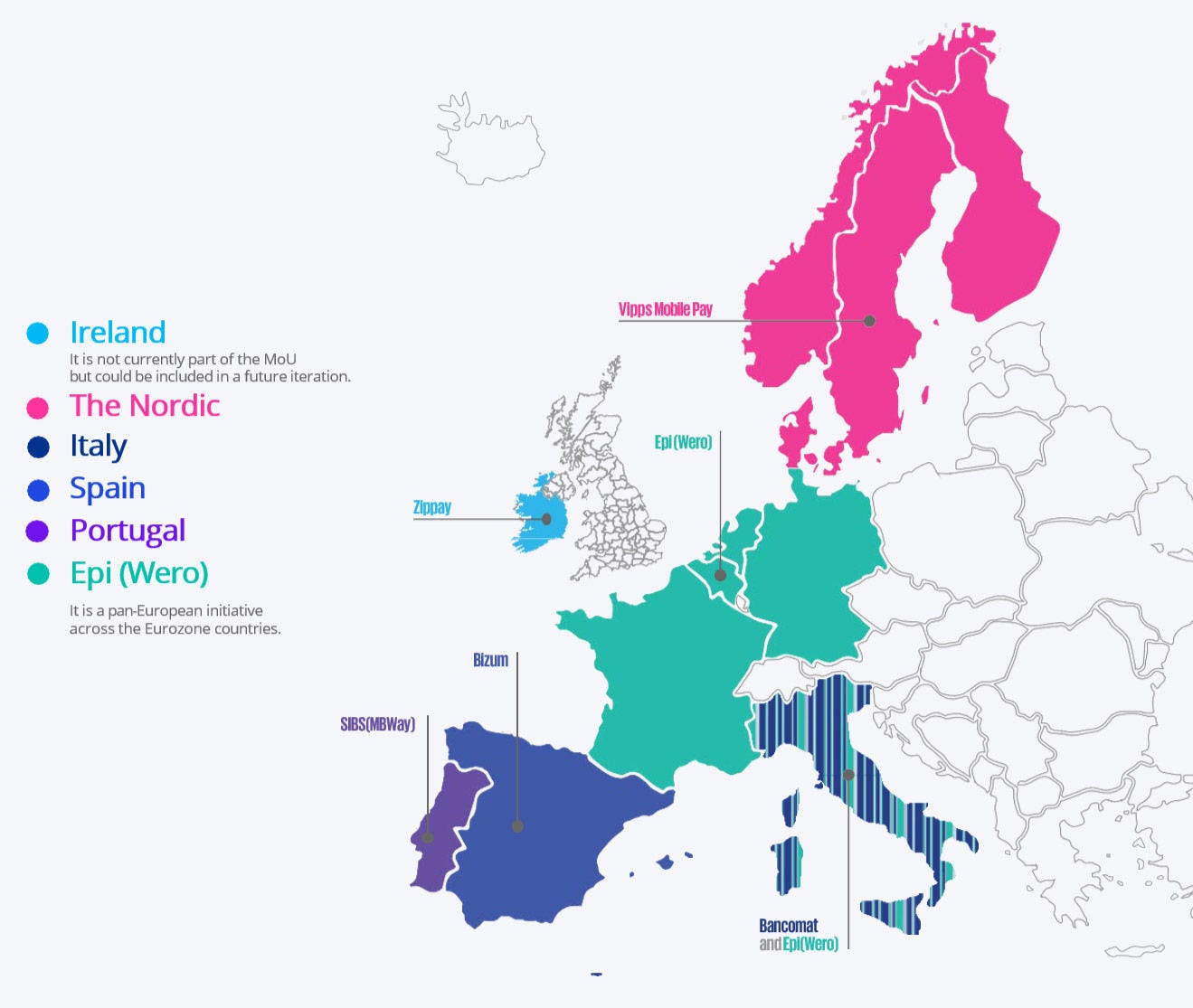
      Interoperability is the critical enabler of European scale. The February 2026 Memorandum of Understanding between Bancomat, Bizum, SIBS (MB Way), Vipps MobilePay and the European Payments Initiative (Wero) marks a major inflection point, through the joining up of established domestic schemes.

      Cards will remain an important part of Europe’s payments mix. However, the structural foundations of everyday payments are shifting. Banks, PSPs, merchants and platforms must now reassess their strategies for a future in which interoperable, account‑based payments operate alongside cards as a core pillar of European commerce.

      Those that adapt early will shape the next decade of Europe’s payments ecosystem.

      Shane Garahy

      Partner, Risk Consulting

      KPMG in Ireland


      The current payments landscape

      Cards dominate in Europe, but a shift is happening


      Europe is entering a decisive phase in the evolution of its payments ecosystem. After decades of card scheme dominance, regulatory reform, sovereign-first policy thinking and rapid merchant adoption are converging to create the first credible, scalable alternative: interoperable, account-to-account (A2A) payments.

      Despite this shift, everyday payments at the point of sale (POS) and in e-commerce checkout remain dominated by card-based transactions. Recent data illustrates the scale of this dominance.

      In February 2026, the Banking & Payments Federation of Ireland (BPFI) published its quarterly Payments Monitor Report highlighting that  over 1.6 billion contactless POS transactions were made in 2025. These transactions had a total value of more than €30 billion, with contactless accounting for almost 90% of all POS card payments.

      These card-based payments operate across a complex ecosystem of gateways, acquirers, issuing banks, processors, big tech companies and other third parties associated with the card schemes. While card and payment infrastructures will continue to coexist; the emergence of interoperable A2A models is beginning to erode the structural advantages that have historically reinforced card dominance.


      Instant payments

      Mandatory instant payments and PSD3/PSR


      Mandatory instant payments under the EU Instant Payments Regulation have fundamentally reset the baseline for bank-to-bank payments. What was previously an optional payment scheme has now become a standard across the SEPA zone, establishing a pan-European, real-time payments layer that operates continuously.

      At the same time, Open Banking powered account to account (A2A) models (first introduced in Europe by PSD2 and now being significantly strengthened through PSD3 and the new Payment Services Regulation) are maturing rapidly. These reforms raise the bar on transparency, reliability and reachability while sweeping away outdated fallback mechanisms.

      Together, instant payments and enhanced open banking form a powerful foundation for next generation A2A experiences, transforming A2A from a niche transfer mechanism into a viable foundation for everyday payment use cases. This shift will both reduce fragmentation and drive genuine European-wide pay by account operability.


      Ireland and Zippay


      Ireland provides a useful illustration of this trend. On 10 March 2026, AIB, Bank of Ireland and PTSB launched Zippay, an in-app A2A payment service that allows customers to send, request and split payments using mobile numbers rather than IBANs.

      Embedded directly within existing banking apps, Zippay is positioned as a bank-led response to the everyday convenience that fintechs such as Revolut have normalised, demonstrating how banks can reclaim relevance in peer-to-peer payments by removing friction at the user interface rather than rebuilding the rails.

      In the longer term, Zippay may offer a basis for exploring how frictionless cross-border peer-to-peer payments could be enabled for Irish customers across the SEPA zone, aligned with wider EU interoperability efforts.


      Why payments sovereignty has become a strategic priority

      These developments in A2A payments are unfolding at a time when sovereignty has moved to the forefront of Europe’s political and economic agenda.

      In recent weeks, European governments have taken steps to reduce their reliance on US-based technology providers, with France announcing plans to move away from platforms such as Zoom and Microsoft Teams in favour of domestic or open-source alternatives, citing concerns around digital sovereignty, data protection and strategic dependency.

      This shift reflects a broader reassessment of Europe’s reliance on non-European infrastructure across critical digital services, including payments, where dependence on international card networks and global technology providers is increasingly viewed as a strategic vulnerability.

      International card schemes such as Visa, Mastercard and American Express play a central role in everyday European commerce, while significant parts of the supporting technology stack rely on US-based cloud providers including Amazon Web Services and Google Cloud.

      In an increasingly uncertain geopolitical environment, this concentration of dependency is creating discomfort among policymakers and regulators, accelerating the push for European-controlled payment alternatives.

      This increases the strategic importance of A2A payments and other bank-based models that reduce reliance on non-European intermediaries. By enabling payments to flow directly between European banks over European-governed infrastructure, A2A payments are increasingly viewed not just as a commercial alternative to cards, but as a strategically important component of Europe’s payments resilience.

      The digital euro is expected to support these sovereignty ambitions and is intended to coexist alongside cash, cards and commercial bank money as part of Europe’s future monetary landscape.

      In February 2026, the European Parliament strongly backed the ECB’s Digital Euro initiative, signalling clear political momentum behind a European central bank digital currency. The ECB has indicated that, pending final legislative adoption, the digital euro is tracking towards a potential launch around 2029.

      In parallel, private-sector initiatives are also emerging that reflect a growing focus on European monetary autonomy. A consortium of ten European banks has announced plans to launch a euro-backed stablecoin, addressing a market currently dominated by US-dollar-denominated instruments.

      Market concentration remains high with 99% of stablecoins in circulation being USD pegged stablecoins, the vast majority (89%) of which are USDT and USDC, reinforcing the global role of the US dollar in digital markets.

      This bank driven euro backed stablecoin initiative is being developed through Qivalis, an Amsterdam-domiciled joint venture established to act as the stablecoin issuer.

      Qivalis is seeking authorisation and supervision as an Electronic Money Institution under the Dutch Central Bank and plans to launch a MiCA compliant, euro denominated stablecoin in the second half of 2026. The project is intended primarily for regulated payments, settlement, and institutional use cases.

      While these initiatives differ in design and purpose, together they highlight a broader shift towards strengthening European control across both public and private forms of digital money.

      Sovereignty has not historically been a defining concern in retail payments; Europe’s dependence on non-European card schemes and technology providers was long treated as a practical market reality rather than a strategic risk.

      Recent geopolitical tensions and the exposure of Europe’s digital dependencies have fundamentally altered that assessment. Sovereignty is now moving from the periphery to a central organising principle for Europe’s future payments landscape.

      As political and economic vulnerabilities become more pronounced, regulators are increasingly likely to regard sovereignty as a foundational requirement in the governance, assurance and scaling of payments infrastructure.

      Public-sector procurement, regulatory design and critical-infrastructure planning will correspondingly place heightened emphasis on European control, operational resilience and jurisdictional alignment.


      A2A market adoption: From policy enablement to commercial reality

      Market adoption shows A2A is viable


      After several years of regulatory and infrastructure groundwork, A2A payments are beginning to appear directly within mainstream checkout journeys, marking an important shift from policy-driven enablement to market-led acceleration.

      Recently, we have seen high profile examples of this momentum, with Amazon UK’s pay by bank launch showcasing real world, large scale A2A adoption. Further, eBay has announced a new partnership with one of the leading European open banking players, TrueLayer, to launch pay by bank at checkout in the UK.

      These flagship use cases reinforce the viability and competitiveness of A2A payment models and signal that pay-by-account is no longer confined to niche or peer-to-peer use cases.

      As large merchants embed A2A directly into their payment flows, consumer familiarity and acceptance are already increasing, creating momentum that will spread across the wider retail ecosystem.


      Overlay services key to making A2A usable at scale


      These developments indicate that A2A payments are emerging as a credible alternative to cards in specific everyday payment scenarios, particularly where speed, cost efficiency and A2A settlement provide clear advantages.

      Over time, and alongside other initiatives such as the digital euro, A2A-based models have the potential to operate as complementary alternatives to card-based payments within Europe’s broader payments mix.

      At the same time, experience across Europe shows that the success of A2A payments depends not only on the underlying rails, but on the overlay services that sit on top of them.

      Overlay services are consumer-facing layers that sit above instant payment infrastructure, abstracting complexity away from IBANs, clearing and scheme-specific processes by linking bank accounts to familiar identifiers such as mobile numbers. Ireland’s Zippay (launched on March 10th 2026) provides an example of this approach, enabling users to send and receive

      A2A payments through their existing banking apps using contact details rather than account information. Wallets, identifier-based payments and embedded account-to-account experiences play a critical role in making A2A usable at scale.

      Zippay represents a significant milestone for payments in the Irish market. It is useful at this point to consider its position in the wider European context.


      The MoU: Interoperability as the enabler of European scale

      The Memorandum of Understanding (MoU) signed in February 2026 represents one of Europe’s strongest steps towards interoperable, sovereign retail payments.

      A group of leading European domestic payment and mobile wallet providers with mainstream adoption across multiple major markets, including Bancomat (Italy), Bizum (Spain), SIBS (MB Way) (Portugal) and Vipps MobilePay (the Nordics), together with the European Payments Initiative (Wero), agreed to accelerate the rollout of interoperable, cross-border wallet payments across Europe.

      Collectively, these wallets already serve approximately 130 million users across 13 European countries, providing immediate relevance and significantly lowering the execution risk that has constrained previous pan-European payment initiatives.


      Map of payment providers in Europe

      Using existing infrastructure and behaviour


      The MoU is significant because it connects existing A2A-based wallets and schemes, enabling interoperable, European-scale payments that support sovereignty ambitions. What differentiates this initiative from previous pan-European efforts is its starting point rather than its ambition.

      Rather than creating new payment rails or attempting to establish a new scheme from scratch, the initiative recognises that Europe’s underlying payment infrastructure and consumer adoption are already strong. By linking domestic and pan-European wallets with established daily usage and deep consumer trust, interoperability builds directly on proven local success.

      The strategic priority is therefore to unlock the full value of existing clearing systems, overlay services and account-mapping layers, significantly reducing the adoption and execution risks that constrained earlier initiatives.


      Establishing a shared framework


      While technical standards provide an essential foundation, the success of the MoU will depend less on technology and more on the alignment of governance, fraud management, liability models, AML frameworks and commercial arrangements across participating markets. It is this operational and commercial coordination that will ultimately determine whether interoperability can be delivered at scale.

      The MoU establishes a shared framework covering:

      • Cross-border wallet interoperability, enabling consumers to pay across participating markets using their existing domestic wallet.
      • No change to consumer brands or front end experiences, preserving trusted national propositions while extending reach.
      • Interoperability without scheme replacement, leveraging existing SEPA instant payment rails and domestic infrastructures.

      Implications for banks, payment service providers (PSPs) and market participants

      The fundamental building blocks of payments are shifting at an unprecedented pace. Regulatory change, instant payments infrastructure, wallet interoperability and A2A capabilities are reshaping how consumers and businesses pay and get paid, both domestically and across borders.

      Over the next five years, cards will remain important, but they will increasingly coexist with new rails and experiences that challenge long established economics, operating models and customer journeys.

      As a result, banks, PSPs and merchants must reassess what their payments strategies need to look like over the medium term. This is no longer about incremental optimisation of card based models, but about ensuring organisations are positioned to support always on, interoperable and increasingly account-based payments at scale.


      What banks and merchants need to start doing now

      • Banks and PSPs
        • Reassess everyday payments strategies to ensure account-to-account and wallet-based payments are embedded alongside cards within core customer journeys.
        • Assess readiness of instant payments infrastructure and cross-border operating models for always-on, cross-scheme scale.
        • Strengthen governance, fraud, liability and AML frameworks to support real-time, cross-border account-to-account payments.
        • Evaluate long-term reliance on non-European card schemes and wallet providers as part of broader payments and digital sovereignty strategies.
      • Merchants
        • Review checkout and point-of-sale strategies to support pay-by-account and local wallet payments alongside cards.
        • Engage early with acquiring banks and PSPs to enable cross-border acceptance of account-to-account payment methods.
        • Assess potential cost, settlement and cash-flow benefits, particularly for cross-border, e-commerce and tourist-heavy use cases.
        • Factor pay-by-account and wallet interoperability into longer-term channel, geographic expansion and platform strategies, supporting simpler access to European customers through familiar local payment methods.


      Europe’s first credible alternative to cards

      Payment cards will remain a critical part of Europe’s payments ecosystem. However, for arguably the first time in over fifty years, Europe now has a commercially viable, genuine alternative for everyday payment, that is capable of operating at scale.

      A convergence of regulatory reform, infrastructure maturity and market adoption has reshaped the foundations of account-to-account payments. Mandatory instant payments, strengthened open banking frameworks and interoperable wallet models have moved A2A from a niche transfer mechanism into mainstream checkout journeys, supported by real-world adoption from banks, merchants and platforms.

      The Bancomat, Bizum, EPI, SIBS and Vipps MobilePay MoU marks a critical inflection point by accelerating this shift through interoperability rather than reinvention. By connecting established domestic schemes instead of creating new rails, the initiative materially lowers execution risk and brings European-scale A2A payments within reach.

      The firms that adapt fastest to an A2A-centric, interoperable environment will shape the next decade of European payments.


      How KPMG can help

      KPMG brings together deep payments, technology and regulatory expertise to help banks, PSPs and market participants translate Europe’s payments sovereignty ambitions into executable, sustainable operating models. Our support is anchored around three outcome-driven pillars:

      • Strategy & market positioning

        We support organisations in defining future-ready payments strategies that respond to structural shifts in Europe’s payments landscape.


        Drawing on our experience working with leading European and international banks, PSPs and market participants, we help firms assess strategic options, clarify market positioning and prioritise initiatives that reflect evolving consumer behaviour, competitive dynamics and geopolitical considerations.


        We work with leadership teams to translate payments sovereignty ambitions into practical strategic roadmaps, ensuring key decisions and initiatives are aligned to long-term business objectives and deliver tangible value.

      • Regulatory alignment & governance

        We help organisations align payments transformation initiatives with evolving European regulatory expectations, including PSD3 / PSR, SEPA Instant Payments Regulation, DORA, AML/CFT and broader consumer protection requirements.


        Our teams support the design and enhancement of governance, risk and compliance frameworks, embedding regulatory considerations into payments strategies, operating models and decision-making from the outset.


        By integrating regulatory alignment into strategy and design, we help firms move beyond reactive compliance and build resilient, regulator-ready payments capabilities.

      • Execution & implementation

        We support firms in moving from ambition to delivery through structured readiness assessments, roadmap development, pilot design and market-by-market implementation planning.


        Leveraging our experience delivering complex payments, technology and regulatory change programmes, we help organisations accelerate time-to-value while managing delivery and execution risk.


        Our end-to-end approach enables firms to progress confidently from strategy through to implementation, ensuring changes are delivered in a controlled, scalable and sustainable manner.


      Contact our Technology team for more

      Shane Garahy

      Partner, Risk Consulting

      KPMG in Ireland

      Ian Nelson

      Head of Regulatory, Head of Financial Services

      KPMG in Ireland

      Niamh Lambe

      Managing Director, Risk and Regulatory Consulting

      KPMG in Ireland

      Solving challenges from scaling AI and modernising digital platforms to securing your infrastructure and unlocking new revenue models

      Discover more in Technology

      Something went wrong

      Oops!! Something went wrong, please try again