error
Subscriptions are not available for this site while you are logged into your current account.
close
Skip to main content

      Background

      Global deforestation and forest degradation are among the most significant drivers of nature loss and climate change, with far‑reaching social and economic consequences for forest‑dependent communities and global supply chains.

      Forest ecosystems provide critical habitats for biodiversity, function as important carbon sinks, regulate water systems and underpin livelihoods, food security, and cultural heritage.

      Continued forest loss (both legal and illegal) presents systemic risks to nature, climate stability and long‑term economic resilience.

      Russell Smyth

      Partner, Head of Sustainable Futures and Corporate Finance

      KPMG in Ireland


      Forest seen from above

      History

      Historically EU consumption has been linked to deforestation beyond its borders, driven by growing demand for agricultural commodities, and forest products associated with land use change. The EU has been linked to a substantial share of global deforestation, driven largely by the international trade supplying the EU (1).

      As a result, the environmental impacts are often unseen as they occur upstream and out of sight of European consumers and regulators. This has been a key driver for regulatory intervention at the EU level, reflecting growing recognition that voluntary commitments and certification approach alone have not been sufficient to halt deforestation or forest degradation at scale.


      Regulation introduction

      In response, the EU Deforestation Regulation (Regulation (EU) 2023/1115, EUDR), as amended by Regulation (EU) 2025/2650 was introduced to address the links between EU demand, deforestation, forest degradation, and associated human rights and governance risks.

      The regulation is intended to ensure that commodities and products placed on, or exported from, the EU market are not associated with deforestation or forest degradation and are produced in accordance with relevant laws in the country of production.

      In doing so, the EUDR seeks to reduce the EU’s global deforestation footprint and support the conservation of critical forest ecosystems, while contributing to wider international commitments on biodiversity protection, climate mitigation and sustainable land use.


      Impact on supply chains

      While the EUDR is fundamentally driven by environmental and governance objectives, it also has direct implications for the long‑term resilience of supply chains reliant on forest and land‑based commodities.

      By setting clear and enforceable requirements for deforestation‑free production and legal compliance, the EUDR aims to re‑align market incentives towards responsible forest management, sustainable agriculture and more transparent supply chains.

      Over time, this is intended to support fair competition, provide greater confidence in the integrity of forest and timber supply, and help underpin more resilient sourcing strategies for EU‑linked value chains.

      Sitting within the broader umbrella of the European Green Deal, the European Biodiversity Strategy for 2030, and the Farm to Fork Strategy, and forming part of a wider set of regulations focused on improving global value chains (2), the regulation will require any company importing or exporting specific commodities to or from the EU, or making them available on the EU market, to demonstrate that products are not produced on land that was deforested or degraded after 31 December 2020, and are produced in accordance with the laws of the country of production.

      Colourful trees seen from above

      Evolving timelines

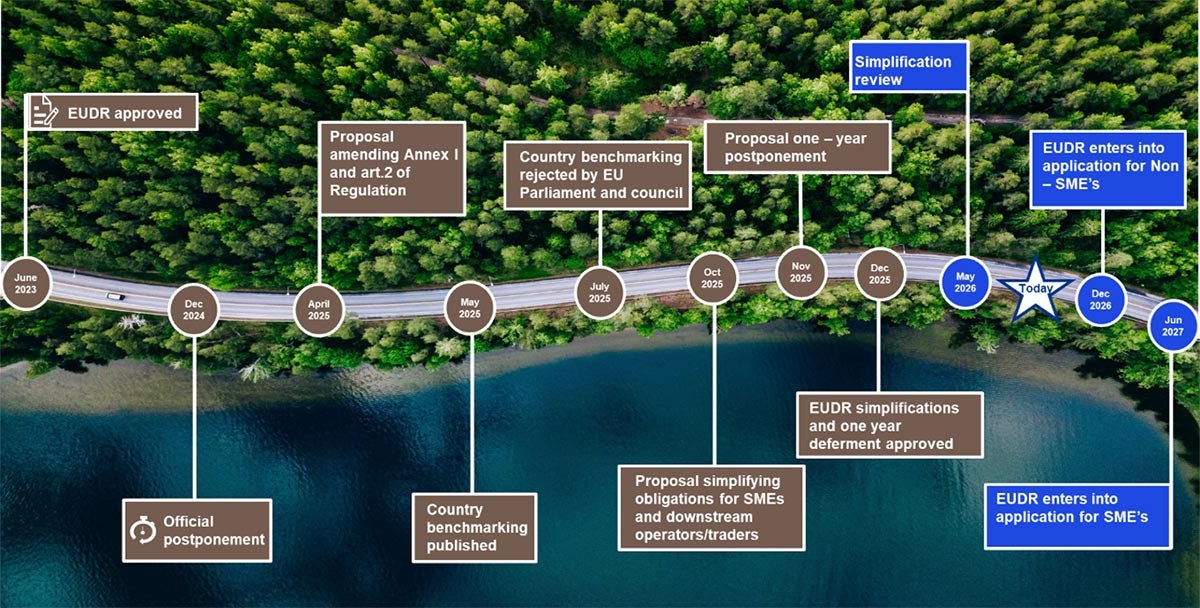
      The EUDR has evolved substantially since it first entered into force in June 2023, with a series of political and legislative developments reshaping both its scope and its application date.

      Following significant concerns from businesses and trading partners regarding readiness and proportionality, the EU agreed a one‑year postponement and a package of simplification measures, formally adopted in December 2025.

      These amendments deferred the main application date to 30 December 2026 for medium and large undertakings and to 30 June 2027 for micro and small undertaking (3).

      The amended regulation also introduced targeted relief measures, particularly for downstream operators and traders, and removed certain products (such as printed materials) from scope.


      Simplification review

      In parallel, the European Commission published its simplification review in May 2026, providing further clarity on the practical application of the Regulation. The review confirms the core design of the EUDR, while introducing a set of targeted simplifications and clarifications that:

      • further reduce administrative burden across value chains;
      • confirm that due diligence responsibility sits with the first operator placing products on the EU market; and
      • provide greater certainty on scope, obligations and implementation.

      The Commission’s review also signals a shift from regulatory uncertainty to implementation readiness, with companies now expected to focus on operationalising compliance.

      In this context, businesses should also anticipate that further refinements to scope and practical expectations may continue as implementation progresses.

      EUDR process


      Commodities covered

      The EUDR targets seven commodities (cocoa, cattle, coffee, palm oil, soy, rubber, and wood), as well as a wide range of derivative products made from these commodities, including chocolate (cocoa), industrial fatty alcohols and glycerol (palm oil), and specified rubber‑based products.

      These cited commodities were selected via a thorough impact assessment, which identified them as the primary drivers of deforestation and forest degradation resulting from agricultural expansion.

      The simplification review did not alter the core list of commodities but refined the scope of covered and excluded derivative products to improve clarity, proportionality and consistency across supply chains.

      Recent guidance and the draft Delegated Act (May 2026) build on this by introducing targeted additions and exclusions (e.g. specific derivatives), and by increasing reliance on precise CN code classification.

      Certain commodities and derivative products are explicitly out of scope under the EUDR, including, inter alia:

      • Products containing a commodity listed in Annex I of the Regulation (which lists covered commodities and products) where the product itself is not listed in Annex I (for example, certain food products containing coca,  such as cakes and pastries );
      • Products that do not contain a commodity listed in Annex I;
      • Certain products listed in Annex I that are made exclusively from recycled material (i.e. materials that have completed their life cycle and would otherwise be disposed of as waste);
      • Certain leather and cattle-derived products;
      • Products made solely from bamboo, as bamboo is categorised as a non-wood forest product, and therefore out of scope of EUDR. In the case of wood products which also contain bamboo components, the bamboo components are not subject to due diligence obligations.
      • Second‑hand goods are explicitly clarified as out of scope, as obligations apply only to the first placing of a product on the EU market or export; and
      • Packaging is assessed based on whether it is placed on the market as a product in its own right; packaging used solely to contain, protect or transport another product is treated as ancillary.

      Obligations, depending on position in the value chain

      A defining feature of the EUDR is that obligations vary significantly depending on an organisation’s role in the value chain and its size.

      The simplification review reinforced this role‑based approach by clearly confirming that due diligence responsibilities sit with the first operator, while downstream obligations are primarily passive and risk‑triggered.


      Placing relevant products on the EU market or exporting them for the first time

      Operators must exercise due diligence through three core steps:, (i) collection of information (including traceability and geolocation data), (ii) risk assessment, and, where necessary, (iii) risk mitigation. A Due Diligence Statement (DDS) must then be submitted via the dedicated EUDR information system prior to placing the product on the EU market or exporting it.

      Example: An Irish timber business importing lumber from Brazil into Ireland for sale in the EU.

      Simplified regime for micro and small primary operators: “Micro or small primary operators” (4) established in a low‑risk country (5) placing products on the market that they themselves produce are not required to submit a DDS; instead, a one‑time simplified declaration applies, with a declaration identifier that accompanies the product.

      These actors do not have standalone due diligence obligations in most cases but have a passive obligation in respect of traceability, including collecting and retaining the due diligence reference number or declaration identifier from the operator.

      Regardless of size, all must keep records, cooperate with authorities, and notify authorities if new information indicates potential non‑compliance.

      Non‑SMEs (3) must also register in the EUDR information system and, in the case of substantiated concerns, must verify that due diligence was exercised and that no or only a negligible risk was found. In such cases, relevant products can only be placed, made available on the market, or exported where the verification demonstrates no or only a negligible risk of non-compliance.

      Example: An Irish furniture manufacturer purchasing timber from an Irish importer to make tables or cabinets.

      These actors have no due diligence obligation and no requirement to collect due diligence references, with obligations limited to basic record‑keeping, cooperation with inspections, and notification of authorities if risks of non‑compliance become known.

      Registration in the EUDR information system is required only where the entity is non‑SME.

      Example: An Irish wholesaler or distributor supplying EUDR‑covered products to retailers.

      Mountains covered with trees

      Actor

      Information required to be recorded

      *Retain for 5 years

      Requirement to register in EUDR information system

      Obligations if substantiated concern regarding non-compliance risk

      Operator

      “Micro or small primary operator”: provides declaration identifier


      All

      Inform Competent Authorities

      Where substantiated concerns exist, verify that due diligence was exercised and that no or only a negligible risk of non-compliance was found before placing product on market / exporting

      Other operators: provide DDS reference number*

      Downstream Operator

      DDS reference number* / declaration identifier* from operator

      Name, registered trade name or registered trademark, the postal address, the email address and, if available, a web address for operators, downstream operators or traders*

      Non‑SMEs only

      Inform Competent Authorities

      Non‑SMEs only: Verify that due diligence was exercised and that no or only a negligible risk of non-compliance was found before placing product on market / exporting

      Downstream Trader

      Name, registered trade name or registered trademark, the postal address, the email address and, if available, a web address for operators, downstream operators or traders*


      What does this mean for your business?

      The Commission’s simplification review confirms that the EUDR’s core requirements and objectives remain unchanged, underscoring the need for businesses to focus on implementation rather than further regulatory uncertainty.

      For businesses operating in producing countries, the inability to meet EUDR requirements may strain or sever relationships with EU customers. Meanwhile, for companies trading in, or making available commodities on the EU market, aligning processes with the EUDR will require significant changes to information flows, governance structures and supply chain oversight.

      Beyond supply chain disruption, violations of EUDR obligations expose businesses to severe penalties, including product confiscation and fines of up to four per cent of annual EU revenue (subject to national legislative adoption).

      This represents an immediate financial risk, which could have profound impacts on the bottom line.

      • Timeline

        The EUDR will enter into force on December 30, 2026. For micro and small undertakings, it will enter into force six months later.

      • Roles

        Information and compliance responsibilities vary depending on role in the supply chain.

      • Due diligence

        In-scope products require a due diligence or simplified declation to be sold or exported; customs may block non-compliant goods.

      • Penalties

        Penalty of 4% of annual turnover, sales ban, and exclusion from public procurement


      Key steps to comply with the EUDR

      Businesses should be prioritising a structured approach to EUDR implementation across four key phases:

      • Scoping

        Identify products and supply chains in scope, determine the organisation’s role (operator or trader), and assess current maturity against EUDR requirements to define key gaps.

      • Preparing

        Establish governance, translate regulatory requirements into internal policies and processes, and design the due diligence and supplier engagement framework needed to support compliance.

      • Implementing

        Operationalise due diligence through data collection, risk assessment and mitigation processes, supported by appropriate systems, controls and technology integration across the organisation.

      • Reporting

        Submit Due Diligence Statements via the EU Information System, maintain a robust and auditable documentation trail, and ensure ongoing compliance through regular review and reporting.

      In addition, companies should plan for “business as usual” ongoing compliance, including maintaining records for at least five years, preparing for National Competent Authority (NCA) enquiries, and building an audit‑ready documentation repository.

      Pile of chopped trees

      How KPMG can help

      KPMG is supporting organisations across sectors and commodities to understand their EUDR compliance obligations and how to prepare for them.

      Our network of multidisciplinary experts assists organisations in addressing supply chain, tax and legal, customs, human rights and deforestation considerations in an integrated manner.

      Understanding that EUDR challenges differ depending on an organisation’s supply chain, commodities and level of maturity, we tailor our approach to efficiently support clients’ specific needs and their broader obligations under the regulation. 


      Get in touch

      For more information, please contact our team below; we'd be delighted to hear from you.

      Russell Smyth

      Partner, Head of Sustainable Futures and Corporate Finance

      KPMG in Ireland

      Sarah Moran

      ESG Advisory Lead

      KPMG in Ireland

      Thomas Ball

      Nature, Biodiversity and Land Use Lead

      KPMG in Ireland

      Our dedicated decarbonisation & sustainability advisory team

      Read more in Sustainable Futures

      Something went wrong

      Oops!! Something went wrong, please try again

      Footnotes

      1. Estimates of the EU’s contribution to global deforestation through international trade are based on consumption based accounting of forest loss embodied in traded commodities. In 2017, EU consumption was responsible for approximately 16% of deforestation associated with international trade, placing the EU among the largest global contributors (https://www.wwf.nl/globalassets/pdf/stepping-up-the-continuing-impact-of-eu-consumption-on-nature-worldwide.pdf) More recent analyses indicate that this contribution has remained at a similar order of magnitude, with EU imports linked to around 15% of global deforestation associated with international trade between 2019 and 2021 (https://www.sei.org/features/eu27-countries-in-the-spotlight-for-deforestation-exposure).
      2. Including the Corporate Sustainability Reporting Directive (CSRD), Corporate Sustainability Due Diligence Directive (CSDDD), Carbon Border Adjustment Mechanism (CBAM), Battery Regulation (BATT2), Ecodesign for Sustainable Products Regulation (ESPR), and the Forced Labour Regulation (EUFL).
      3. Undertaking size is determined in accordance with Article 3 of Directive 2013/34/EU, meeting at least two of: micro‑undertakings ≤10 employees, ≤€450,000 balance sheet total and ≤€900,000 net turnover; small undertakings  ≤50 employees, ≤€5 million balance sheet total and ≤€10 million net turnover; medium undertakings ≤250 employees, ≤€25 million balance sheet total and ≤€50 million net turnover and large undertakings >250 employees,>€25 million balance sheet total and >€50 million net turnover.
      4. “Micro or small primary operator” means an operator who is a natural person or a micro-undertaking (≤10 employees, ≤€450,000 balance sheet total and ≤€900,000 net turnover) or small undertaking (≤50 employees, ≤€5 million balance sheet total and ≤€10 million net turnover), irrespective of its legal form, established in a country classified as low risk in accordance with Article 29 2023/1115, and who, in the course of a commercial activity, places on the market or exports relevant products that this operator itself has grown, harvested, obtained from or raised on relevant plots of land, or, as regards cattle, on establishments located in that country; this includes operators who exceed the limits of at least two of the three criteria for micro and small undertakings, but who can demonstrate that the parts of their balance sheet total, net turnover and average number of employees during the financial year, related to the relevant commodities and the relevant products, do not exceed the limits of at least two of three of those criteria.
      5. Country Classification List - Green Forum - European Commission