error
Subscriptions are not available for this site while you are logged into your current account.
close
Skip to main content

      As investment in mission-critical assets accelerates, safety-critical build elements are evolving from a compliance afterthought to a strategic delivery enabler.

      Fire and lightning protection systems now sit directly on the critical path, with testing, certification and operational sign-off acting as gateways for completion and commercial operations. For developers and operators, commissioning delays can be disastrous.

      As a result, safety-critical project elements once compressed toward programme completion are being engaged as key components of early design development.


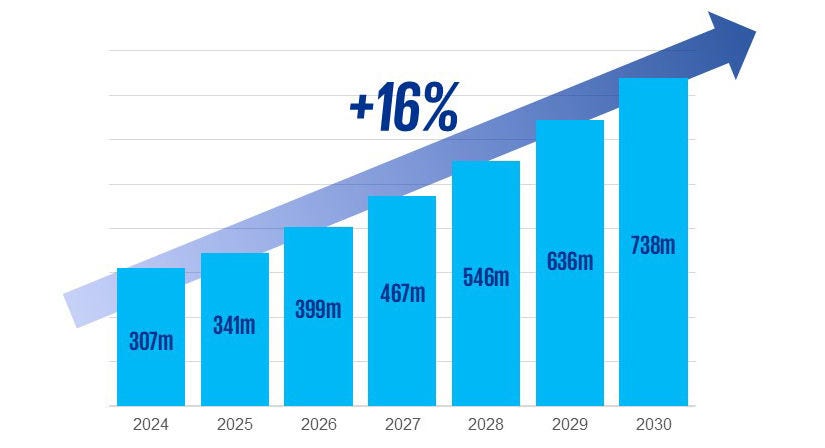
      Europe data centre fire contracting total market size

      Europe data centre fire contracting total market size, €m
      Christopher Brown

      Partner, Head of Strategy

      KPMG in Ireland

      Voice of the market

      It is not just construction of new DCs that is driving growth for our industry. There is a real push for retrofit of existing DCs to increase density in existing campuses. This isn’t speculative, its happening already.

      Business Unit Lead,
      European DC GC

      Higher rack densities necessitate more fire suppression nozzles due to greater thermal load. Existing sprinkler systems are often inadequate for these new AI configurations. 

      Director,
      KPMG Construction Advisory

      Unlike new builds, retrofits incur higher costs due as the fire contractor must proceed in phases to prevent operational disruptions, leading to slower completion times. A typical upgrade can take up to two years, as work progresses room by room.

      Head of Tenders,
      European Fire Contractor


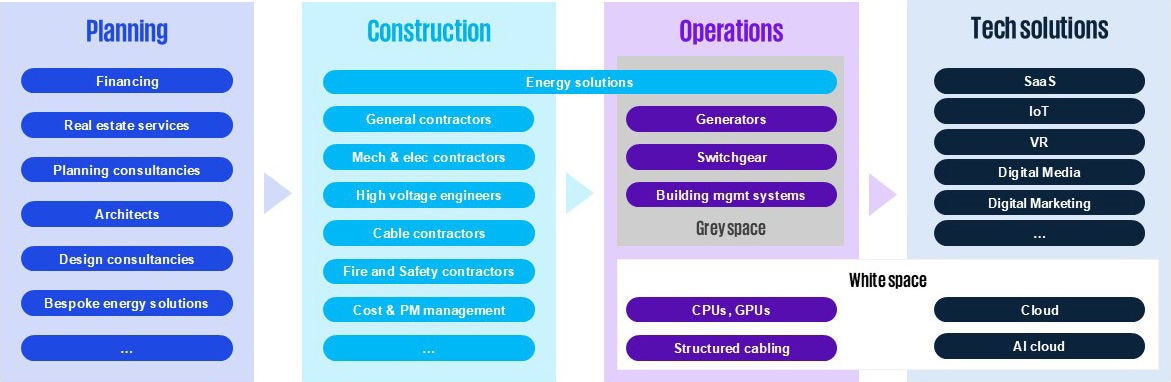
      Safety and the mission-critical value chain

      Fire detection, suppression and compartmentation systems interface directly with mechanical, electrical, controls and building-management platforms.

      Similarly, lightning and surge-protection systems integrate with HV/MV/LV networks to safeguard power continuity and protect sensitive digital and processing equipment.

      Failures or delays in either discipline can stall integrated testing and handover, making these systems schedule-critical as well as safety-critical.

      The data centre ecosystem underpins the digital economy


      The data centre ecosystem underpins the digital economy

      Increasingly, specialist contractors like Automatic, and Writech are supporting major builds from early design through to commissioning assurance – contributing to constructability reviews, BIM model coordination, certification planning and digital compliance documentation.

      This evolution reflects the reality that safety-critical delivery is now inseparable from programme risk management on complex facilities.


      Growth assured

      In Ireland and the UK, with their strong DC and LS building activity, demand for specialist fire and lightning protection delivery is outstripping qualified contractor supply, creating opportunities to scale in a highly consolidated market.

      Growth in safety-critical systems demand is being driven by powerful converging forces, including:


      • DC expansion

        Rapid campus development across Greater Dublin and regional UK hubs is sustaining elevated demand for advanced detection systems, smoke-management design, gas and water suppression solutions, lightning protection and surge-mitigation systems.

      • Life-sciences investment

        Ongoing investment in biologics and advanced manufacturing facilities supports steady demand for high-spec cleanroom detection networks, containment-compatible suppression technologies, continuous monitoring platforms and enhanced compliance testing.

      • Grid upgrades and energy infrastructure

        Large-scale substation construction and network reinforcement programmes require comprehensive earthing grids, lightning protection and fault-protection engineering as the electrical load density of national grids continues to rise.

      • Government intervention

        The Irish government has launched fire safety and retrofit funding, while tightening compliance obligations for fire safety. The 2024 amendments to the Building Regulations introduced mandatory sprinkler systems for multi-storey residential care facilities, and buildings with a topmost floor height over 15m. Under the fire remediation scheme, 100k+ multi-unit buildings nationwide are required to be upgraded over next several years with full remediation works expected to cost more than €2.5bn, all trends supporting the growth of companies as diverse as PM Group and ORS.


      Market capacity to meet these demands remains strained due to increasing regulatory and insurer scrutiny, skills shortages (notably in commissioning, testing and certification engineering), and lengthening OEM lead times for specialist detection hardware, cylinders, and surge-protection components.


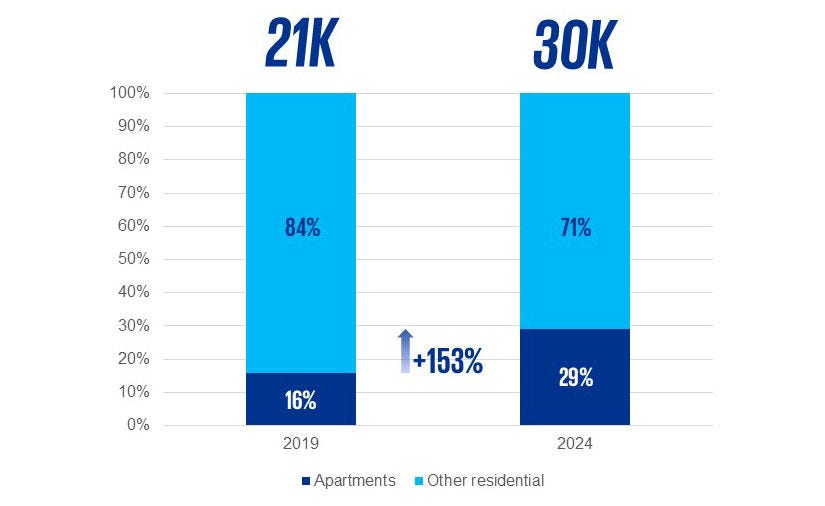
      Proportion of apartment completions vs overall completions in Ireland


      Proportion of apartment completions vs overall completions in Ireland

      Apartments are key to the residential sprinkler market. High occupancy density and multi-unit design fall under increasingly stringent building codes and fire safety regulations which mandate sprinkler systems for compliance.


      “The residential market in Ireland is a relatively new market because historically residential buildings haven’t had sprinkler systems installed. So, in many ways it's a developing market. Companies have dabbled in it. [Peer] have set up a new business targeting residential specifically.” 

      Executive,
      Irish Fire Contractor

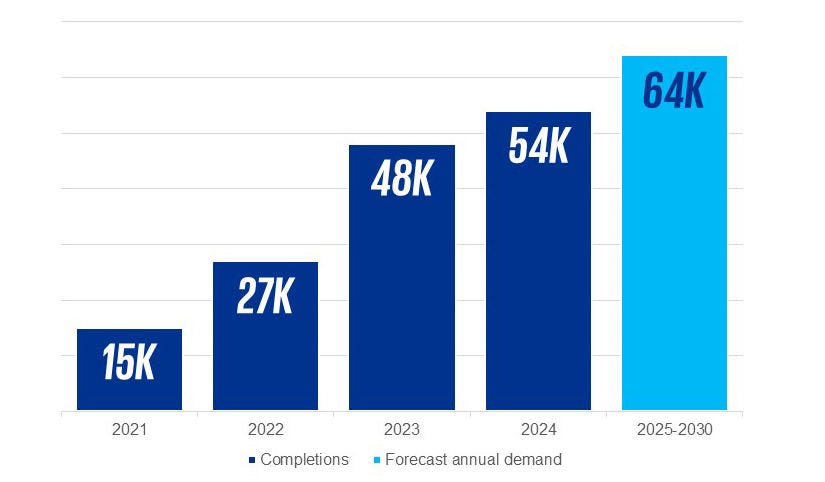
      Total annual dwelling retrofits completed in Ireland


      Total annual dwelling retrofits completed in Ireland

      While these figures consolidate various types of retrofits, including heating systems, ventilation, insulation, and others, under the fire remediation scheme, 100k+ multi-unit buildings nationwide are required to be upgraded over next several years with full remediation works expected to cost more than €2.5bn.


      Strategic opportunity for specialists

      This supply-demand imbalance is placing upward pressure on pricing and extending delivery pipelines, creating opportunities for well-positioned safety-critical providers with the capabilities required to scale.

      Fire and lightning protection spend scales directly with investment in hyperscale, pharma and grid assets, which are among the most resilient growth segments in the built environment. Unlike conventional construction projects, revenues are typically programme-based with repeat client engagement rather than project-by-project tendering.

      Higher electrical loads, increased redundancy standards and more prescriptive safety regulations drive system complexity, benefitting specialists capable of integrated design-install-commission delivery, supporting superior margins relative to commoditised subcontracting.

      On the positioning side, safety-critical specialists increasingly engage directly with developers, insurers and engineering majors, embedding them earlier in project decision-making and strengthening high-value, resilient client relationships.

      With sustained data centre, life sciences and grid investment across Ireland and the UK, demand for safety-critical systems looks resilient. Capacity constraints in commissioning expertise are likely to persist, preserving favourable market conditions for scalable specialist firms.

      For operators and investors alike, safety-critical platforms represent a resilient and increasingly strategic corner of the mission-critical ecosystem.


      Get in touch

      The evolution of today’s built environment landscape is faster than ever before, and sector players need to think about how they are going to respond in real time to capitalise on these changes.

      Connect with us today to explore how our strategic services can empower your organisation.    

      Ireland's leading strategy team; articulating your vision through insights and evidence
      Christopher Brown

      Partner, Head of Strategy

      KPMG in Ireland

      Eoin Dunphy

      Director, Construction Advisory

      KPMG in Ireland

      Morgan Mullooly

      Associate Director

      KPMG in Ireland

      Byron Smith

      Associate Director, Strategy

      KPMG in Ireland


      Discover more in Data Centres

      Something went wrong

      Oops!! Something went wrong, please try again