error
Subscriptions are not available for this site while you are logged into your current account.
close
Skip to main content

      Continued growth in a
      resilient economy

      Ireland is set to post remarkably strong GDP growth of 10.6% in 2025, driven by an exceptional first half of the year.

      Growth momentum is expected to slow in 2026, with a more modest increase of 0.2%. However, combined growth over 2025–2026 will average more than 5% per annum, placing Ireland’s domestic economy among the highest performing economies in the EU.
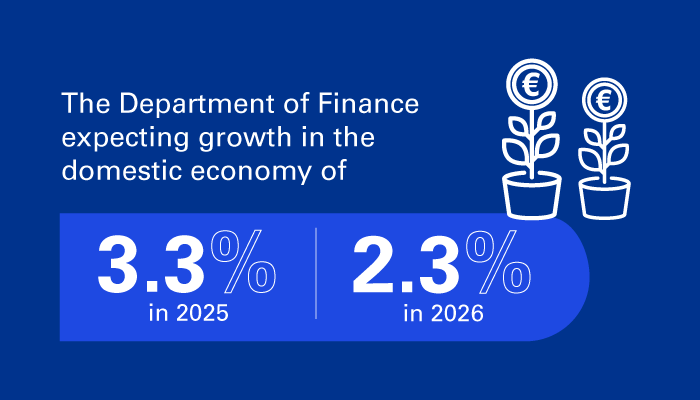

      The Department of Finance is expecting growth of 3.3% in 2025 and 2.3% in 2026.
      Ireland’s projected GDP and MDD growth for 2025 far outpaces its European peers, underscoring its economic resilience. The country’s strong performance relative to its closest political and trading partners puts it in a position of strength as it prepares to take on the role of EU Council Presidency in July 2026.
      Daragh McGreal
      Dr Daragh Mc Greal

      Head Economist

      KPMG Ireland


      Domestic growth is strong, but prices are impacting confidence

      Ireland’s domestic growth remains robust, supported by exports and strong demand. Key drivers include SME performance, AI adoption, migration, and tourism.

      Employment hit an all-time high in 2025 at more than 2.8 million, but unemployment was 5.0% in October, reflecting workforce growth.

      Wages growth remains strong at 5%, but inflation is eroding gains. Headline inflation reached 2.9% in October, and grocery and housing costs are climbing 6–7%, reducing disposable income and negatively impacting consumer confidence.


      Employment is at record levels and wages are rising. But price levels are very high compared to peer EU countries and, for many, wage growth is being eroded by rental prices, house prices, grocery prices and by no changes to income taxation. There is a real risk of a disconnect between what people are hearing about strong economic growth and what they are seeing in their wallets.
      Daragh McGreal
      Dr Daragh Mc Greal

      Head Economist

      KPMG in Ireland


      State funding plugging the gap in investment drop

      Government boosts capital spending to offset sharp decline in private investment.

      Ireland has outpaced most EU countries in population and economic growth since 2019, with the population up 7% and the economy expanding by over 50%. Yet, public and private investment has fallen by nearly 60% in absolute terms.

      To address this, the Government has increased National Development Plan funding to €103 billion for 2026–2030, with €19 billion earmarked for capital projects in 2026—€2 billion more than in 2025.


      The revised funding allocation for the National Development Plan and the additional capital spend in 2026, can help to address bottlenecks in utilities and infrastructure, which are hindering domestic economic growth and prosperity. There is the potential fora step change in the efficiency of how people in Ireland move, work, and build their lives.
      Daragh McGreal
      Dr Daragh Mc Greal

      Head Economist

      KPMG Ireland


      Tariff turbulence brought unforeseen benefits for the Irish economy

      Stockpiling and trade clarity helped Ireland weather global risks.

      Early 2025 saw US businesses stockpiling Irish goods ahead of potential tariffs, boosting exports and helping the economy navigate uncertainty. The EU-US Trade Deal signed in August provided clarity for Ireland-based businesses.

      Only about 3% of Irish exports were affected by US tariffs, as most trade is concentrated in pharmaceuticals and ICT, which remain untaxed.


      Ireland saw two large export events even before President’s Trump final tariff announcements in August. Since then, demand from the US has continued at a level similar to a no tariff outcome and tariff costs are being borne by US consumers. For Ireland, these US-side supply chain decisions impact our exports, jobs, and taxes. While trading like this is sub-optimal, the economy has weathered risks better than many people had anticipated.
      Daragh McGreal
      Dr Daragh Mc Greal

      Head Economist

      KPMG in Ireland


      Europe faces a modest growth outlook and continued trade headwinds

      Low confidence and tariff impacts weigh on outlook despite easing inflation.

      With inflation near its long-term target, Europe’s central banks are expected to make one final rate cut before ending the current cycle. Strong labour markets and lower interest rates may not be enough to boost household spending, with savings likely to remain high. Government spending could provide short-term support, although high government debt will require fiscal discipline. Tariffs introduced earlier this year may reduce EU GDP by around 1% by end-2026, while trade patterns continue to shift following the US-EU deal.


      There are initial signs of trade diversion impacting European imports across a number of goods categories. We expect this to lead to a further easing of inflationary pressures in the remainder of this year and early into 2026.
      Yael Selfin

      Yael Selfin

      European Chief Economist

      KPMG


      More than a year on from the publication of the Draghi report, the pace of reforms on the competitiveness agenda remains slow. Meanwhile, latest data shows that Europe continues to lag other global competitors on innovation, while productivity growth continues to slow.  


      This is a crucial moment for Europe to act, as without a clear policy direction supported by tangible funding, Europe could find itself lagging the countries at the technological frontier, while gradually losing ground in traditional middle-technology sectors to lower cost competitors.
      Yael Selfin

      Yael Selfin

      European Chief Economist

      KPMG


      European Countries 2024 2025 2026
      Ireland (GDP) 2.6 10.6 0.2
      Poland 2.9 3.4 3.3
      Ireland (MDD*) 1.8 3.3 2.3
      Spain 3.2 2.7 2.0
      Denmark 3.7 2.4 1.7
      Norway 0.6 2.0 1.6
      Portugal 1.9 1.9 2.1
      Netherlands 1.0 1.4 0.7
      Sweden 0.9 1.3 2.1
      UK 1.1 1.3 1.2
      Switzerland 1.3 1.2 1.4
      Belgium 1.0 1.1 1.2
      Luxembourg 0.4 1.1 1.7
      France 1.1 0.6 0.6
      Italy 0.5 0.6 0.6
      Germany -0.2 0.2 1.1
      Austria -1.3 0.1 1.0

      Source: KPMG Global projections of GDP using Oxford Economics’ Global Economic Model. Average % change on previous calendar year measured in real terms. Norway figures represent mainland GDP. *Ireland MDD figures are the Department of Finance’s Budget 2025 forecast.


      Get in touch

      Interested in unlocking the full potential of your business? Connect with us today to explore how our strategic services can empower your organisation. Our experienced team offers tailored solutions to help you navigate challenges and foster sustainable growth.

      Don't hesitate—take the first step towards shaping a successful future by reaching out to us now. We're here to support your journey.

      Daragh McGreal

      Economist

      KPMG in Ireland

      Get our unique insights

      Something went wrong

      Oops!! Something went wrong, please try again

      Strategy

      Ireland's leading strategy team; articulating your vision through insights and evidence
      Chess pieces on chess board