error
Subscriptions are not available for this site while you are logged into your current account.
close
Skip to main content

      Rule changes can boost engagement with a sport, driving both economic and social benefits. By making games faster, safer, and more accessible, they help attract new audiences, increase attendance and stimulate local economies.

      These changes can also increase participation and strengthen community ties, contributing to a sport’s long-term relevance and impact.

      Listed below are examples of sports that have introduced rule changes to improve fan engagement over the past 20-25 years.
      Key features of rule changes

      • Basketball
        • Shot clock adjustments
        • Three-point line emphasis
        • Video review systems
        • Stricter officiating
      • Cricket
        • Stop clock rule
        • Expanded Decision Review System (DRS)
        • Helmet mandates
        • Super Over revisions
      • Lacrosse
        • Free movement rule
        • Shot clock and self-starts
        • Draw restrictions
        • Penalty structure updates
      • Rugby
        • Offside from kicks
        • Shot clocks
        • Red card replacement

      Economic impact of rule changes

      Rule changes in sport can support economic growth by increasing attendance, merchandise sales, and media and sponsorship interest. While some spending may shift from other activities, engaging new audiences and encouraging more frequent participation can generate additional economic activity.

      These changes can also lead to investment in facilities, the development of teams and organisations, and job creation across a sport’s ecosystem.

      Economic impact channels


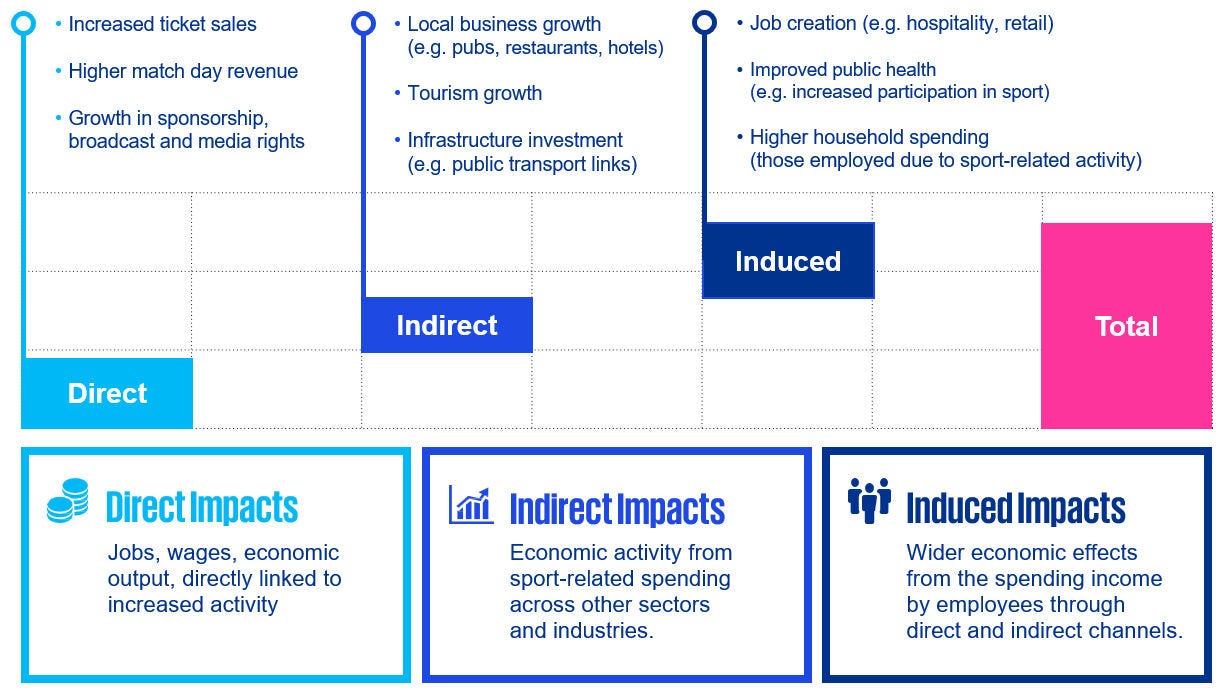
      Economic impact of a sport’s activity occurs through multiple channels. These can be defined as direct, indirect and induced impacts. Together, these three impact channels comprise the total economic impact that increased engagement from rule changes can generate.


      Graph 1: Economic impact channels from sports activities

      Economic impact channels from sport activities

      Real world examples of benefits supported by rule changes

      Case Study 1: Major League Baseball (MLB) Rule Changes


      In 2023, the MLB introduced rule changes to speed up games and improve fan engagement. A pitch clock cut average game times by 30 minutes, and larger bases led to a rise in stolen bases – 3,617 in 2024 (45% increase since the 2022 season), the highest since 1915.

      These changes contributed to increased attendance, showing how gameplay-focused reforms can help re-engage fans and attract new audiences.


      Table 1: Attendance pre and post rule changes in MLB 

      MLB match attendance
      2019* Change to 2022 Change to 2023**
      68.5m -4.0m (-6%) +2.2m (+3%)

      *Last Pre-COVID season
      **New rules introduced for the 2023 season
      Estimated using MLB statistics and data available on match day attendance in the public domain.


      Table 2: Estimated MLB revenues

      Ticket sales (€) Match day revenue – Food & Drink (€)
      2019* Change to 2022 Change to 2023** 2019* Change to 2022 Change to 2023**
      2.0bn +0.1bn (+3%) +0.3bn (+16%) 1.9bn +0.2bn (+9%) +0.5bn (+23%)

      *Last Pre-COVID season
      **New rules introduced for the 2023 season

      Based on average MLB ticket prices across all teams and stadiums for the 2019, 2022, and 2023 seasons.

      Assuming match day spend of €38 (2019), €43 (2022), and €45 (2023) per person (adjusted annually for inflation).

      Across each year, we assume that 74% of MLB match attendees spend on food and beverages.


      Key takeaway: The MLB’s rule changes helped reverse a decline in attendance caused by factors such as reduced interest and COVID-19.

      Following introduction of the new rules, attendance not only returned to pre-pandemic levels but also grew by 2.2 million, suggesting increased engagement from both existing and new audiences.


      Case study 2: GAA rule changes

      In 2025, the GAA introduced seven rule changes to speed up gameplay and encourage a more skilful, attacking style of Gaelic football.

      Aimed at improving discipline, team structure, and game flow, the changes responded to a 12% drop in attendance, driven by concerns around style of play and match predictability.

      By improving match quality, the GAA seeks to re-engage fans, attract new audiences, and support both economic and social outcomes.


      Spotlight – Senior Football Championship (SFC)


      Increased attendance and estimated economic impact

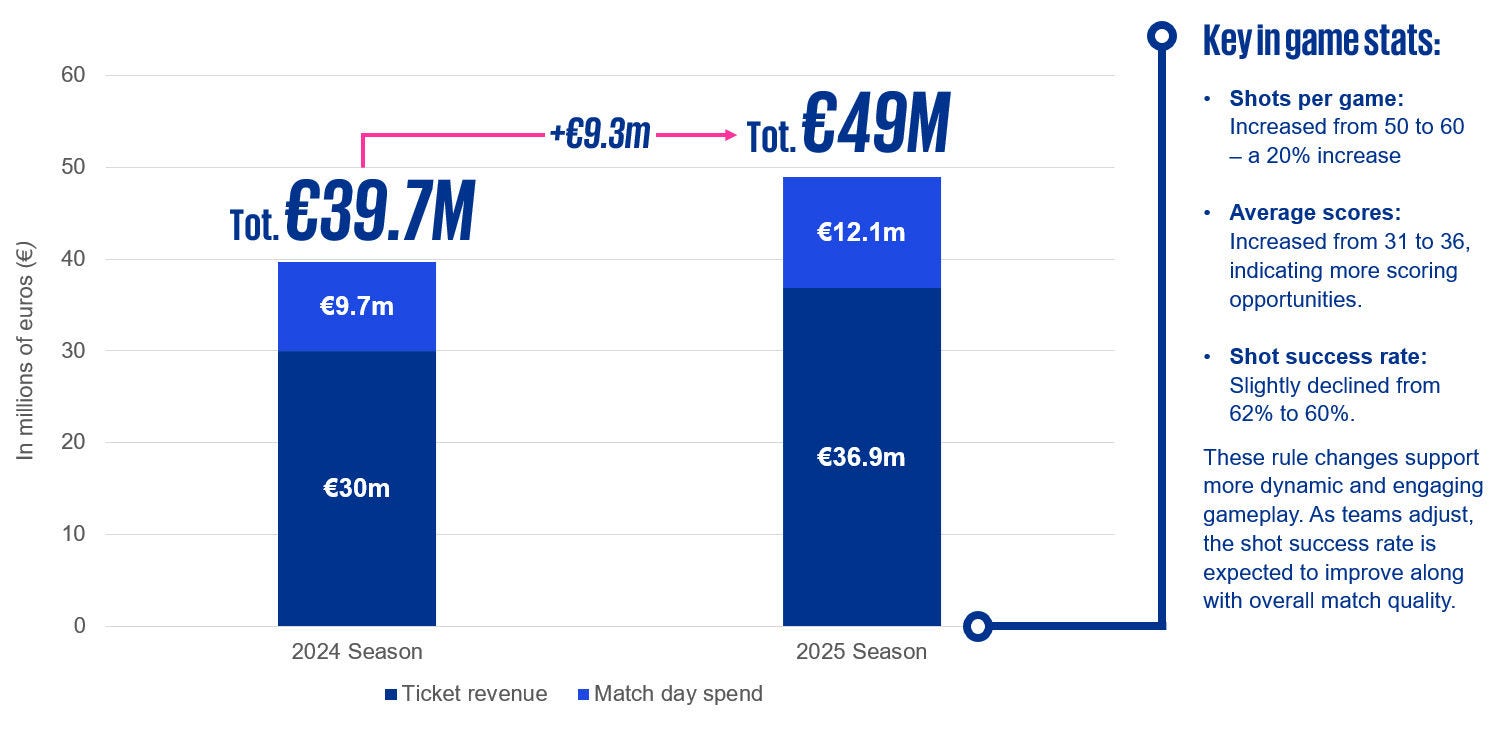
      • Championship attendance increased 20% from 858,459 to 1,209,963 between 2024 and 2025 
      • This growth generated an estimated €2.4 million in additional match day spending and €7 million in ticket revenue.
      • Higher attendance at championship games can support local businesses and contribute to longer-term economic activity in surrounding communities.

      These values represent the estimated increase in revenue to the GAA looking at 1) match day spend on food and a drink and 2) ticket sales. They do not account for other revenue streams.

      These estimates are informed by the most recent SFC match attendance figures report by the GAA from September 2025. This analysis is used to illustrate the potential impact of increased attendance at GAA games on the wider economy.

      It is noted that attendance has increased across league games and other categories but are not looked at in detail here.

      Football Review Committee Final Report 2024/2025: Football Review Committee publishes Final Report


      Graph 2: Estimated revenue (Ticket and match day spend)

      Estimated ticket revenue and match day spend (2024 vs. 2025 season)

      Wider community impact


      Rising interest in following Gaelic football can lead to increased participation. Increased attendance and spend at the games can be reinvested to help fund community programmes like GAA for Dads & Lads, which offers social playing opportunities and helps strengthen local connections.

      • GAA for Dads & Lads provides social football and hurling opportunities outside the traditional competitive format, helping more people engage with the sport.[1]
      • The GAA for Dads & Lads programme grew from 20 teams in 2019 to 163 teams in 2023 across all provinces.
      • Please find more detail on the GAA for Dads & Lads initiative here: GAA for Dads & Lads

      Key takeaway: The GAA’s 2025 rule changes were introduced to modernise Gaelic football and improve engagement. Early results show increased attendance at championship games and an estimated €9.4 million in additional revenue (Tickets and match day spend).

      The changes can also support broader participation and community involvement through programmes like GAA for Dads & Lads, highlighting the potential for the sport’s wider social impact.


      Conclusion

      Rule changes in sport can enhance the spectator experience and encourage more engaging play.

      This can lead to increased attendance, support economic activity through local spending and job creation, and promote social benefits by encouraging broader participation and healthier lifestyles.

      Faster, higher, stronger: The economic impact of sport in Ireland


      Get in touch

      If you have any queries related to the economic impacts of the rule changes in sport, please don't hesitate to contact our team below. We'd be delighted to hear from you.

      Christopher Brown

      Partner, Head of Strategy

      KPMG in Ireland

      Daragh McGreal

      Economist

      KPMG in Ireland

      Megan Roberts

      Associate Director

      KPMG in Ireland

      Aaron Lalor

      Economist

      KPMG in Ireland


      Get our unique insights

      Something went wrong

      Oops!! Something went wrong, please try again