error
Subscriptions are not available for this site while you are logged into your current account.
close
Skip to main content

      Power solutions for mission-critical infrastructure

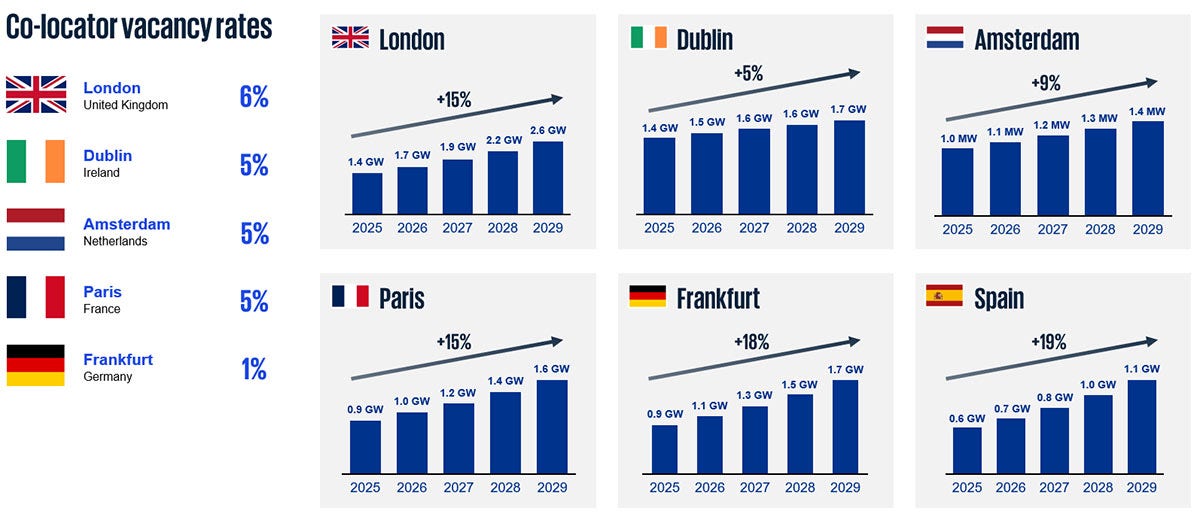
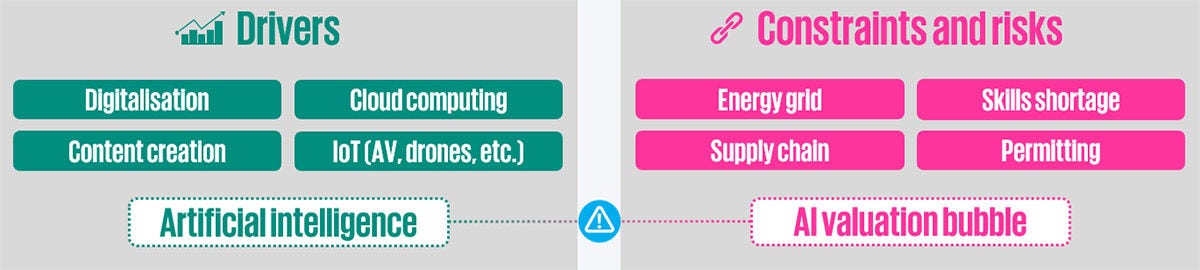
      Data centre (DC) proliferation is one of the strongest drivers of activity across the mission-critical sector, with capacity expected to grow at over 10% annually through to 2030, supported by durable digital trends.

      However, this growth is placing unprecedented pressure on grids. Power availability, resilience and integration increasingly determine whether projects proceed, stall or fail altogether.

      As a result, power has shifted from a downstream utility consideration to a primary design, scheduling and investment constraint. For hyperscalers and DC infrastructure investors, the key question is no longer how much power a facility will ultimately require, but how, when and under what conditions that power can be secured. Grid access, redundancy architecture and long-lead electrical infrastructure have therefore become among the most material risks in mission-critical delivery, and key drivers of success and failure for mission critical infrastructure contractors.

      A sustained growth market, stabilised by supply constraints


      Christopher Brown

      Partner, Head of Strategy

      KPMG in Ireland


      A new paradigm in power planning

      As with other built-environment segments, DC projects have exploded in scale and complexity. Historically, power planning focused on securing a grid connection and layering redundancy through generators and UPS systems.

      Today, power strategies must span a much broader set of considerations, including grid negotiations, capacity reservation, substation delivery, medium- and low-voltage distribution design, backup generation, battery storage, commissioning sequencing and regulatory compliance.

      Crucially, many of these elements must now be planned and progressed in parallel, often well before land acquisition or full planning consent is secured. Power has become a critical input across every phase of the development lifecycle, rather than a discrete package delivered later in the programme, and grid availability has become the binding constraint on new DC development.

      Connection lead times of five to eight years are now common in the UK and Ireland, while network reinforcement works often sit outside the direct control of developers. This creates structural risks: delays in energisation directly defer revenue generation; late changes in available capacity can force costly redesign; site selection is increasingly driven by power rather than land; and significant capital is often committed long before go-live.

      In response, power-availability risk modelling has become central to investment decision-making, with developers and investors assessing scenarios such as phased energisation, partial load ramp-up or alternative supply strategies.


      Resilience, redundancy and alternative power solutions

      Mission-critical assets demand exceptional resilience, making redundancy decisions central to design. Choices around single versus dual utility feeds, on-site versus off-site substations, modular versus centralised UPS systems, and diesel versus gas-based backup generation all have implications for planning, emissions compliance, fuel logistics and long-term operating cost.

      As DCs scale into campus-level developments, power architecture must increasingly balance uptime requirements with compliance around carbon constraints and community impact.

      With grid capacity constrained, developers are also exploring hybrid and alternative power solutions, including temporary generation to bridge grid delays, on-site gas or reciprocating engine plants, battery storage systems, all on top of available renewable power purchase agreements.

      While these approaches can unlock capacity, they introduce additional layers of technical, regulatory and operational complexity. As such solutions become more prevalent, integrators such as AVK and Zwart are playing an increasingly important role in delivering prime and bridge-power systems that allow capacity to be energised ahead of permanent grid connections.

      These systems in turn rely on specialist OEMs such as Wärtsilä or Everllence, which supply the large-scale gas turbine and generation technology increasingly used in on-site and near-site power solutions for mission-critical campuses.


      The growing sophistication of on-site and bridge power solutions also foregrounds funding and ownership considerations. Developers must increasingly decide whether these more capable but capital-intensive assets should sit on balance sheet – with associated financing and carbon-reporting implications – or whether it is better for energy and finance providers to assume ownership and price power availability, flexibility and emissions performance into long-term contracts.


      Evolving contractor model in DC enables M&A activity

      As power systems have become the critical path in DC delivery, the traditional general-contractor-led model is giving way to new contracting structures.

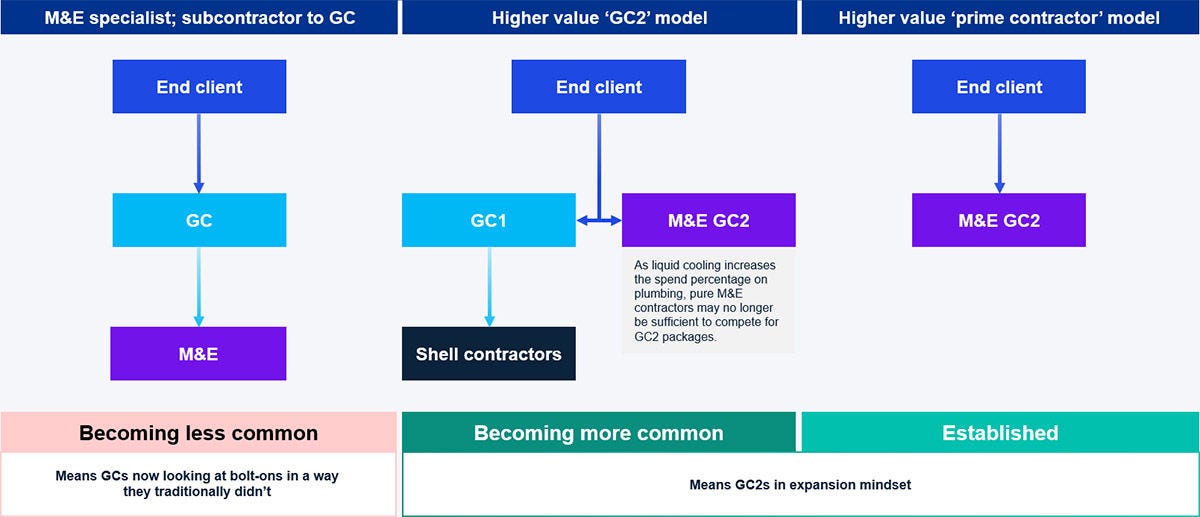
      Historically, M&E contractors sat beneath a GC as specialist subcontractors, but this model is becoming less common as hyperscalers seek direct accountability for power, cooling and commissioning risk. Increasingly, projects are delivered under split-prime arrangements, where a traditional GC delivers shell and civils works while an M&E-led “GC2” contracts directly with the end client to deliver all electrical, mechanical and power systems.

      At the most advanced end of the spectrum, M&E-led prime contractors assume full delivery responsibility, subcontracting civils and envelope works beneath them. This shift materially elevates the strategic importance of power capability and is driving M&E contractors to acquire high-voltage, commissioning, controls and modular power specialists.

      At the same time, it has prompted traditional GCs to pursue bolt-on acquisitions to protect relevance, reshaping the contractor landscape and accelerating M&A activity across the mission-critical supply chain.


      In the Irish and UK markets, this shift is evident in the strategies of contractors such as Sisk, John Paul and Collen at the GC level, alongside M&E-led specialists including Dornan, Suir Engineering, Designer Group, Jones Engineering and STS Group, all of whom have built deep capability in power-led, mission-critical delivery. 


      Power as strategic capability, not a utility

      For mission-critical infrastructure, power is no longer a background service but a strategic differentiator. Firms that can integrate grid strategy, engineering design, procurement, risk modelling and regulatory engagement are positioning themselves as indispensable partners to hyperscalers and investors, ready to capture the next phase of mission-critical growth.


      Get in touch

      The evolution of today’s built environment landscape is faster than ever before, and sector players need to think about how they are going to respond in real time to capitalise on these changes.

      Connect with us today to explore how our strategic services can empower your organisation.    

      Ireland's leading strategy team; articulating your vision through insights and evidence
      Christopher Brown

      Partner, Head of Strategy

      KPMG in Ireland

      Eoin Dunphy

      Director, Construction Advisory

      KPMG in Ireland

      Morgan Mullooly

      Associate Director

      KPMG in Ireland

      Byron Smith

      Associate Director, Strategy

      KPMG in Ireland


      Discover more in Data Centres

      Something went wrong

      Oops!! Something went wrong, please try again