error
Subscriptions are not available for this site while you are logged into your current account.
close
Skip to main content

      The first week of COP31 highlighted the scale and urgency of the challenge facing global climate action. It is now widely recognised that limiting global warming to 1.5°C is increasingly unlikely, with initial discussions at COP31 emphasising the need to accelerate emissions reductions, limit the extent and duration of any temperature overshoot, and strengthen adaptation efforts.

      Each COP aims to deliver a negotiated agreement outlining the next steps for global climate action. As COP31 entered its final week, attention shifted towards the challenging task of securing consensus on this agreement.

      The COP31 Presidency published an initial draft on 16 November, setting out proposals to accelerate emissions reductions, transition away from fossil fuels, expand electrification, strengthen adaptation and mobilise climate finance.

      Revised draft 

      A revised text released on 19 November narrowed several of these proposals, removing explicit references to transitioning away from fossil fuels, consolidating detailed implementation measures and revising proposals on adaptation finance. The final wording on fossil fuels remains a central question for negotiators.

      With nearly 200 countries needing to reach consensus before Friday's scheduled conclusion, final negotiations have focused on determining which proposals will be included in the final agreement.

      The revised draft is shorter and more consolidated, retaining key provisions on electrification, adaptation and finance, although several commitments have been weakened or removed. Important questions about the strength of implementation commitments remain unresolved. The latest draft represents a basis for further negotiations, rather than an indication of the final outcome.


      Ireland's role

      Ireland has a particularly important role in these negotiations, coordinating and leading the EU's negotiating efforts as holder of the Presidency of the Council of the European Union.

      The EU has reaffirmed its commitment to achieving climate neutrality by 2050 and formally endorsed the 35-by-35 Global Electrification Pledge, which aims to increase electricity's share of global final energy consumption to 35% by 2035.

      At a national level, Ireland launched its first Roadmap on Transitioning Away from Fossil Fuels during COP31, outlining its approach to achieving a just, orderly and equitable energy transition.

      It also announced plans to co-host the Second International Conference on Transitioning Away from Fossil Fuels with Tuvalu in 2027, further demonstrating its commitment to advancing international climate action.

      The outcomes of COP31 will help shape the international policy landscape within which Ireland pursues its climate commitments, reinforcing the importance of translating global ambition into national implementation.

      Lorraine McCann

      Partner, Head of Sustainable Futures

      KPMG in Ireland


      Key developments

      Below are five key developments emerging from the Presidency's draft agreement:

      • Recognition of 1.5°C overshoot

        The draft acknowledges the growing likelihood of temporarily exceeding 1.5°C and calls for urgent action to limit the scale and duration of any overshoot. The initial proposal for a dedicated scientific work programme on temperature overshoot has been replaced with a proposed high-level dialogue on the subject.

      • Fossil fuel commitments remain a key point of contention

        The first draft called for accelerated action to phase out fossil fuels, including an immediate transition away from fossil fuels in energy systems. However, these explicit references have been removed from the revised draft, leaving the strength of any final commitments on fossil fuels a central issue in negotiations.

      • New ambition for global electrification

        The draft proposes increasing electricity's share of global final energy consumption from 23% today to 35% by 2035, alongside accelerating renewable energy deployment, energy efficiency improvements and investment in electricity grids and storage.

      • Increased focus on adaptation and climate finance

        The revised draft recognises that developing countries' adaptation finance needs could reach $305 billion annually by 2035. The text proposes technical work on a baseline and an implementation pathway, alongside a new Antalya-to-Addis Ababa Roadmap on Adaptation and Resilience Finance, aimed at identifying new sources of funding and improving access to finance for developing countries, with findings to be presented at next year's UN climate summit. This places renewed attention on how funding commitments can be translated into accessible finance.

      • Greater emphasis on implementation and just transition

        The revised draft retains practical measures across methane reductions, carbon management, early warning systems and nature-based solutions.  However, several detailed measures have been consolidated into broader calls for cooperation, with less explicit language on just transition than in the earlier draft. The focus now turns to whether the final text provides sufficient direction to accelerate delivery.


      What we’re hearing on the ground

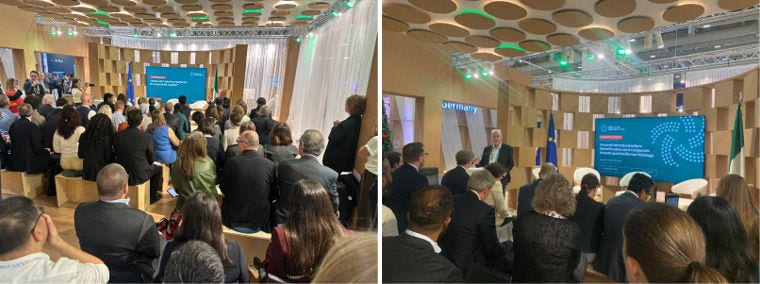
      KPMG has a significant presence at COP31 in Antalya, including sponsorship of Ireland's first-ever national pavilion, coinciding with Ireland's Presidency of the Council of the European Union. The pavilion provides a platform to showcase Irish and European climate leadership and foster international collaboration.


      Meetings at COP31

      KPMG has also hosted a series of events at COP31, focusing on key topics including climate finance, transition planning, electrification, adaptation and resilience. KPMG’s team on the ground in Antalya has identified several emerging themes, including a growing shift from commitments to implementation, the importance of mobilising private investment, and the increasing prominence of nature and resilience.

      A number of interconnected themes are emerging from these discussions, highlighting the practical challenges and opportunities in accelerating climate action:

      • From commitments to implementation (Transition Planning)

        As COP31’s second week draws to a close, the focus has sharpened on what it will actually take to deliver climate transition planning.
         

        With the second Global Stocktake* formally launched at COP31, attention is increasingly turning to the practical conditions needed to translate ambition into progress. Discussions in Antalya are highlighting how delivery depends not only on individual businesses, but on interconnected energy systems, infrastructure, technology, supply chains and workforce readiness. For Irish businesses, understanding these dependencies can help identify potential bottlenecks, inform strategic decisions and assess the workforce and stakeholder implications of planned changes. The next step in climate transition planning is therefore not simply mapping a pathway but understanding what is needed to deliver it.


        * A process under the Paris Agreement that assesses collective global progress towards its long-term climate goals and helps inform countries’ subsequent climate action and commitments. The second Global Stocktake begins at COP31 and will conclude at COP33.

      • Electrification as a driver of energy security and competitiveness

        The focus on electrification is increasingly shifting from ambition to delivery. Discussions at COP31 have also highlighted the importance of coordinated investment in renewable generation, grids, storage, and flexibility, alongside secure and responsible supply chains in expanding the role of electricity across transport, heating, and industry.


        These elements need to develop simultaneously, as additional renewable generation will have limited impact if grid capacity and supporting infrastructure lag. For businesses, access to secure, affordable, and low-carbon electricity will increasingly shape investment decisions, operating costs, and long-term competitiveness.

      • Understanding compounding climate risks

        Discussions around COP31 are reinforcing the importance of understanding how climate hazards interact and compound. Flooding, storms and extreme heat can damage infrastructure and disrupt transport, energy, water and other essential services, with problems in one area quickly affecting others.


        These knock-on impacts can ultimately affect businesses, communities, public services and vulnerable groups, amplifying existing social and economic pressures. This points to the need for more integrated approaches to climate risk assessment and resilience planning that recognise dependencies between systems and the wider consequences of their disruption.

      • Mobilising capital where it is needed most:

        Climate finance remains below estimated global needs, particularly in emerging markets and developing economies. Narrowing this gap requires increased flows of private capital alongside sustained public finance.


        At COP31, KPMG and UNDP examined how national climate priorities can be translated into pipelines of investable projects, building on the Climate Promise: Forward framework* and insights from the pilot project with the Government of Mexico. Stronger project preparation, appropriate risk allocation, and, where suitable, aggregation of comparable projects can strengthen investment attractiveness. Targeted blended finance can help to address specific risks and investment barriers and support the mobilisation of private capital.


        *Climate Promise: Forward is the UN system’s framework for coordinating support to countries to implement their Nationally Determined Contributions (NDCs) and National Adaptation Plans (NAPs) and advance sustainable development.


      Looking ahead to the final negotiations

      As COP31 reaches its scheduled conclusion, negotiations remain ongoing and may extend into the weekend. The latest draft leaves important issues unresolved, including the transition away from fossil fuels, climate finance and the detail of implementation measures.

      Following the conclusion of COP31, KPMG will publish a key takeaways and perspectives piece exploring the most significant outcomes and what they could mean for businesses.

      You can also hear directly from those on the ground at COP31 in our upcoming webcast, exploring what developments in energy, physical climate risk and transition investment could mean for business competitiveness, resilience and investment priorities.

      Register for the webcast: https://social.kpmg/5c23f8


      How KPMG can help

      If you have any questions about COP31 developments, emerging themes or the topics explored in this article, KPMG Sustainable Futures would be delighted to hear from you.

      Our team of sustainability experts are helping corporate and public-sector clients develop and implement sustainability solutions that drive both resilience and commercial value.

      Whether you are considering climate and nature risk, decarbonisation, energy and renewables, transition planning, finance, or reporting compliance, our team are here to help.


      Follow KPMG Ireland at COP31

      KPMG professionals will be present at COP31 in Antalya, Türkiye, which will bring together world leaders, policymakers, industry innovators, and climate specialists to exchange ideas and formulate strategies to help tackle climate change.

      Our team will be publishing weekly wrap-ups at the end of each week of COP31, providing timely reactions to the key developments and emerging themes.

      Following COP31, we will also publish a key takeaways and perspectives piece reflecting on the most significant outcomes and what they could mean for businesses.

      Lorraine McCann

      Partner, Head of Sustainable Futures

      KPMG in Ireland

      Michael Hayes

      Partner, Global Head of Renewables

      KPMG in Ireland

      Russell Smyth

      Partner, Head of Sustainable Futures and Corporate Finance

      KPMG in Ireland

      Shane O'Reilly

      Managing Director, ESG Strategy & Transition Planning Lead

      KPMG in Ireland


      Get our COP31 insights

        No content available

        No results match your current settings

        Server error

        A server error prevented us from completing your search. Please try again later.

        Sustainable Futures

        Our dedicated decarbonisation & sustainability advisory team
        Turbine illustration