error
Subscriptions are not available for this site while you are logged into your current account.
close
Skip to main content

      RESS 5 is the fifth Onshore Renewable Electricity Support Scheme auction held by the Government of Ireland and is seen as a pivotal component of meeting Ireland’s ambitious targets of 80% renewable electricity (RES-E) by 2030.

      Following the RESS 5 auction submissions closing date on the September 09th 2025, the provisional auction results were published by EirGrid on September 24th, 2025. Our Sustainable Futures team covers the provisional auction results below.

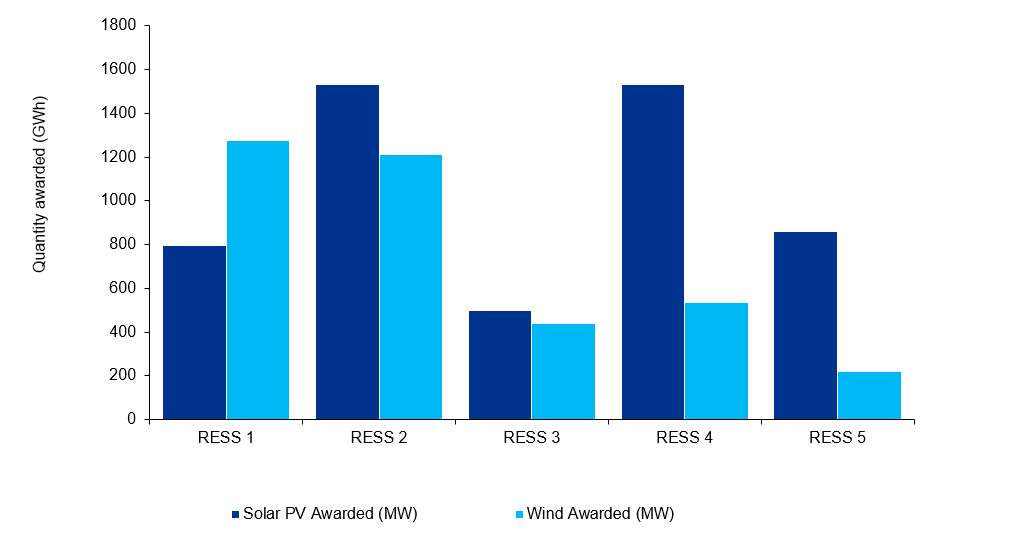
      69% of applicants by deemed energy quantity were provisionally successful in this year’s RESS auction, corresponding to 1500GWh of new renewable generation. This is a 25% decrease in deemed energy quantity from last year’s RESS 4 auction result, which delivered 2,071 GWh.

      This sits well below the 2,000 – 5,500GWh indicative auction volume target range set by DCEE and will support less renewable energy than the RESS 1, RESS 2, or RESS 4 auctions. The 1500GWh of successful generation projects are comprised of 860MW of solar PV assets and 219MW of onshore wind generation assets at an average price of €98.81/MWh across all projects.

      RESS 5 strike price increase below EU inflation rate 

      At €98.81 per MWh, the average price of provisionally successful renewable projects rose by €1.96 per MWh from RESS 4 to RESS 5 – a 2% increase. While this uptick may be viewed unfavourably by Irish electricity consumers, it aligns with the 2% Consumer Price Index (CPI) inflation recorded between August 2024 and August 2025 and is below the EU-27 Harmonised Index of Consumer Prices (HICP) inflation rate of 2.4% for the same period. 


      Weighted average strike price for successful offers per RESS auction

      Weighted average strike price for successful offers per RESS auction

      The average RESS 5 price is lower than the year-to-date price of wholesale electricity at c. €116 per MWh. The average RESS 5 price is also lower than that of the RESS 2 and RESS 3 auctions; however, it is worth noting that the RESS 2 price was unindexed while subsequent auction prices include a 30% partial indexation element for the duration of the contract.

      Reflecting its position as the cheapest form of renewable energy in the Irish market, the average price for onshore wind was €96.56 per MWh while the price of solar PV was €100.63 per MWh.


      Successful deemed energy quantity in RESS auctions

      Successful Deemed Energy Quantity in RESS Auctions

      23 applicants were provisionally awarded RESS 5 contracts, selected from a total of 33 eligible bids. This level of successful applicants matches the historic low in RESS 3, albeit the applicant success rate has remained broadly stable in recent auctions.

      It is difficult to see Ireland’s target of 80% RES-E by 2030 being delivered with this level of project throughput.


      Successful projects per RESS auction

      Successful projects per RESS auction


      Solar continues to dominate successful
      RESS assets

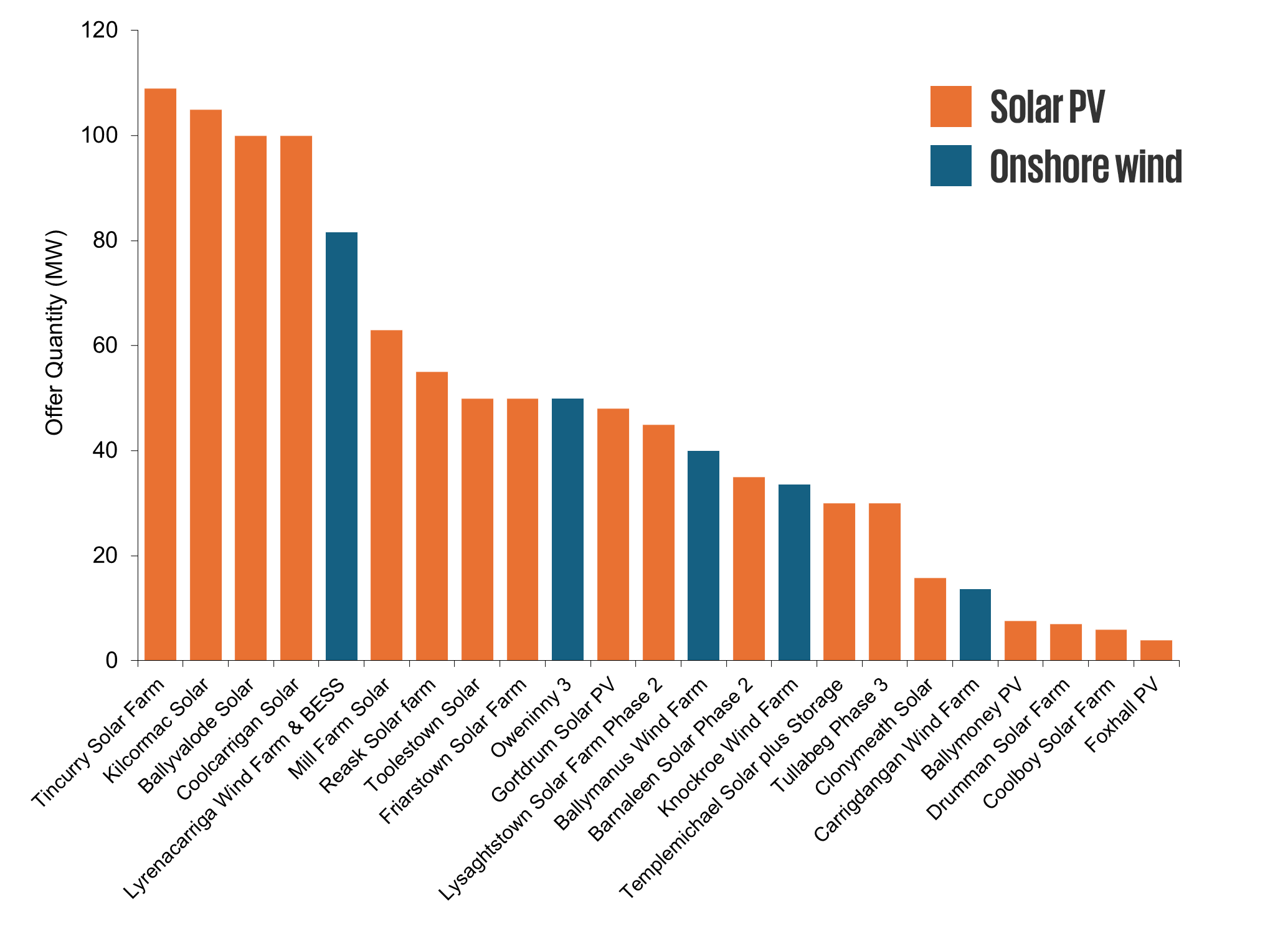
      Of the 23 provisionally successful projects in RESS 5, only 5 projects, totalling 860MW are onshore wind with the remainder of projects delivering 219MW of solar PV generation capacity.

      No other eligible technologies such as hybrid wind and solar PV, hybrid wind and storage, hybrid solar PV and storage, hybrid wind and solar PV and storage, hydro, biomass High Efficiency Combined Heat and Power (HECHP), waste-to-energy HECHP, or biogas HECHP were successful.


      Deemed energy quantity provisionally successful and unsuccessful by eligible technology 

      Successful projects per RESS auction

      Commonly cited reasons for the scarcity of wind projects competing in RESS include issues with securing the necessary planning consents and projects opting for Corporate Power Purchase Agreements (CPPAs) as an alternative route to market.

      While the Planning and Development Act 2024 and the subsequent 2025 Amendment Act, together with steps taken to assist the resourcing of Planning Authorities and An Coimisiún Pleanála have been welcomed by industry in aiming to address some of the issues within the planning system in Ireland, the planning process remains a significant issue for Ireland’s renewables industry.


      Successful RESS 5 assets by offer quantity

      Successful RESS 5 assets by offer quantity

      Planning and infrastructure remain as key blockers to renewables development

      Overall, the provisional results of RESS 5 show a decrease in awarded capacity from RESS 4. Rising supply chain costs, grid connection charges, and prolonged planning delays have driven up costs and contributed to the lower energy volumes and slightly higher prices which we have seen in RESS 5.

      The success of future RESS auctions require significant improvements in Ireland’s planning system and electricity grid. Key industry voices continue to call for increased resourcing and improved systems in both national and local planning bodies as a necessity to deliver on the 2030 80% RES-E target.  

      Similarly, Ireland’s electricity grid urgently needs significant investment and upgrade to enable the connection of new renewable energy assets. Strong political support and direction is required to underpin the change for both planning and grid.


      Preparing for a future powered by renewables

      RESS 5 marks the final auction included in Ireland’s original renewables support programme which was subject to State Aid approval from the European Commission.

      The recent revision of EU Commission State Aid rules is expected to enable the continuation of RESS auctions into the future. This comes as part of the broader Clean Industrial Deal which seeks to boost green projects, while maintaining competitiveness.

      Looking ahead to next year’s RESS 6 auction, it is hoped that the positive developments from the provisional RESS 5 results will continue. While a lot of work remains to enable acceleration of Irish renewable energy generation deployment, continued developer appetite and promised improvements in statutory bodies lend promise for the future.

      With a shared vision for a future driven by renewable energy, stronger collaboration between Government and Industry could be the catalyst for accelerating the deployment of solar PV, onshore wind, and other clean energy technologies.


      Get in touch

      If you would like to discuss the outcomes of RESS 5 in further detail, assess the potential for an alternative route to market for your project or have a general conversation about the renewable market in Ireland, please reach out to one of the team below.

      James Delahunt

      Partner, Corporate Finance, Head of Energy & Natural Resources

      KPMG in Ireland

      Terence McGovern

      Energy and Decarbonisation Lead

      KPMG in Ireland

      Aoife Cahill

      Senior Consultant

      KPMG in Ireland

      Dónal Ó Céileachair

      Senior Consultant

      KPMG in Ireland

      Read more in Sustainable Futures

      Something went wrong

      Oops!! Something went wrong, please try again

      Sustainable Futures

      Our dedicated decarbonisation & sustainability advisory team
      Turbine illustration